Credit: ©Science China Press
African swine fever (ASF) is one of the most pathogenic viral diseases in pigs caused by African swine fever virus (ASFV). The fatality rate is almost 100%, which brings huge economic losses to the hog industry in countries with epidemics. China was the first Asian country to have an ASF epidemic, and it spread quickly across the country after the first epidemic was reported in August 2018. After that, Mongolia, Vietnam, Cambodia and North Korea also reported on the ASF epidemic in succession. The African swine fever virus is a member of the Asfarviridae family and is the only known DNA virus that can be transmitted by ticks. The virion is 175-215 nm in diameter and is icosahedral symmetrical with an envelope and the genome enclosed in it is a double-stranded linear DNA with a size of 170-190 kb. In pigs, ASFV can replicate in the cytoplasm of a variety of cells, especially reticuloendothelial cells and mononuclear macrophages. Given that the genome of the African swine fever virus is very complex and whole genome information is currently inadequate, it is important to efficiently obtain virus genome sequence for genomic and epidemiological studies.
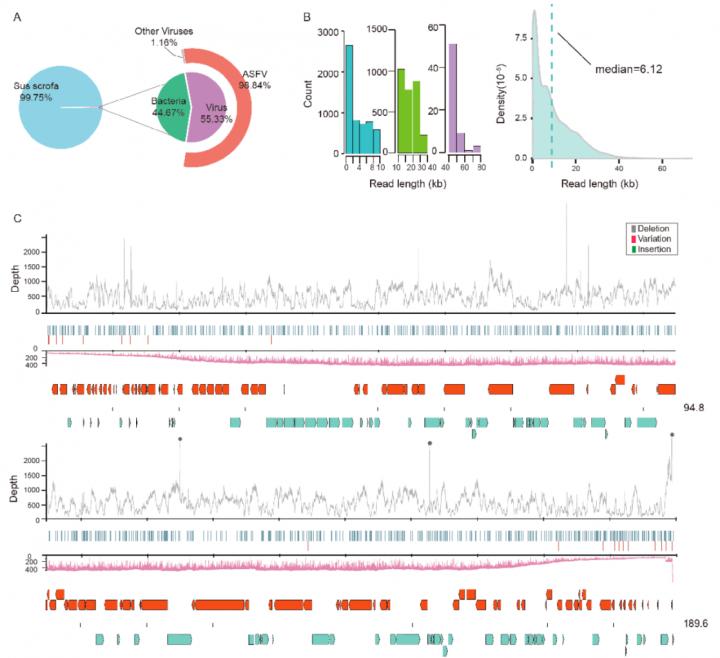
“We first use the nanopore platform to directly sequence clinical samples from pigs infected with ASFV, and explore the possibility of TGS acquiring large viral genomes such as ASFV.” said Dr. Lijia Jia, the first author for this work. The results of this research indicated that the Nanopore technology can obtain ASFV genome faster than next-generation sequencing.”As for working time, the NGS library preparation and on-machine sequencing took significantly longer than the TGS. The Hiseq X10 yields 100 Gb data for 76 h, while the nanopore library preparation time and the time to generate 100 Gb data on the promethION sequencer add up to less than 24 h”, said Jia. The advantage of nanopore sequencing is the rapid obtaining of the pathogen genome, and the advantage of NGS is sequencing accuracy. The method of using TGS+NGS is a good choice in terms of time and accuracy.”Although the current data suggest that the outbreak of African swine fever in China seemed like a single source, our results show that there are still 6-93 variations in the genome of ASFV isolates in different provinces and cities. As a large double-stranded DNA virus, ASFV has a relatively conservative genome, and its natural variation is very slow, but it can be accelerated by interaction with the host and stimulation of environmental factors. In this context, it is necessary to promote whole genome sequencing of ASFVs in different regions, which can provide us with more meaningful variation information and may play an important role in re-establishing the ASFV transmission route”, said Professor Di Liu, the co-corresponding author.
These encouraging results confirm the utility of ONT sequencing as a non-cultured direct sequencing method for ASFV genomes from PCR-positive clinical tissue. Real time sequencing of the entire genome of the outbreak strain provides a baseline for subsequent epidemiological tracking and evolutionary studies.
###
This work was supported by grants from the National Key R&D Program of China (Nos. 2016YFC1200800 & 2018YFC0840402), Research Project of African Swine Fever of Chinese Academy of Sciences (KJZD-SW-L06), China Mega-Project for Infectious Disease (2017ZX10103005-005), the State Key Laboratory of Veterinary Biotechnology Research Fund (SKLVBF201902).
See the article:
Jia, L., Jiang, M., Wu, K, et al. (2019). Nanopore sequencing of African swine fever virus. Sci China Life Sci, in press, https:/
Media Contact
Di Liu
[email protected]
Related Journal Article
http://dx.