• HOME
  • NEWS
  • EXPLORE
    • CAREER
      • Companies
      • Jobs
    • EVENTS
    • iGEM
      • News
      • Team
    • PHOTOS
    • VIDEO
    • WIKI
  • BLOG
  • COMMUNITY
    • FACEBOOK
    • INSTAGRAM
    • TWITTER
Saturday, November 21, 2026
BIOENGINEER.ORG
No Result
View All Result
  • Login
  • HOME
  • NEWS
  • EXPLORE
    • CAREER
      • Companies
      • Jobs
        • Lecturer
        • PhD Studentship
        • Postdoc
        • Research Assistant
    • EVENTS
    • iGEM
      • News
      • Team
    • PHOTOS
    • VIDEO
    • WIKI
  • BLOG
  • COMMUNITY
    • FACEBOOK
    • INSTAGRAM
    • TWITTER
No Result
View All Result
Bioengineer.org
No Result
View All Result
Home NEWS Science News

Nanomaterials with laser printing

Bioengineer by Bioengineer
September 6, 2025
in Science News
Reading Time: 2 mins read
0
IMAGE
Share on FacebookShare on TwitterShare on LinkedinShare on RedditShare on Telegram

New laser-driven method

In the journal Nature Communications, an interdisciplinary team from the Max Planck Institute of Colloids and Interfaces presents for the first time a laser-driven technology that enables them to create nanoparticles such as copper, cobalt and nickel oxides. At the usual printing speed, photoelectrodes are produced in this way, for example, for a wide range of applications such as the generation of green hydrogen.

Previous methods produce such nanomaterials only with high energy input in classical reaction vessels and in many hours. With the laser-driven technology developed at the institute, the scientists can deposit small amounts of material on a surface and simultaneously perform chemical synthesis in a very short time using high temperatures from the laser. ‘When I discovered the nanocrystals under the electron microscope, I knew I was onto something big,’ says Junfang Zhang, first author of the study and doctoral researcher. The discovery turned into a new and environmentally friendly method for synthesizing materials that can, among other things, efficiently convert solar energy into electricity.

Without detours with sunlight to hydrogen: ‘Nowadays most of green hydrogen is produced from water using electricity generated by solar panels and stored in batteries. By employing photoelectrodes we can use solar light directly,’ says Dr. Aleksandr Savateev.

The newly developed principle works with so-called transition metal oxides, mainly copper, cobalt and nickel oxides, all of which are good catalysts. The special feature of these oxides is the variety of their crystal forms (nanocrystals such as nanorods or nanostars), which affect their surface energy. Each structure can have a different effect on catalytic reactions. Therefore, it is important that these nanostructures can be made targeted – or even untargeted, but repeatable. The developed technology could also be used to find quickly and efficiently new catalysts. ‘Laser dot by laser dot, we can create different catalysts side by side by simply varying the composition and conditions, and then also test them in parallel right away,’ says Dr. Felix Löffler adding, ‘But now we need to work on making the catalyst systems more persistent in all applications’.

The method

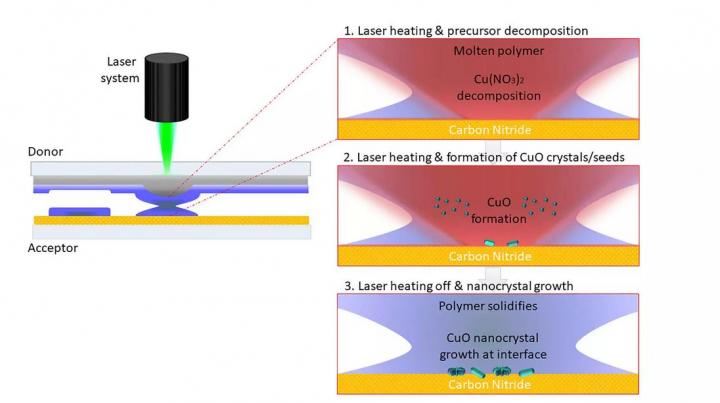
Similar to the principle of a typewriter, material is transferred from a donor to an acceptor carrier. On the former is the ‘ink’, a solid polymer, which is mixed with metal salts, the latter consists of a thin carbon nitride film on a conductive electrode. Targeted laser irradiation transfers the salts to the acceptor along with the molten polymer. The brief high temperatures cause the salts to react within milliseconds and they transform into metal oxide nanoparticles with desired morphology.

###

Original publication

Zhang, J., Zou, Y., Eickelmann, S. et al.

Laser-driven growth of structurally defined transition metal oxide nanocrystals on carbon nitride photoelectrodes in milliseconds

Nat Commun 12, 3224 (2021)

Published: 28 May 2021

Media Contact
Juliane Jury
juliane.jury@mpikg.mpg.de

Original Source

https://www.mpg.de/16976860/0531-koll-nanomaterials-with-laser-printing-152310-x

Related Journal Article

http://dx.doi.org/10.1038/s41467-021-23367-7

Tags: Chemistry/Physics/Materials SciencesMaterialsTechnology/Engineering/Computer Science
Share12Tweet8Share2ShareShareShare2

Related Posts

Sinus Implants Linked to Greater Symptom Relief in Retrospective Cohort

Sinus Implants Linked to Greater Symptom Relief in Retrospective Cohort

November 21, 2026
Computational Study Evaluates XRhP Half-Heusler Alloys for High-Temperature Thermoelectric Applications

Computational Study Evaluates XRhP Half-Heusler Alloys for High-Temperature Thermoelectric Applications

November 21, 2026

Dissolved Salt Chemistry Controls Permeability and Pore Integrity in Curing Concrete

November 21, 2026

Ionic Liquid Doping Boosts Polymer Electrolyte Conductivity in Dye-Sensitized Solar Cells

November 21, 2026
Please login to join discussion

POPULAR NEWS

  • Targeting Lipid Remodeling Restores Cytotoxicity in Aged Natural Killer Cells

    Targeting Lipid Remodeling Restores Cytotoxicity in Aged Natural Killer Cells

    29 shares
    Share 12 Tweet 7
  • Periodic Plane-Wave Quantum Algorithms Successfully Calculate Molecular Energies on Trapped-Ion Hardware

    29 shares
    Share 12 Tweet 7
  • Furmonertinib Rechallenge Controlled Lung Adenocarcinoma Following Almonertinib-Induced Interstitial Lung Disease

    29 shares
    Share 12 Tweet 7
  • Surgeons Preserve Fertility While Removing Giant Ovarian Cyst Masked by Obesity

    29 shares
    Share 12 Tweet 7

About

We bring you the latest biotechnology news from best research centers and universities around the world. Check our website.

Follow us

Recent News

Sinus Implants Linked to Greater Symptom Relief in Retrospective Cohort

Computational Study Evaluates XRhP Half-Heusler Alloys for High-Temperature Thermoelectric Applications

Dissolved Salt Chemistry Controls Permeability and Pore Integrity in Curing Concrete

Subscribe to Blog via Email

Enter your email address to subscribe to this blog and receive notifications of new posts by email.

Join 88 other subscribers
  • Contact Us

Bioengineer.org © Copyright 2023 All Rights Reserved.

Welcome Back!

Login to your account below

Forgotten Password?

Retrieve your password

Please enter your username or email address to reset your password.

Log In
No Result
View All Result
  • Homepages
    • Home Page 1
    • Home Page 2
  • News
  • National
  • Business
  • Health
  • Lifestyle
  • Science

Bioengineer.org © Copyright 2023 All Rights Reserved.