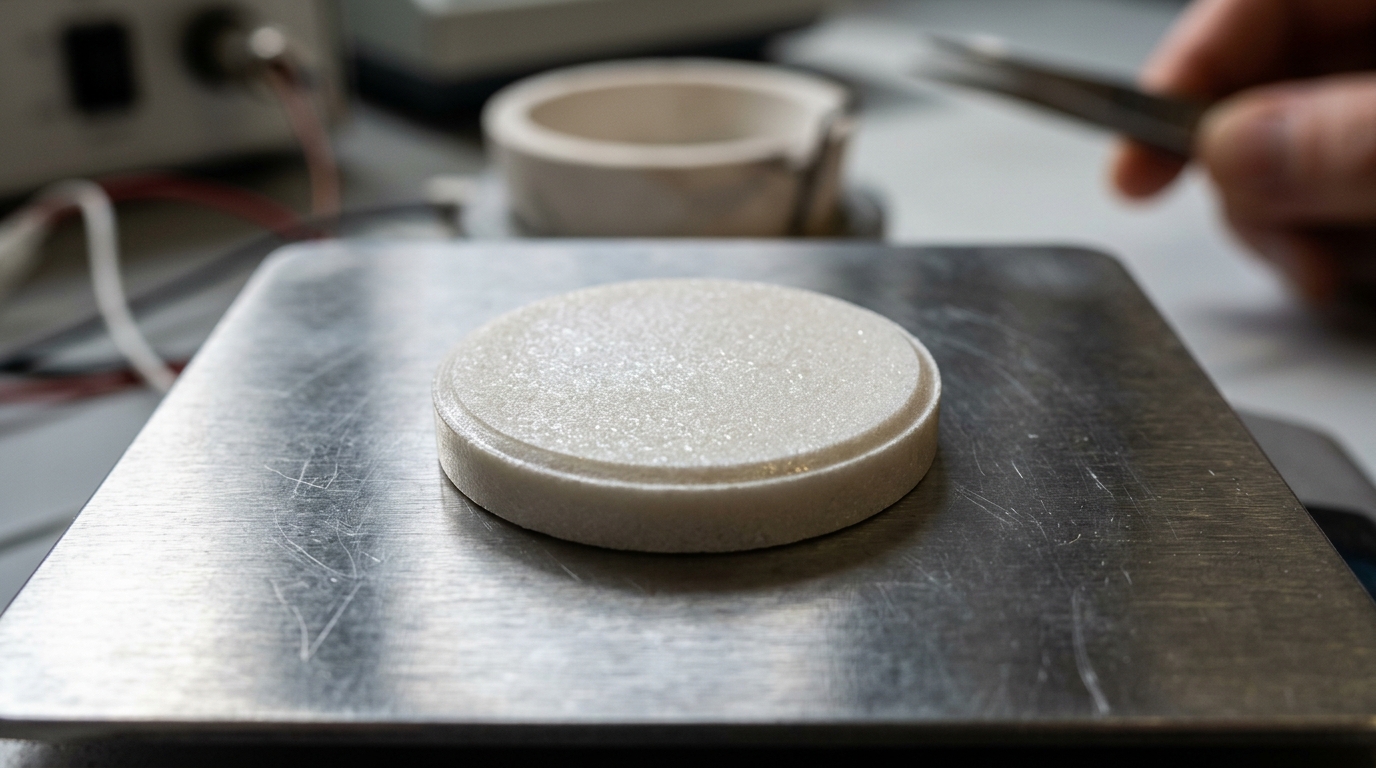
The research team investigated heterogeneous doping to overcome critical trade-offs in solid-state electrolyte design, demonstrating that nanodiamond addition increases ionic conductivity by up to three orders of magnitude in low-temperature phase II while significantly improving material resistance to deformation.
The investigation addresses central challenges in the ongoing development of fully solid-state electrochemical energy storage systems, which require solid electrolytes capable of reliable ion transport and robust mechanical integrity. Organic ionic plastic crystals are widely regarded as promising candidates for these systems due to their favorable ionic properties. However, their intrinsically high ionic conductivity is typically restricted to elevated temperatures. In addition, their characteristic softness causes them to flow under relatively low mechanical stresses, leaving them incapable of impeding the growth of lithium dendrites that can emerge during battery operation. To tackle these dual limitations, the authors explored heterogeneous doping with solid inorganic nanoparticles as an integrated route for simultaneous transport and mechanical enhancement.
To assess the impact of inorganic particulate inclusion, the experimental work examined composites based on two specific morpholinium salts: N, N-dimethylmorpholinium tetrafluoroborate, abbreviated as [C1mmor][BF4], and N-methyl-N-ethylmorpholinium tetrafluoroborate, designated as [C2mmor][BF4]. The researchers introduced nanodiamond particles into both matrix systems and systematically evaluated the resulting effects on their thermal behavior, transport dynamics, mechanical characteristics, and electrochemical properties.
The transport measurements revealed substantial gains in conductivity driven by nanodiamond-induced structural disorder. The introduction of nanodiamonds triggered amorphization of the morpholinium salts, enabling ionic conductivity increases of up to three orders of magnitude within low-temperature phase II. In addition to elevating low-temperature ion conduction, the additive lowered the operating threshold required to attain an optimal conductivity benchmark of roughly 10⁻⁴ S/cm. In the pristine state, achieving this conductivity required heating to 110 °C. Following nanodiamond doping, the temperature required to reach 10⁻⁴ S/cm decreased to 85 °C for the [C1mmor][BF4] composite and dropped further to 60 °C for the [C2mmor][BF4] composite, demonstrating marked reductions in the thermal energy needed for rapid ion migration.
The presence of the nanodiamond surface induces the formation of a highly conductive amorphous layer possessing an approximate thickness of 3.5 nanometers. At nanodiamond loadings between 20 and 30 volume percent, the interfacial layers form a continuous, interconnected network, providing highly conductive pathways that facilitate efficient charge transport throughout the solid composite volume.
Along with elevated conductivity, the composite materials exhibited substantial mechanical reinforcement. Microhardness testing established that the incorporation of nanodiamonds produced a several-fold increase in hardness at higher filler loadings compared to the unmodified salts. This mechanical strengthening directly addresses one of the primary vulnerabilities of organic ionic plastic crystals, whose tendency to flow under minimal stress compromises electrolyte stability and fails to prevent lithium dendrite penetration.
However, the experimental findings also highlighted an important performance trade-off concerning electrochemical stability under electrical polarization. Whereas the pristine morpholinium plastic crystal salts displayed a wide electrochemical stability window exceeding 5 V, nanodiamond addition narrowed this operational window to approximately 3.0 to 4.0 V. This contraction indicates that while nanodiamond incorporation concurrently enhances ionic transport and mechanical microhardness, the formulation introduces constraints on high-voltage operation. The researchers emphasize that successfully implementing these nanodiamond-doped plastic crystals requires precise control over component ratios to balance the notable transport and mechanical gains against the narrowing of electrochemical stability.
Subject of Research: Nanodiamond doping of morpholinium organic ionic plastic crystal electrolytes
Article Title: Effect of nanodiamond addition on the thermal, transport, mechanical, and electrochemical properties of morpholinium-based organic ionic plastic crystals
Article References: Stebnitskii, I., Utkin, A., & Mateyshina, Y. (2026). Effect of nanodiamond addition on the thermal, transport, mechanical, and electrochemical properties of morpholinium-based organic ionic plastic crystals. Ionics. https://doi.org/10.1007/s11581-026-07639-0
Image Credits: AI Generated
DOI: 10.1007/s11581-026-07639-0
Keywords: organic ionic plastic crystals, nanodiamonds, solid-state electrolytes, ionic conductivity, salt amorphization, [C1mmor][BF4], [C2mmor][BF4], N, N-dimethylmorpholinium tetrafluoroborate, N-methyl-N-ethylmorpholinium tetrafluoroborate, microhardness, electrochemical stability, lithium dendrites, phase II transition, conductive amorphous layer, electrochemical energy storage, heterogeneous doping, morpholinium electrolytes
News Source: Denise Maddox. (November 14, 2026). Nanodiamond Addition Boosts Conductivity and Hardness in Morpholinium Solid Electrolytes. Scienmag.