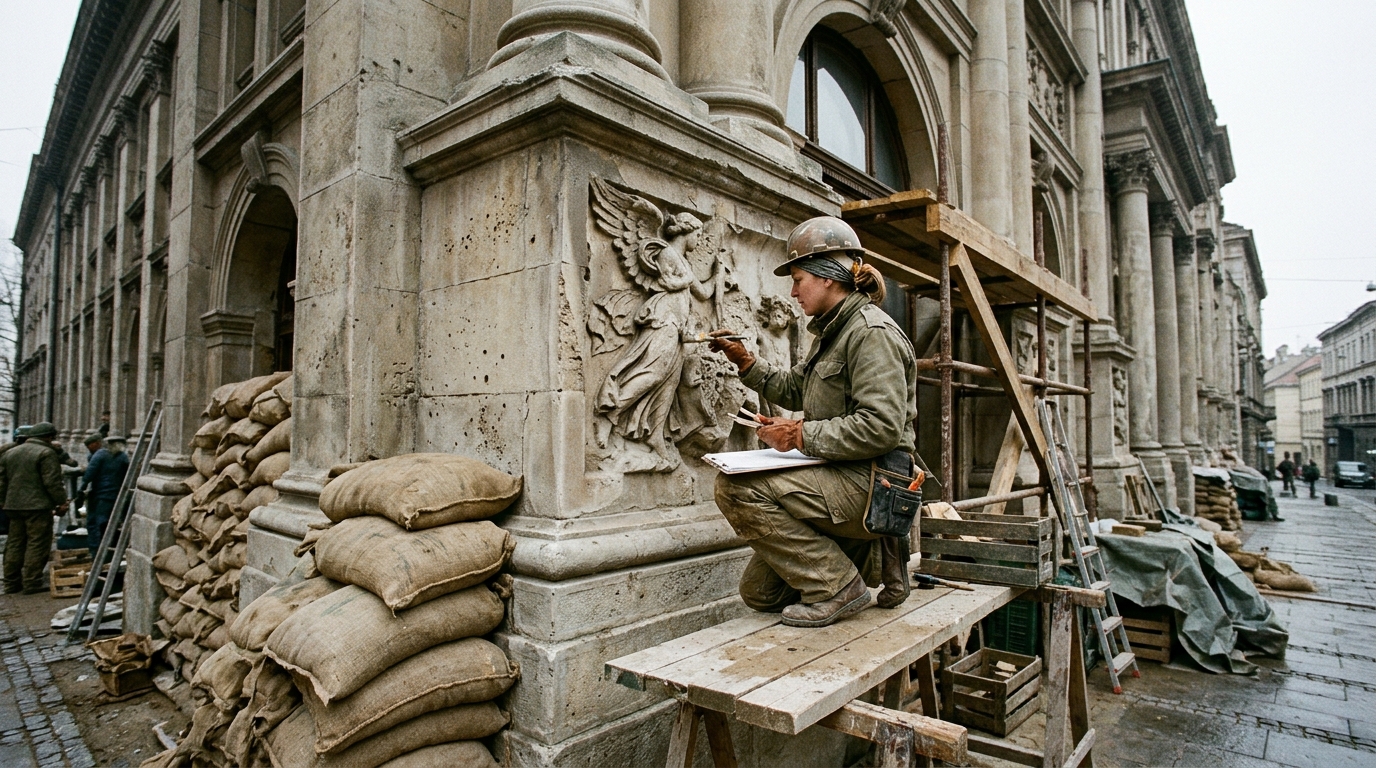
A historical-institutional investigation into the urban conservation system of Belgrade reveals that professional heritage practice endured through late socialism and the violent breakup of Yugoslavia, only to experience gradual disempowerment following post-2000 neoliberal market transformations. Published in the journal Built Heritage by researchers Miloš Ničić, Sara Nikolić, and Sanja Iguman Glušac, the study examines the evolution of urban conservation and heritagisation across the capital city between 1970 and 2003. Contrary to prevailing transition narratives that frame the post-socialist 1990s as an immediate and definitive institutional rupture, the empirical findings demonstrate that expert communities preserved methodological continuity, internal authority, and rigorous preservation practices throughout wartime isolation and political upheaval. The substantive dismantling of conservation authority emerged later, driven by market-oriented planning legislation that subordinated professional preservation mandates to speculative urban development and real estate investment.
To trace these institutional shifts, the research team implemented an interdisciplinary methodological framework combining critical legal history, archival document analysis, and interpretive empirical testimony. The empirical core comprises semi-structured, in-depth expert interviews lasting between sixty and ninety minutes with current and former senior employees of the Republic Institute for the Protection of Cultural Monuments of Serbia. These participants included former director Marko Omčikus, principal conservator Dragoljub Todorović from the architecture department, and anthropologist-conservator Estela Radonjić Živkov from the documentation department. Because direct interviews with the Cultural Heritage Preservation Institute of Belgrade could not be scheduled, the researchers incorporated a comprehensive 2021 institutional monograph authored by a former director of the municipal institute, titled Sixty Years of the Cultural Heritage Preservation Institute of Belgrade 1960–2020. The authors systematically triangulated this institutional monograph against primary statutory texts, regulatory instruments, and expert interviews, coding interview transcripts inductively through thematic analysis to identify operational tensions and governance trajectories.
The historical trajectory of Serbian heritage governance diverged substantially from Western European models, which had developed primarily to counter the architectural destruction caused by industrialisation and political revolutions. In Serbia, early preservation priorities were shaped by nineteenth-century national liberation struggles against Ottoman administration, fostering an institutional preference for isolated, symbolically charged religious structures such as medieval Serbian Orthodox monasteries rather than the wider urban fabric. Significant legislative formalisation began with the national Construction Law of 1931, whose twenty-fourth and twenty-fifth articles permitted municipal authorities to protect historically significant urban sections and regulate adjacent construction. This was followed by the municipal 1936 Regulation on the Protection of Belgrade Antiquities and a wartime 1941 preservation decree establishing a fifty-year designation threshold. Post-war socialist authorities acted rapidly, issuing a foundational monument protection decree in February 1945, followed by the federal General Law on the Protection of Cultural Monuments. Crucially, statutory reforms in 1959 incorporated urban values into the definition of cultural monuments for the first time, though subsequent federal revisions in 1965 omitted specific urban provisions when transposed to republic-level statutes.
A decisive paradigm shift occurred following the 1974 Yugoslav constitutional amendments, which decentralised administrative power across federal republics and prompted Serbia to adopt its landmark 1977 Law on the Protection of Cultural Heritage. Comprising 165 articles, this statutory framework categorised immovable cultural heritage into four distinct classes: cultural monuments, spatial cultural-historical units, archaeological sites, and historic landmarks. The law also instituted a three-tier hierarchical ranking based on cultural significance, categorising assets into properties of general importance, great importance, and exceptional importance. Article 36 proved transformative for urban conservation by formally codifying spatial cultural-historical units, defined as parts of urban or rural settlements possessing collective cultural and historical importance as an integrated whole. This innovative instrument allowed practitioners to move beyond isolated object protection and safeguard wider urban ensembles, streetscapes, and historic quarters where ambient value depended on the spatial relationships between buildings rather than the exceptional architectural merit of individual structures.
Practitioners consistently remember the late 1970s and 1980s as an institutional golden age characterised by substantial professional autonomy and insulation from direct political interference. Operating under decentralized governance, the Belgrade City Institute, which had been founded in 1960, conducted extensive surveys of previously neglected nineteenth-century bourgeois civic architecture, designating nearly three hundred structures during its initial two years despite prevailing political views dismissing them as low-value historical styles. Expert respondents noted that Yugoslav heritage professionals perceived their methodology and administrative documentation as closely aligned with Austrian and Central European technocratic conservation traditions rather than Soviet bureaucratic models. Nevertheless, the 1977 legislation introduced an enduring structural tension: while heritage institutes retained exclusive authority over assessing heritage value, formal designation powers were transferred to municipal assemblies. As legal historian Krstić observed, statutory regulations and professional practices began living separate lives, initiating an administrative divergence that initially left professional authority intact while altering its formal legal anchoring.
During the final decade of socialist Yugoslavia, conservation institutions operated within the ideological framework of self-management culture, which organized cultural work through self-governing professional associations and encouraged public engagement with preservation initiatives. The Belgrade City Institute expanded its staff to more than one hundred specialists, executing extensive conservation campaigns including the systematic photographic cataloguing of the historic Stari grad municipal core, the designation of Topčider as a protected spatial ensemble, the restoration of the Belgrade City Library in 1985, and major reconstruction work on the National Theatre in 1989. However, municipal conservation efforts increasingly clashed with socioeconomic pressures and national housing legislation. The 1984 Law on the Extension of Buildings and Conversion of Common Spaces authorized the conversion of shared attics and roof terraces into residential units without requiring conservation consent, an exemption expanded in 1987 to commercial ateliers. Furthermore, municipal listings during the 1980s reflected clear thematic selectivity: out of ninety-four protected architectural units, ninety-three dated to the pre-war era, with the 1983 listing of the Tomb of People’s Heroes in Kalemegdan representing the sole socialist-era monument protected.
The violent dissolution of Yugoslavia, international economic sanctions, hyperinflation, and armed conflict during the 1990s subjected heritage institutions to extreme operational stress, yet professional structures maintained functional continuity. Republic Institute professionals undertook hazardous salvage operations in conflict zones, documenting war damage and securing imperiled cultural artifacts around Vukovar and Knin while communicating findings directly to international monitoring bodies like UNESCO and ICOMOS. Domestically, the statutory architecture underwent further modifications: the 1990 Law on Cultural Heritage introduced specific provisions for ambient zones and memorial sites, while the 1994 Law on Cultural Property granted institutes authority to challenge municipal planning schemes that failed to incorporate conservation requirements. However, institutional capacity eroded rapidly: professional staffing at the Republic Institute fell from eighty experts in the early 1990s to barely forty-six in subsequent years, and direct state funding for conservation interventions was completely eliminated between 1991 and 1993, covering only basic staff salaries.
The empirical interviews revealed that institutional coping mechanisms during the 1990s generated a governance phenomenon the authors define as defensive heritage inflation. Motivated by geopolitical rivalry among former Yugoslav republics and the symbolic assertion of cultural sovereignty, heritage authorities instituted aggressive designation quotas, incentivizing staff with thirty percent salary bonuses for generating listing proposals. Consequently, official registers expanded dramatically even as financial, technical, and custodial capabilities collapsed, producing a formal catalogue of approximately 2,700 designated cultural properties. Conservator Estela Radonjić Živkov reported that an estimated one-third of these listed properties no longer physically exist, while another third possess highly questionable cultural value. Similarly, roughly three hundred Partisan monuments from the National Liberation War were maintained on official registers but starved of all maintenance funding, suspended between formal protection and functional neglect. This period of extreme isolation ended with the 1999 NATO bombing campaign, which inflicted severe structural destruction across Belgrade on major architectural ensembles, including the Generalštab military headquarters and the Avala telecommunications tower.
The decisive dismantling of conservation authority occurred not during wartime turmoil, but through the legal restructuring accompanying post-2000 neoliberal economic reforms and aggressive privatization legislation enacted in 2001. Rather than simply withdrawing state oversight, post-socialist governance reconstituted administrative power, subordinating preservation mandates to spatial planning authorities and real estate development priorities. Amendments to the national Planning and Construction Law progressively stripped conservation conditions of their legally binding status, reducing expert preservation assessments to optional advisory opinions. Conservators reported that municipal planning bodies routinely disregard conservation guidelines in approximately fifty percent of development proposals, while legal revisions permitted civil engineers lacking training in architectural history to oversee interventions on protected monuments. Furthermore, the commodification of urban land dismantled the protective efficacy of spatial cultural-historical units: commercial developers consistently fragment integrated ensembles into isolated land parcels, treating complex cultural sites like the damaged Generalštab complex as speculative real estate commodities rather than coherent historical ensembles.
The authors conclude that Belgrade’s post-socialist trajectory necessitates rethinking standard conceptual models of institutional transition, demonstrating that systemic change operated through a process of slow dismemberment rather than sudden political collapse. While conservation institutions maintained operational resilience, professional ethics, and expert legitimacy throughout state disintegration and armed conflict, the subsequent alignment of state power with private market capital systematically severed the constituent capacities of the preservation regime. By transferring binding enforcement authority from conservation institutes to developer-driven planning bodies, the post-2000 regulatory architecture hollowed out the practical efficacy of urban protection while leaving inflated heritage registers nominally intact. The Belgrade case demonstrates how contemporary neoliberal transformations can maintain the superficial facade of institutional heritage protection while systematically stripping expert communities of the regulatory power required to safeguard the historic urban fabric from speculative redevelopment.
Subject of Research: Institutional history and transformation of urban conservation and heritage governance in Belgrade from 1970 to 2003
Article Title: Urban conservation and heritagisation in Belgrade, 1970–2003: institutional continuity, professional authority and gradual transformation of heritage protection system
Article References: Ničić, M., Nikolić, S., & Glušac, S. I. (2026). Urban conservation and heritagisation in Belgrade, 1970–2003: institutional continuity, professional authority and gradual transformation of heritage protection system. Built Heritage, 10(1), Article 84. https://doi.org/10.1186/s43238-026-00331-2
Image Credits: AI Generated
DOI: 10.1186/s43238-026-00331-2
Keywords: Belgrade, urban conservation, heritagisation, heritage governance, spatial cultural-historical units, Republic Institute for the Protection of Cultural Monuments, Belgrade City Institute, Yugoslav socialism, postsocialist transformation, defensive heritage inflation, slow dismemberment, Generalštab, planning legislation, cultural monuments, neoliberal urbanism, institutional history, historic preservation
News Source: Margaret Porter. (November 14, 2026). Belgrade Heritage Protectors Sustained Conservation Through Wartime Before Facing Institutional Dismemberment. Scienmag.