Published in BMC Molecular and Cell Biology, the study introduces a method called dictyGrad-ALFA, which utilizes a synthetic peptide tag and a specific nanobody to direct proteins for degradation via the ubiquitin-proteasome pathway. This approach addresses a significant limitation in current genetic tools for D. discoideum, where efficient methods for conditional loss-of-function studies have been scarce compared to established techniques like CRISPR/Cas9 genome editing or homologous recombination.
The primary motivation for developing this system stems from the biological constraints of existing knockout strategies. While gene disruption is well-established in D. discoideum, it cannot be applied to genes essential for the growth phase of the organism. Furthermore, the loss of genes essential for early development precludes comprehensive analyses of their roles in later stages. The new system allows for stage- and cell-type-specific loss-of-function studies, overcoming the secondary effects and off-target silencing issues associated with RNA interference, which is under developmental control in this species.
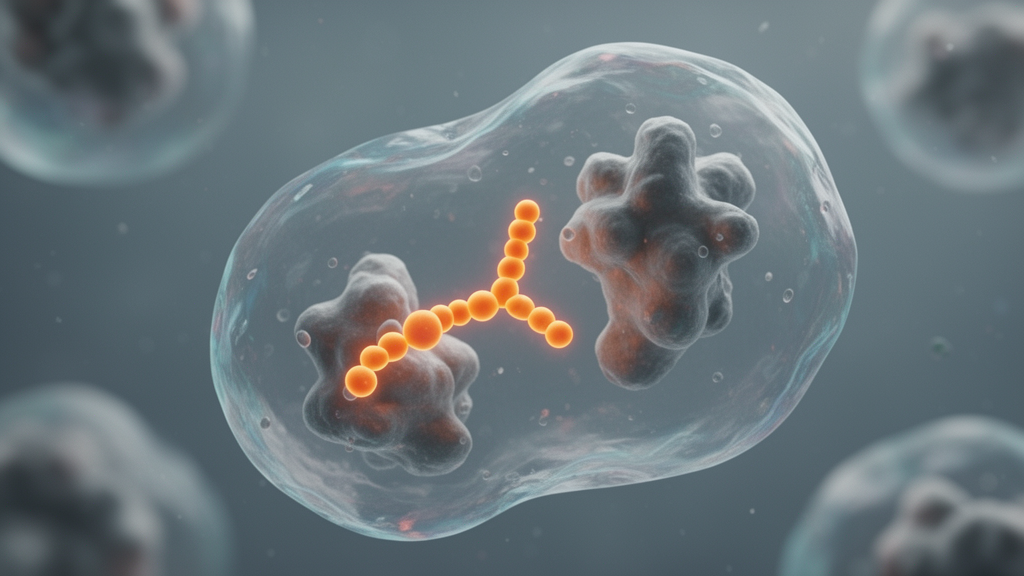
The dictyGrad-ALFA system operates by recruiting ALFA-tagged proteins to the Skp1-Cullin-F-box (SCF) complex. The ALFA-tag is a small, 15-amino acid hydrophilic artificial alpha-helix designed to serve as a unique epitope tag. By fusing an anti-ALFA nanobody, known as NbALFA, to the F-box domain of the D. discoideum protein FbxD, the researchers created a chimeric protein that directs the tagged target toward ubiquitination. This mechanism leaves conventional fluorescent markers, such as GFP, available for downstream imaging, which is particularly useful for multi-color analyses.
To validate the system, the team generated a knock-in strain carrying Histone H1 fused to mScarlet-I and the ALFA-tag at the act5 locus. In vegetative cells, the expression of dictyGrad-ALFA resulted in a 73% reduction in the fluorescence signal of the tagged histone compared to cells without nanobody expression. Western blot analysis confirmed these microscopic observations, showing a 74% reduction in the full-length Histone H1-mScarlet-I-ALFA protein. The study noted that even standalone NbALFA expression caused a 27% reduction, indicating that some protein destabilization occurs through nanobody binding alone, but the F-box fusion significantly enhanced the degradation efficiency.
The researchers further demonstrated the utility of the system for cell type-specific targeting during the multicellular developmental stage. By expressing dictyGrad-ALFA under the control of prestalk-specific and prespore-specific gene promoters, they achieved region-specific degradation in developing slugs. Under the prestalk-specific ecmAO promoter, Histone H1-mScarlet-I-ALFA fluorescence was reduced by 87% in the anterior region of the slugs. Conversely, expression under the prespore-specific D19 promoter resulted in a 69% reduction in the posterior region. This spatial specificity contrasts with the ubiquitous coaA promoter, which reduced fluorescence by 98% throughout the entire slug, confirming the ability to restrict degradation to specific cell lineages.
To test the functional impact of the knockdown, the team targeted adenylyl cyclase A (ACA), a protein essential for the early stages of development. They used CRISPR/Cas9 to knock in mScarlet-I-ALFA at the 3′ end of the acaA locus. When dictyGrad-ALFA was expressed constitutively, the ACA-mScarlet-I-ALFA fluorescence became almost undetectable, and the cells failed to aggregate even 24 hours after starvation. This phenotype mirrored that of the acaA knockout, validating the efficacy of the system in depleting a functionally important protein. The aggregation-deficient phenotype confirmed that the targeted degradation successfully disrupted the biological process dependent on ACA.
Investigations into the developmental consequences of cell type-specific ACA knockdown revealed that while development was delayed, it was not permanently arrested. Cells expressing dictyGrad-ALFA under the prestalk or prespore promoters remained in the slug stage at 24 hours after starvation, whereas control cells had already formed fruiting bodies. However, by 48 hours, the knockdown strains completed culmination and formed normal fruiting bodies with cellulose-coated stalk cells and spores. This suggests that while ACA plays a role in directing cell movements or differentiation during the mound stage, it is dispensable for the final formation of the fruiting body structure.
The study also explored the integration of the ALFA-tag approach with the auxin-inducible degron 2 (AID2) system for conditional, inducible protein depletion. The AID2 system relies on the binding of indole-3-acetic acid (IAA) or its analog 5-Ph-IAA to mediate the interaction between a target protein fused to the mAID tag and a fusion protein containing OsTIR(F74G) and an F-box domain. In this configuration, the anti-ALFA nanobody is fused to the mAID tag, allowing for the targeted degradation of ALFA-tagged proteins in the presence of the ligand.
However, the application of the AID2 system in D. discoideum presented challenges regarding efficiency. Treatment with 10 µM 5-Ph-IAA for 24 hours resulted in a 60% decrease in Histone H1-mScarlet-I fluorescence compared to the mock control. Western blotting revealed reductions of 78% and 58% in protein levels with or without IAA, indicating significant background degradation. The half-life for 50% reduction under 10 µM 5-Ph-IAA treatment was 4.35 hours, which is substantially longer than the rates reported for mammalian cells or C. elegans. The recovery of protein levels after the removal of 5-Ph-IAA was also slow, with a half-time of approximately 15.9 hours.
In the multicellular stage, the AID2 system showed differential efficacy across cell types. In slugs developed on filter pads containing 10 µM 5-Ph-IAA, the fluorescence intensity of Histone H1-mScarlet-I was reduced by 65% in the anterior prestalk region but only by 23% in the posterior prespore region. This suggests that prestalk cells are more susceptible to IAA-induced degradation, while prespore cells exhibit greater resistance to the perturbation. The authors noted that high basal degradation and low potency of 5-Ph-IAA likely contributed to the lower overall efficiency compared to other model systems.
The development of dictyGrad-ALFA provides a powerful tool for functional genomics in D. discoideum, enabling the study of essential genes that were previously inaccessible to conditional knockdown methods. The use of the small ALFA-tag minimizes interference with the function of endogenous proteins, facilitating the study of sensitive loci where larger fluorescent tags might have adverse effects. The system’s compatibility with various promoters and inducible systems opens the door for complex stage- and cell-type-specific analyses.
Despite its advantages, the system has limitations that require further optimization. The degradation of highly expressed proteins, such as the act5-promoter-driven Histone H1, was incomplete, potentially due to the protein level exceeding the degradation capacity of the SCF complex. The authors suggest that using alternative F-box domains or generating strains with multiple genomic copies of the degron system could improve efficiency. Additionally, the heterogeneity in nanobody expression from extrachromosomal plasmids may lead to variable knockdown levels, which can mask developmental phenotypes due to cell non-autonomous effects.
The integration of nanobody-based degrons with the AID2 system offers a pathway for inducible protein depletion, although current efficiency in D. discoideum is lower than in other organisms. The high background degradation observed in the absence of IAA suggests potential cross-talk between the OsTIR/mAID components and endogenous factors. Future improvements may involve the use of alternative ligands, such as 5-Ad-IAA, or different dimerization tools to mitigate these issues. Overall, these systems pave the way for more precise functional analyses of genes essential for growth and development in this model organism.
Subject of Research: Development of a nanobody-based degron system for targeted protein knockdown in Dictyostelium discoideum
Article Title: A nanobody-based degron system for targeted protein knockdown in Dictyostelium discoideum
Article References: Hashimura, H., Fujishiro, S., Shimada, N., Adachi, T., Sugita, T., Kuwana, S., & Sawai, S. (2026). A nanobody-based degron system for targeted protein knockdown in Dictyostelium discoideum. BMC Molecular and Cell Biology, 27(1), Article 15. https://doi.org/10.1186/s12860-026-00572-0
Image Credits: AI Generated
DOI: 10.1186/s12860-026-00572-0
Keywords: Dictyostelium discoideum, Nanobody, Protein knockdown, Degrone system, ALFA-tag, CRISPR/Cas9, Cell biology, Ubiquitin-proteasome pathway, Conditional gene expression, Developmental biology, nanobody-based, degron
News Source: Juliet Wilcox. (November 8, 2026). Nanobody Degrade System Targets Proteins in Slime Mold. Scienmag.