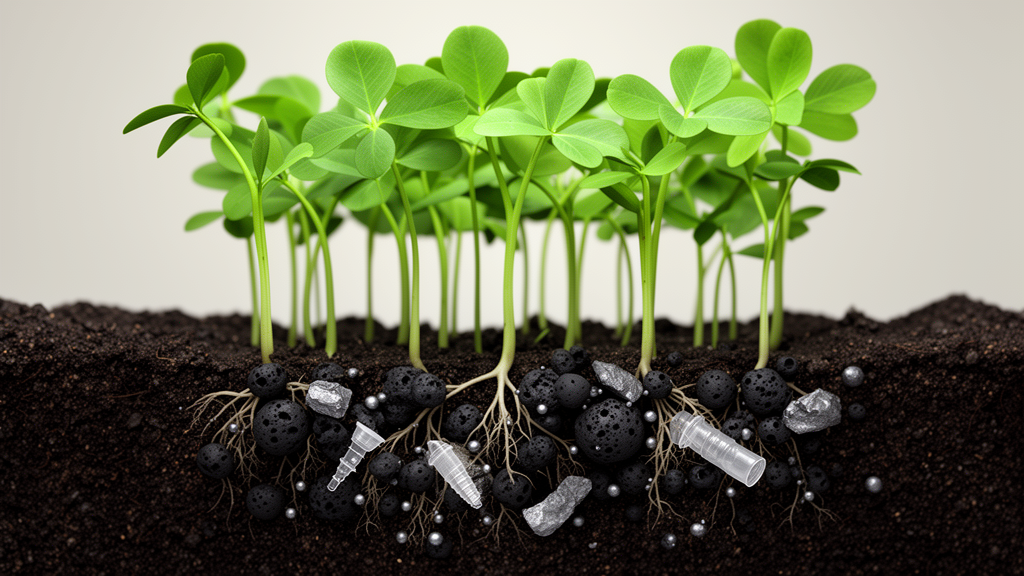
A soil amendment built from biochar and calcium oxide nanoparticles may help alfalfa cope with two stubborn pollutants at once: lead and microplastics. A new study reports that the composite material improved plant growth, photosynthesis, nitrogen metabolism, and antioxidant defenses while reducing the damage caused by the combined stressors.
Microplastics and heavy metals are increasingly found together in agricultural soils, where they threaten crop productivity and raise concerns for human health. The researchers set out to test whether biochar modified with calcium oxide nanoparticles, abbreviated NBC, could blunt the toxic effects of lead, microplastics, and the two applied together on alfalfa plants.
The experiment compared several treatments: an untreated control; lead stress at 100 milligrams per kilogram of soil; microplastics at 1 percent; lead combined with microplastics; and the same contaminant treatments paired with 2 percent NBC. This design allowed the team to separate the effects of each pollutant alone from those of their interaction and to measure what the amended material added.
The results showed that lead and microplastics acting together reduced alfalfa growth and biomass yield. The decline was tied to lower chlorophyll content and reduced photosynthetic performance, including a lower photosynthetic rate, reduced transpiration rate, decreased stomatal conductance, and lower intercellular carbon dioxide. The co-contamination also reduced the availability of soil nutrients.
At the same time, the stressed plants showed classic signs of oxidative damage. Levels of malondialdehyde, electrolyte leakage, and hydrogen peroxide all rose, while antioxidant enzyme activities fell. Growth losses were further linked to impaired nitrogen assimilation, with reduced activity of key enzymes including glutamate dehydrogenase, glutamine synthetase, nitrate reductase, and glutamate synthase.
Adding the nano-modified biochar reversed much of this damage. Treated plants showed chlorophyll synthesis boosted by 66.50 percent, photosynthetic rate by 18.69 percent, transpiration rate by 36.31 percent, stomatal conductance by 87.50 percent, and intercellular carbon dioxide by 38 percent. Antioxidant activities, including APX, CAT, POD, SOD, GSH, and MDHAR, increased, as did osmolyte synthesis in the form of proline and soluble proteins, along with production of the hormones indole acetic acid and gibberellic acid.
The amendment also cut the stress markers sharply: electrolyte leakage dropped by 37.72 percent, malondialdehyde by 54.18 percent, and hydrogen peroxide by 39.24 percent. Nitrogen assimilation enzymes responded as well, with nitrate reductase up 43.68 percent, glutamine synthetase up 42.86 percent, glutamate synthase up 48.13 percent, and glutamate dehydrogenase activity up 34.60 percent, changes the authors link to better growth under stress.
Soil effects mattered too. The NBC amendment reduced the availability of lead in the soil, increased nutrient and carbon availability, and raised soil enzyme activities, all of which contributed to improved growth and biomass yield in the alfalfa plants.
The authors conclude that applying nano-modified biochar is an effective measure against combined lead and microplastic toxicity, offering a potential solution to the persistent challenge of co-contaminated soils. Because the findings come from a controlled treatment study in alfalfa, further work will be needed to confirm how the approach performs across different soils, crops, and field conditions.
Subject of Research: Mitigation of lead and microplastic co-contamination toxicity in alfalfa using nano-modified biochar
Article Title: Nano-modified biochar mitigates toxicity from co-contamination with lead and microplastics in alfalfa by modulating photosynthesis, nitrogen assimilation, and antioxidant systems
Article References: Yang, Y., Cui, L., Xie, Z., Yang, J., Malik, M. S., Mohany, M., Ye, C., & Ahmed, W. (2026). Nano-modified biochar mitigates toxicity from co-contamination with lead and microplastics in alfalfa by modulating photosynthesis, nitrogen assimilation, and antioxidant systems. Chemical and Biological Technologies in Agriculture. https://doi.org/10.1186/s40538-026-01120-w
Image Credits: AI Generated
DOI: 10.1186/s40538-026-01120-w
Keywords: biochar, calcium oxide nanoparticles, lead, microplastics, alfalfa, soil remediation, photosynthesis, nitrogen assimilation, antioxidant enzymes, heavy metal toxicity, plant stress, Nano-modified
News Source: Alan Morgan. (October 30, 2026). Nano-Modified Biochar Eases Lead and Microplastic Stress in Alfalfa. Scienmag.