• HOME
  • NEWS
  • EXPLORE
    • CAREER
      • Companies
      • Jobs
    • EVENTS
    • iGEM
      • News
      • Team
    • PHOTOS
    • VIDEO
    • WIKI
  • BLOG
  • COMMUNITY
    • FACEBOOK
    • INSTAGRAM
    • TWITTER
Wednesday, May 20, 2026
BIOENGINEER.ORG
No Result
View All Result
  • Login
  • HOME
  • NEWS
  • EXPLORE
    • CAREER
      • Companies
      • Jobs
        • Lecturer
        • PhD Studentship
        • Postdoc
        • Research Assistant
    • EVENTS
    • iGEM
      • News
      • Team
    • PHOTOS
    • VIDEO
    • WIKI
  • BLOG
  • COMMUNITY
    • FACEBOOK
    • INSTAGRAM
    • TWITTER
  • HOME
  • NEWS
  • EXPLORE
    • CAREER
      • Companies
      • Jobs
        • Lecturer
        • PhD Studentship
        • Postdoc
        • Research Assistant
    • EVENTS
    • iGEM
      • News
      • Team
    • PHOTOS
    • VIDEO
    • WIKI
  • BLOG
  • COMMUNITY
    • FACEBOOK
    • INSTAGRAM
    • TWITTER
No Result
View All Result
Bioengineer.org
No Result
View All Result
Home NEWS Science News Chemistry

Nano-microscope gives first direct observation of the magnetic properties of 2D materials

Bioengineer by Bioengineer
September 18, 2020
in Chemistry
Reading Time: 3 mins read
0
IMAGE
Share on FacebookShare on TwitterShare on LinkedinShare on RedditShare on Telegram

Discovery means new class of materials and technologies
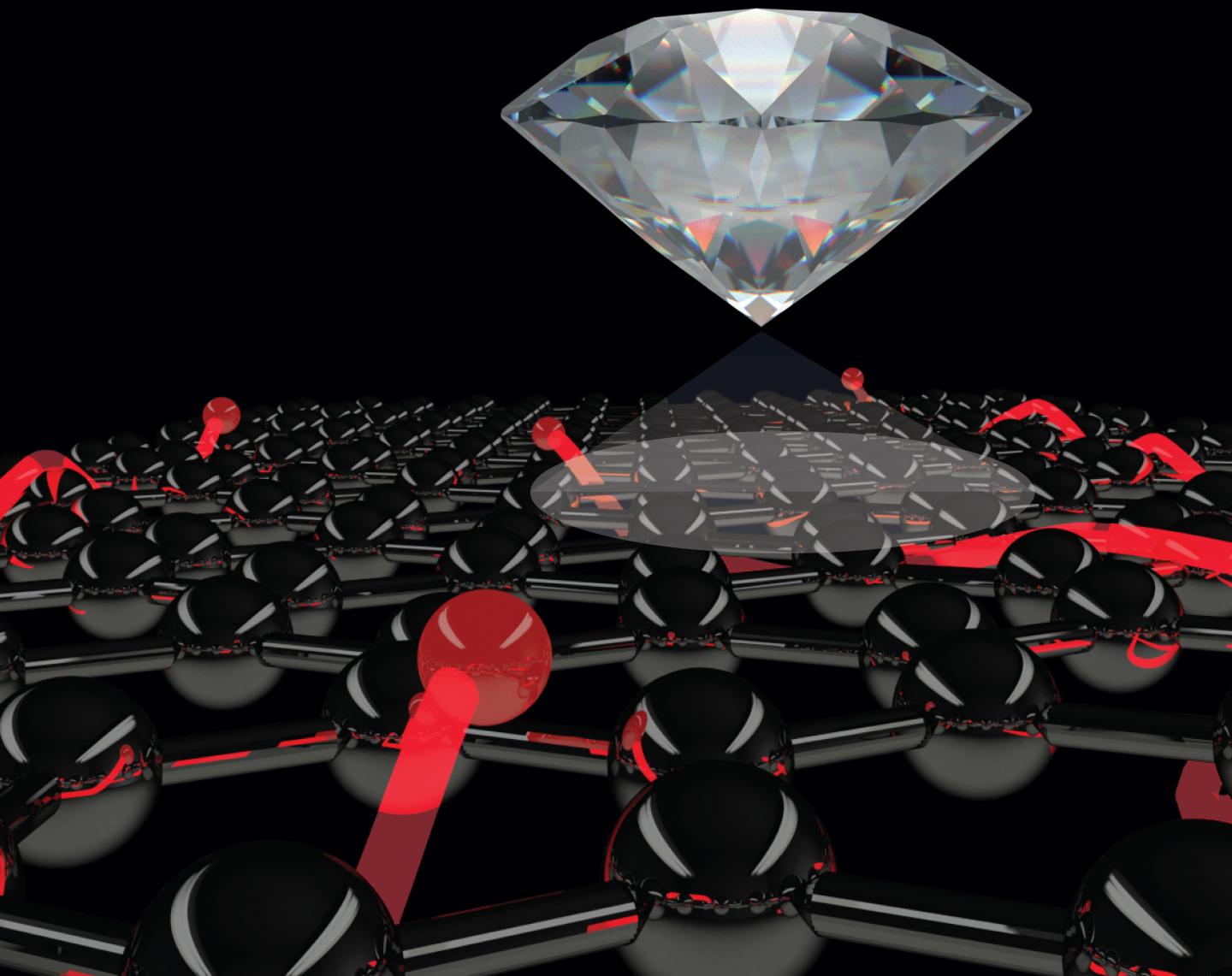
IMAGE

Credit: David A. Broadway

Australian researchers and their colleagues from Russia and China have shown that it is possible to study the magnetic properties of ultrathin materials directly, via a new microscopy technique that opens the door to the discovery of more two-dimensional (2D) magnetic materials, with all sorts of potential applications.

Published in the journal Advanced Materials, the findings are significant because current techniques used to characterise normal (three-dimensional) magnets don’t work on 2D materials such as graphene due to their extremely small size – a few atom thick.

“So far there has been no way to tell exactly how strongly magnetic a 2D material was,” said Dr Jean-Philippe Tetienne from the University of Melbourne School of Physics and Centre for Quantum Computation and Communication Technology.

“That is, if you were to place the 2D material on your fridge’s door like a regular fridge magnet, how strongly it gets stuck onto it. This is the most important property of a magnet.”

To address the problem, the team, led by Professor Lloyd Hollenberg, employed a widefield nitrogen-vacancy microscope, a tool they recently developed that has the necessary sensitivity and spatial resolution to measure the strength of 2D material.

“In essence, the technique works by bringing tiny magnetic sensors (so-called nitrogen-vacancy centres, which are atomic defects in a piece of diamond) extremely close to the 2D material in order to sense its magnetic field,” Professor Hollenberg explained.

To test the technique, the scientists chose to study vanadium triiodide (VI3) as large 3D chunks of VI3 were already known to be strongly magnetic.

Using their special microscope, they have now shown that 2D sheets of VI3 are also magnetic but about twice as weak as in the 3D form. In other words, it would be twice as easy to get them off the fridge’s door.

“This was a bit of a surprise, and we are currently trying to understand why the magnetisation is weaker in 2D, which will be important for applications,” Dr Tetienne said.

Professor Artem Oganov of Skolkovo Institute of Science and Technology (Skoltech) in Moscow said the findings have the potential to trigger new technology.

“Just a few years ago, scientists doubted that two-dimensional-magnets are possible at all. With the discovery of two-dimensional ferromagnetic VI3, a new exciting class of materials emerged. New classes of material always mean that new technologies will appear, both for studying such materials and harnessing their properties.”

The international team now plan to use their microscope to study other 2D magnetic materials as well as more complex structures, including those that are expected to play a key role in future energy-efficient electronics.

###

Other organizations involved in the research include University of Basel, RMIT University, Nanjing University of Posts and Telecommunications, Moscow Institute of Physics and Technology, Northwestern Polytechnical University, and Renmin University of China.

Media Contact
Lito Vilisoni Wilson
[email protected]

Original Source

https://physics.unimelb.edu.au/news/new-diamond-based-nano-microscope-gives-first-direct-observation-of-the-magnetic-properties-of-2d-materials

Related Journal Article

http://dx.doi.org/10.1002/adma.202003314

Tags: Atomic/Molecular/Particle PhysicsChemistry/Physics/Materials SciencesNanotechnology/Micromachines
Share12Tweet8Share2ShareShareShare2

Related Posts

Transforming Environments into a ‘Virtual Screen’ Enhances 3D Machine Vision — Chemistry

Transforming Environments into a ‘Virtual Screen’ Enhances 3D Machine Vision

May 20, 2026
Scientists Observe Massive Light-Conversion Effect in Chiral Carbon Nanotubes — Chemistry

Scientists Observe Massive Light-Conversion Effect in Chiral Carbon Nanotubes

May 19, 2026

TransEuroOGS Project to Connect Optical Ground Stations Across Europe

May 19, 2026

Decarbonizing the Grid: The Essential First Step to Capturing Carbon from the Environment

May 19, 2026
Please login to join discussion

POPULAR NEWS

  • blank

    New Study Reveals Plants Can Detect the Sound of Rain

    732 shares
    Share 292 Tweet 183
  • Research Indicates Potential Connection Between Prenatal Medication Exposure and Elevated Autism Risk

    846 shares
    Share 338 Tweet 212
  • ESMO 2025: mRNA COVID Vaccines Enhance Efficacy of Cancer Immunotherapy

    274 shares
    Share 110 Tweet 69
  • Breastmilk Balances E. coli and Beneficial Bacteria in Infant Gut Microbiomes

    58 shares
    Share 23 Tweet 15

About

We bring you the latest biotechnology news from best research centers and universities around the world. Check our website.

Follow us

Recent News

Tau Aggregates Trigger Neuronal Death via Z-RNA

Thouless Quantum Walks in Topological Flat Bands

Flexible Organic-Inorganic Hybrid Synapse Advances Physical Reservoir Computing

Subscribe to Blog via Email

Enter your email address to subscribe to this blog and receive notifications of new posts by email.

Join 82 other subscribers
  • Contact Us

Bioengineer.org © Copyright 2023 All Rights Reserved.

Welcome Back!

Login to your account below

Forgotten Password?

Retrieve your password

Please enter your username or email address to reset your password.

Log In
No Result
View All Result
  • Homepages
    • Home Page 1
    • Home Page 2
  • News
  • National
  • Business
  • Health
  • Lifestyle
  • Science

Bioengineer.org © Copyright 2023 All Rights Reserved.