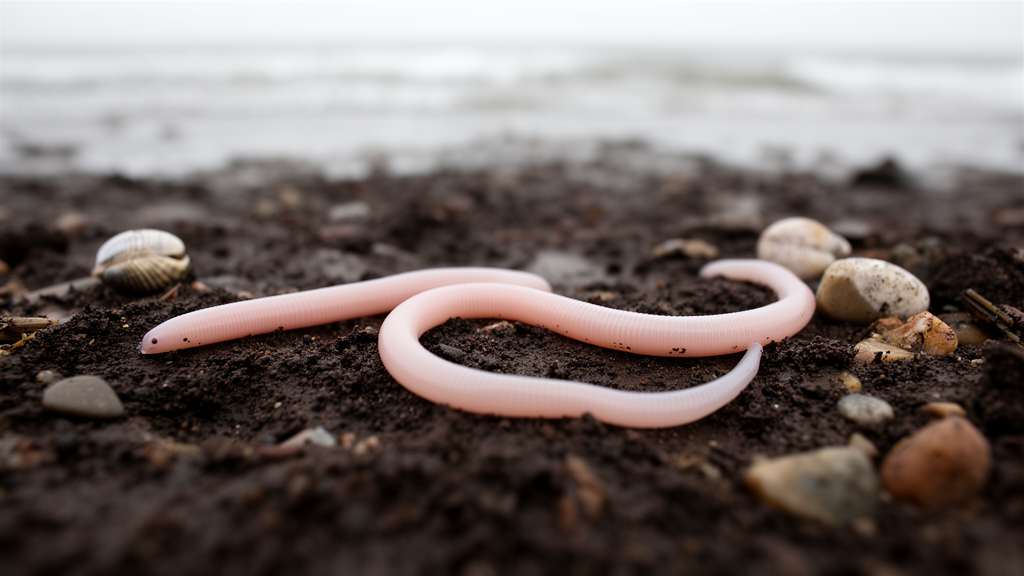
A quiet but pointed dispute has erupted in the world of marine systematics, and it centers on a family of burrowing polychaete worms that most beachgoers have never heard of. The Magelonidae, a group of slender annelids distinguished by their shovel-shaped heads and frilly feeding palps, have become the unlikely battleground for a debate about how scientists should name branches of the tree of life. In a new paper published in Zoosystematics and Evolution, the author argues that a recent decision to revive the long-dormant genus name Maea has inadvertently broken one of the core rules of modern classification: that every formally named group must be monophyletic, meaning it contains an ancestor and all of its descendants.
The trouble began with a comprehensive review of magelonid systematics by Kate Mortimer and colleagues, published in 2021. That work laid out the first rigorous phylogenetic hypotheses for the family and concluded that the family name Magelonidae and the genus name Magelona should refer to exactly the same group of organisms. In other words, the family would be monotypic, containing a single genus. This was not an arbitrary choice. The authors defined both names by reference to a specific set of shared, evolutionarily inherited features: a shovel-shaped prostomium, the absence of nuchal organs, ridges on the prostomium, ventral palps with papillate surfaces, a specialized burrowing organ, and a characteristic magelonid pattern of body regionation. By tying the names to these homologous characters and the phylogenetic hypothesis they explain, Mortimer and colleagues ensured that both Magelona and Magelonidae would remain monophyletic under that hypothesis.
In 2026, however, Mortimer and colleagues reinstated the genus Maea, originally erected by Johnston in 1865, to house fifteen species that had previously been placed within Magelona. The justification rested on pronounced morphological differences between the type species of the two genera, Magelona papillicornis and Maea mirabilis, together with the phylogenetic results of the earlier 2021 study. But according to the new critique, this move carries a hidden cost that the original authors did not acknowledge. On the consensus tree published in 2021, the set of species assigned to Maea corresponds to what was informally labeled clade m, a branch nested well inside Magelona. Naming that branch as a separate genus leaves the remainder of Magelona paraphyletic, because Magelona would then exclude descendants that share its most recent common ancestor.
This is not merely a matter of taxonomic tidiness, the author insists. Paraphyly corrupts the scientific content of a name. In modern phylogenetic systematics, a formal supraspecific name is supposed to function as a shorthand for a causal explanation: an account of the origin and fixation of homologous characters in an ancestral population, followed by the population-splitting events that produced the group’s members. A paraphyletic name cannot serve that role cleanly, because it arbitrarily excludes some descendants while retaining others, breaking the link between the name and the explanatory hypothesis it is meant to convey.
Phylogenetic trees, the paper explains, are dense with implied hypotheses. Beyond the clades that readers casually identify on a tree, each phylogenetic hypothesis is a composite construct that bundles several distinct classes of explanatory claims. These include hypotheses about the origins of homologous characters, hypotheses about population-splitting events, and, in cases where character distributions conflict with the best-supported tree, ad hoc hypotheses of homoplasy, the independent evolution of superficially similar features. Layered on top are separately inferred species hypotheses, each derived by abduction from its own set of premises. Formal nomenclature requires that species hypotheses always be named, but it imposes no such requirement on phylogenetic hypotheses, and the ranked system of classification makes naming every clade impossible in practice.
That asymmetry creates a hazard. Because the choice of which clades to name is largely discretionary, researchers can inadvertently, or deliberately, select branches whose recognition renders other named groups paraphyletic. The new paper argues that this is precisely what happened twice in recent magelonid history. First, Meißner and colleagues in 2023 reinstated the genus Octomagelona, which Mortimer and colleagues had synonymized with Magelona in 2021, producing the same paraphyly problem. Fitzhugh and colleagues responded in 2024, reiterating that names should only be applied when monophyly can be guaranteed. Now, the author contends, the reinstatement of Maea repeats the error in a new form, especially puzzling given that Mortimer and colleagues recognized Maea while leaving Octomagelona unrecognized, despite both producing the same phylogenetic complication.
The critique also takes issue with the way Maea was defined. Rather than presenting Maea as a phylogenetic hypothesis tied to specific explanatory content, Mortimer and colleagues offered what the paper characterizes as a descriptive diagnosis, an account of characters instantiated by the developmental stages, or semaphoronts, of the included organisms, rather than a definition in the sense recommended by the International Commission on Zoological Nomenclature. Mortimer and colleagues had themselves emphasized in 2021 that supraspecific names should be consistent with phylogenetic hypotheses precisely because such consistency reflects the causal understanding of organismal features. The 2026 paper, the critique notes, neither provided an updated phylogenetic inference for the family nor explicitly connected the name Magelona to the composite phylogenetic hypothesis it had previously been defined by, weakening the conceptual foundation that made the earlier framework so robust.
There is also a historical dimension to the dispute. The author observes that justifying a genus by highlighting the degree of morphological divergence between its members and their relatives echoes the mid-twentieth-century practice of evolutionary taxonomy, in which prominent characters were used to carve out paraphyletic grades, groups that share an ancestor but exclude some of its descendants. Evolutionary taxonomists of that era, such as Ernst Mayr, accepted paraphyly as a legitimate outcome of classification. Modern phylogenetic systematics does not. The science of systematics, the paper argues, aims not only to describe organisms but to infer explanatory hypotheses about their history, and the formal naming of some of those hypotheses must not come at the expense of communicating them accurately. A name that signifies a paraphyletic assemblage misrepresents the very evolutionary history it is supposed to summarize.
The proposed remedy is straightforward, if unpromising for fans of nomenclatural novelty: Maea should once again be placed in synonymy with Magelona, joining the list of synonyms that also includes Rhynophylla, Meredithia, and Octomagelona. The only legitimate path to formally naming clade m, or any other branch within the family, would be a new phylogenetic inference that incorporates observations of individuals belonging to additional species and postdates the 2021 study. Until such an analysis demonstrates that a rearrangement can be achieved without creating paraphyly, the framework laid out in 2021 should stand. The author stresses that this does not diminish the scientific interest of clade m. Unnamed phylogenetic hypotheses are just as important as named ones, and the clade identified in the 2021 tree merits continued attention regardless of whether it ever receives a formal genus name.
The broader lesson extends well beyond a family of marine worms. The episode illustrates a tension that surfaces whenever taxonomy meets phylogeny: the ranks and names of formal nomenclature are discretionary tools, while the hypotheses they label are empirical claims subject to testing and revision. When naming decisions are guided by perceived morphological distinctiveness rather than by the requirement of monophyly, the resulting names can quietly distort the evolutionary stories they are meant to tell. The paper concludes that the pursuit of causal understanding, achieved through the inference of explanatory hypotheses, must remain the primary objective of systematics, with the application of names under the nomenclatural codes playing a strictly secondary role. Had that principle been followed, the author argues, the Maea problem would never have arisen, and the next productive step for magelonid research would have been simply an updated inference of phylogenetic relationships, building on the foundation already in place.
Subject of Research: Taxonomic monophyly and paraphyly in the polychaete family Magelonidae following the reinstatement of the genus Maea
Article Title: Monophyly revisited: Magelona vs. Maea ( Annelida , Polychaeta , Magelonidae )
Article References: Fitzhugh, K. (2026). Monophyly revisited: Magelona vs. Maea (Annelida, Polychaeta, Magelonidae). Zoosystematics and Evolution, 102(5), 1171-1175. https://doi.org/10.3897/zse.102.205086
Image Credits: AI Generated
Keywords: Magelonidae, Magelona, Maea, polychaetes, Annelida, systematics, taxonomy, phylogeny, monophyly, paraphyly, nomenclature, Zoosystematics and Evolution
News Source: Gavin Prescott. (October 15, 2026). Name Game Under the Mud: Reinstated Genus Maea Leaves Ribbon Worm Family Paraphyletic. Scienmag.