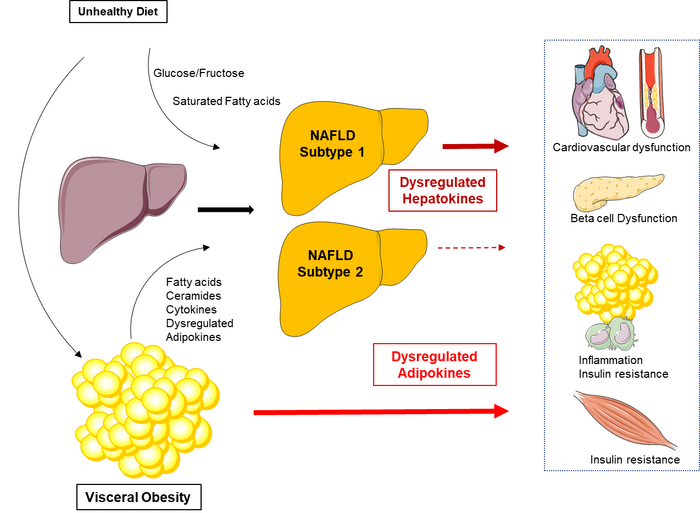
Non-alcoholic fatty liver disease (NAFLD) is an important risk factor for type 2 diabetes and cardiovascular diseases. In a Perspective in Cell Metabolism, Norbert Stefan from the University of Tübingen, Helmholtz Munich and the German Center for Diabetes Research, Morris F. White from the Harvard Medical School, and colleagues first highlight the dysregulation of hepatokines – proteins released from the liver – in people with NAFLD. Then, they discuss pathomechanisms of type 2 diabetes and cardiovascular diseases specifically related to NAFLD by focusing on hepatokine-related organ crosstalk. Finally, they propose how the determination of major hepatokines and adipokines (proteins released from fat) can be used for the identification of subtypes of people with NAFLD, to better implement precision medicine in clinical practice.
Credit: Copyright: Norbert Stefan
Non-alcoholic fatty liver disease (NAFLD) is an important risk factor for type 2 diabetes and cardiovascular diseases. In a Perspective in Cell Metabolism, Norbert Stefan from the University of Tübingen, Helmholtz Munich and the German Center for Diabetes Research, Morris F. White from the Harvard Medical School, and colleagues first highlight the dysregulation of hepatokines – proteins released from the liver – in people with NAFLD. Then, they discuss pathomechanisms of type 2 diabetes and cardiovascular diseases specifically related to NAFLD by focusing on hepatokine-related organ crosstalk. Finally, they propose how the determination of major hepatokines and adipokines (proteins released from fat) can be used for the identification of subtypes of people with NAFLD, to better implement precision medicine in clinical practice.
Worldwide more than 25% of adults and 3-10% of children have NAFLD. The percentage of NAFLD is much higher when obesity and/or diabetes is present in adults (60%) and in children (⁓40%). These numbers are alarming, because NAFLD, and more so non-alcoholic steatohepatitis, is the main cause of chronic liver disease and liver cancer. Furthermore, results from large studies reveal that NAFLD associates with ⁓2.5-fold increased risk of type 2 diabetes and ⁓1.5-fold increased risk of cardiovascular events. But what are the mechanisms by which the fatty liver impacts on the genesis of type 2 diabetes and cardiovascular diseases? Furthermore, how can the impact of fatty liver be separated from the impact of increased abdominal obesity, which is often found in people with fatty liver, on these diseases?
The researchers from Tübingen and Boston have been studying these questions since many years (also jointly, e.g. Norbert Stefan as Visiting Professor at the Harvard Medical School). They have identified important hepatokines that are dysregulated in NAFLD and have described their role in metabolism. ‘We found that the hepatokine fetuin-A is increasingly produced by the fatty liver and that it strongly predicts the incidence of type 2 diabetes and cardiovascular events. We also identified mechanisms of cellular action of fetuin-A to promote insulin resistance, subclinical inflammation and impairment of insulin secretion’, highlights Professor Norbert Stefan. Professor Morris White adds: ‘We identified another important hepatokine which is increasingly produced by the fatty liver – follistatin. We found mechanisms up-regulating the production of follistatin in the liver and identified the mechanisms by which follistatin increases glucose levels and insulin resistance. In large human cohorts we found that follistatin associates with an increased risk of type 2 diabetes’. In their present article the researchers describe the mechanisms of action of these hepatokines and summarize knowledge about other hepatokines that are being studied in the scientific community.
Finally, the researchers made use of a currently very popular research tool – cluster analysis, a data dimensionality reduction approach – to disentangle the close relationship between fatty liver and abdominal obesity and to identify subtypes of people with fatty liver. Clustering the parameters liver fat content, visceral fat mass, the hepatokine fetuin-A and the adipokine adiponectin, they identified 3 clusters. The clusters 1 and 3 had similar insulin resistance and elevated liver fat content but largely differed in the plasma levels of fetuin-A and adiponectin. The researchers concluded that they identified subtypes of people with fatty liver having different pathomechanisms of insulin resistance and that the research into hepatokines may be helpful to find other subtypes of fatty liver in the future.
The German Center for Diabetes Research (DZD) is one of six German Centers for Health Research. It brings together experts in the field of diabetes research and combines basic research, translational research, epidemiology and clinical applications. The aim is to develop novel strategies for personalized prevention and treatment of diabetes. Members are Helmholtz Munich – German Research Center for Environmental Health (Director: Professor Matthias Tschöp), the German Diabetes Center in Düsseldorf, the German Institute of Human Nutrition in Potsdam-Rehbrücke, the Paul Langerhans Institute Dresden of the Helmholtz Munich at the University Medical Center Carl Gustav Carus of the TU Dresden and the Institute for Diabetes Research and Metabolic Diseases of the Helmholtz Zentrum München at the Eberhard-Karls-University of Tuebingen (IDM; Director: Professor Andreas Birkenfeld) together with associated partners at the Universities in Heidelberg, Cologne, Leipzig, Lübeck and Munich.
Helmholtz Munich is a leading biomedical research center. Its mission is to develop breakthrough solutions for better health in a rapidly changing world. Interdisciplinary research teams focus on environmentally triggered diseases, especially the therapy and prevention of diabetes, obesity, allergies and chronic lung diseases. With the power of artificial intelligence and bioengineering, the researchers accelerate the translation to patients. Helmholtz Munich has more than 2,500 employees and is headquartered in Munich/Neuherberg. It is a member of the Helmholtz Association, with more than 43,000 employees and 18 research centers the largest scientific organization in Germany. More about Helmholtz Munich (Helmholtz Zentrum München Deutsches Forschungszentrum für Gesundheit und Umwelt GmbH): www.helmholtz-munich.de/en
Journal
Cell Metabolism
DOI
10.1016/j.cmet.2023.01.006