A laboratory study reports that a nitrogen-doped reduced graphene oxide–silver vanadate composite, designated NrGO–AVO, delivered a specific capacity of 178 mAh g−1 at a 1 C rate when used as the cathode in an aqueous zinc-ion battery. The NrGO–AVO//Zn cell also showed appreciable cycling stability over 500 cycles and reached a reported specific energy of 151 Wh kg−1 at a specific power of 195 W kg−1. These findings describe laboratory battery tests rather than commercial-cell performance, and the study summary does not establish readiness for deployment in full-scale energy-storage systems.
The composite was synthesized through a hydrothermal process and characterized using X-ray diffraction, Fourier transform infrared spectroscopy, Raman spectroscopy, field-emission scanning electron microscopy, thermogravimetric analysis and X-ray photoelectron spectroscopy. Its electrochemical behavior was assessed with cyclic voltammetry, galvanostatic charge–discharge measurements and electrochemical impedance spectroscopy. The researchers also used galvanostatic intermittent titration technique analysis to estimate the Zn²⁺ diffusion coefficient in NrGO–AVO and in pure AVO, allowing the composite’s ion-transport behavior to be compared with that of the unmodified material.
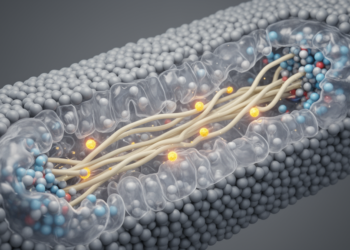
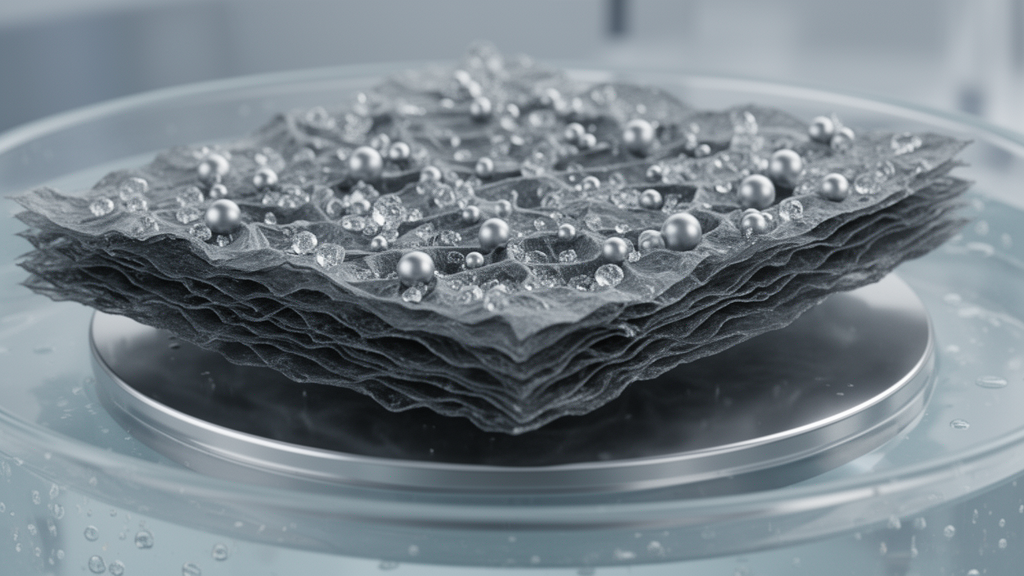
The central feature of the design was the incorporation of nitrogen-doped reduced graphene oxide into silver vanadate. The researchers attributed the composite’s improved overall performance to increased accessibility of active sites, which enhanced charge-transfer kinetics, and to more efficient electron transport during charge and discharge. These mechanisms were presented as the basis for the measured electrochemical improvements.
Intermittent-titration analysis indicated a higher Zn²⁺ diffusion coefficient for NrGO–AVO than for pure AVO under the tested conditions. The estimated value for the composite was of the order of 10−9 cm² s−1, whereas the value for pure AVO was of the order of 10−10 cm² s−1. This difference corresponds to favorable Zn²⁺-transport kinetics in the composite and is consistent with the broader electrochemical results.
The abstract does not provide the underlying numerical data, measurement conditions or uncertainty ranges for these estimates, so the size and reproducibility of the difference cannot be assessed in detail from the available evidence. Following cycling, the researchers performed a post-mortem study of the NrGO–AVO//Zn aqueous zinc-ion battery using X-ray diffraction, field-emission scanning electron microscopy and energy-dispersive X-ray analysis. The reported post-cycling results were interpreted as supporting the suitability of NrGO–AVO as a cathode material for aqueous zinc-ion batteries.
The abstract does not give detailed post-mortem measurements of structural changes, elemental redistribution or capacity loss, and it does not report performance beyond the stated 500-cycle stability assessment. Overall, the study presents a materials-level result: a nitrogen-doped graphene–silver vanadate cathode combining capacity, energy–power measurements, cycling stability and an estimated improvement in zinc-ion diffusion, while remaining a laboratory evaluation of a single battery architecture.
Subject of Research: Evaluation of an NrGO–silver vanadate cathode for aqueous zinc-ion batteries
Article Title: N-rGO anchored AgVO3 composite as cathode material for aqueous zinc-ion battery application
Article References: Louis, C., Shameela, P., Chandran, M., & Shafi, P. M. (2026). N-rGO anchored AgVO3 composite as cathode material for aqueous zinc-ion battery application. Ionics. https://doi.org/10.1007/s11581-026-07587-9
Image Credits: AI Generated
DOI: 10.1007/s11581-026-07587-9
Keywords: aqueous zinc-ion batteries, silver vanadate, nitrogen-doped reduced graphene oxide, cathode materials, zinc-ion diffusion, charge transfer, galvanostatic cycling, electrochemical energy storage, N-rGO, anchored, AgVO3, composite
News Source: Faith Mcneil. (October 22, 2026). N-rGO anchored AgVO3 composite as cathode material for aqueous zinc-ion battery application. Scienmag.