• HOME
  • NEWS
  • EXPLORE
    • CAREER
      • Companies
      • Jobs
    • EVENTS
    • iGEM
      • News
      • Team
    • PHOTOS
    • VIDEO
    • WIKI
  • BLOG
  • COMMUNITY
    • FACEBOOK
    • INSTAGRAM
    • TWITTER
Sunday, February 8, 2026
BIOENGINEER.ORG
No Result
View All Result
  • Login
  • HOME
  • NEWS
  • EXPLORE
    • CAREER
      • Companies
      • Jobs
        • Lecturer
        • PhD Studentship
        • Postdoc
        • Research Assistant
    • EVENTS
    • iGEM
      • News
      • Team
    • PHOTOS
    • VIDEO
    • WIKI
  • BLOG
  • COMMUNITY
    • FACEBOOK
    • INSTAGRAM
    • TWITTER
  • HOME
  • NEWS
  • EXPLORE
    • CAREER
      • Companies
      • Jobs
        • Lecturer
        • PhD Studentship
        • Postdoc
        • Research Assistant
    • EVENTS
    • iGEM
      • News
      • Team
    • PHOTOS
    • VIDEO
    • WIKI
  • BLOG
  • COMMUNITY
    • FACEBOOK
    • INSTAGRAM
    • TWITTER
No Result
View All Result
Bioengineer.org
No Result
View All Result
Home NEWS Science News Chemistry

N-doped porous carbon supported Fe single atom catalysts for highly efficient ORR

Bioengineer by Bioengineer
April 15, 2020
in Chemistry
Reading Time: 2 mins read
0
IMAGE
Share on FacebookShare on TwitterShare on LinkedinShare on RedditShare on Telegram

IMAGE

Credit: ©Science China Press

Noble metals (e.g., platinum) are often used as catalysts in the oxygen reduction reaction (ORR) of fuel cell cathodes. However, the drawbacks, such as the high cost, easy to be poisoned by CO, and poor stability, obviously limit their industrialization and application. Therefore, it is urgent to develop a new type of oxygen reduction catalysts to replace platinum.

Nitrogen-doped porous carbon supported single atom catalysts (SACs) have become one of the most promising alternatives to precious metal catalysts in ORR due to their unique geometric/electronic structures and outstanding performances, especially the Fe/Co SACs. However, most of them involve tedious pre- and/or post-treatments, especially derived from porphyrin-based materials, which would increase the operation difficulty, even mislead the relationship between structures and activities of the catalysts.

Therefore, the rational design of synthesis route, the achievement of the high efficiency in electrocatalytic reactions and the exploration of the catalytic mechanism and active sites, have become one of the research focus of SACs in fuel cells.

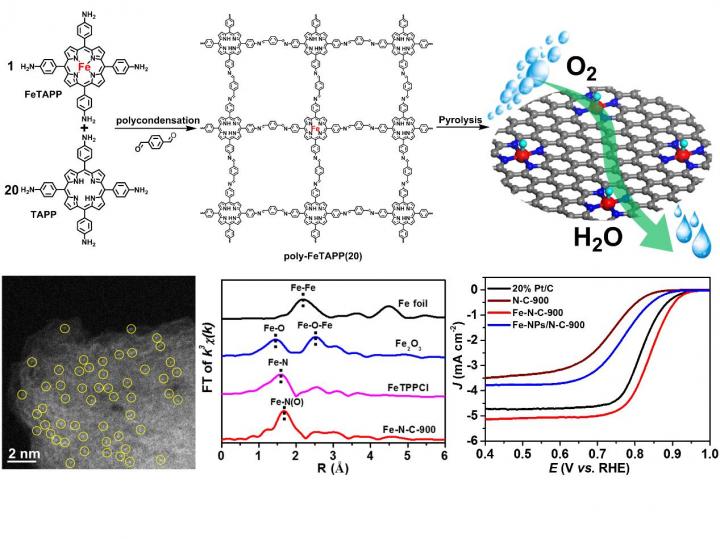
Very recently, the group of Professor Hongbing Ji and Dr. Xiaohui He in Fine Chemical Industry Research Institute of Sun Yat-sen University demonstrated a facile precursor-dilution strategy to prepare nitrogen-doped porous carbon supported Fe SACs through the Schiff-based reaction via co-polycondensation of amino-porphyrin materials, followed by pyrolysis at high temperature.

According to the aberration corrected high-angle annular dark-field scanning transmission electron microscopy and synchrotron radiation, which determined that the Fe atom was atomically dispersed in the support and forming a FeN4O-like structure. It is superior to commercial 20 wt% Pt/C in terms of ORR activities, stability, and methanol resistance in alkaline condition, and moderate ORR activities under the acidic condition.

The structure-activity relationship and catalytic mechanism of the catalyst was further verified by KSCN poisoning, CO poisoning and catalytic activity comparison with reference sample (pure carbon supports without metal loadings, iron nanoclusters, and iron nanoparticles), which confirmed that the active centers of electrocatalytic oxygen reduction were atomically dispersed Fe species.

###

This research was funded by the National Natural Science Foundation of China (Nos. 21938001, 21606260, 21576302, 21376278, 21425627, 21701199), the National Natural Science Foundation of China-SINOPEC Joint Fund (No. U1663220), the Local Innovative and Research Teams Project of Guangdong Pearl River Talents Program (2017BT01C102), the NSF of Guang-dong Province (2015A030313104), the Fundamental Re-search Funds for the Central Universities of Sun Yat-sen University (15lgjc33, 19lgpy129).

See the article: He Q, Meng Y, Zhang H, Zhang Y, Sun Q, Gan T, Xiao H, He X, Ji H. Amino-metalloporphyrin polymer derived Fe single atom catalysts for highly efficient oxygen reduction reaction. Sci. China Chem., 2019, DOI: 10.1007/s11426-019-9703-7.
https://link.springer.com/article/10.1007/s11426-019-9703-7
http://engine.scichina.com/publisher/scp/journal/SCC/doi/10.1007/s11426-019-9703-7?slug=fulltext

Media Contact
Ji Hongbing
[email protected]

Related Journal Article

http://dx.doi.org/10.1007/s11426-019-9703-7

Tags: Chemistry/Physics/Materials Sciences
Share12Tweet8Share2ShareShareShare2

Related Posts

blank

Breakthrough in Environmental Cleanup: Scientists Develop Solar-Activated Biochar for Faster Remediation

February 7, 2026
blank

Cutting Costs: Making Hydrogen Fuel Cells More Affordable

February 6, 2026

Scientists Develop Hand-Held “Levitating” Time Crystals

February 6, 2026

Observing a Key Green-Energy Catalyst Dissolve Atom by Atom

February 6, 2026
Please login to join discussion

POPULAR NEWS

  • Robotic Ureteral Reconstruction: A Novel Approach

    Robotic Ureteral Reconstruction: A Novel Approach

    82 shares
    Share 33 Tweet 21
  • Digital Privacy: Health Data Control in Incarceration

    63 shares
    Share 25 Tweet 16
  • Breakthrough in RNA Research Accelerates Medical Innovations Timeline

    53 shares
    Share 21 Tweet 13
  • Mapping Tertiary Lymphoid Structures for Kidney Cancer Biomarkers

    50 shares
    Share 20 Tweet 13

About

We bring you the latest biotechnology news from best research centers and universities around the world. Check our website.

Follow us

Recent News

Barriers and Facilitators to Smoking Cessation for HIV+ Men

Community Involvement Eases Depression in China’s Empty Nesters

Group Therapy Boosts Recovery in Elderly Depression

Subscribe to Blog via Email

Enter your email address to subscribe to this blog and receive notifications of new posts by email.

Join 74 other subscribers
  • Contact Us

Bioengineer.org © Copyright 2023 All Rights Reserved.

Welcome Back!

Login to your account below

Forgotten Password?

Retrieve your password

Please enter your username or email address to reset your password.

Log In
No Result
View All Result
  • Homepages
    • Home Page 1
    • Home Page 2
  • News
  • National
  • Business
  • Health
  • Lifestyle
  • Science

Bioengineer.org © Copyright 2023 All Rights Reserved.