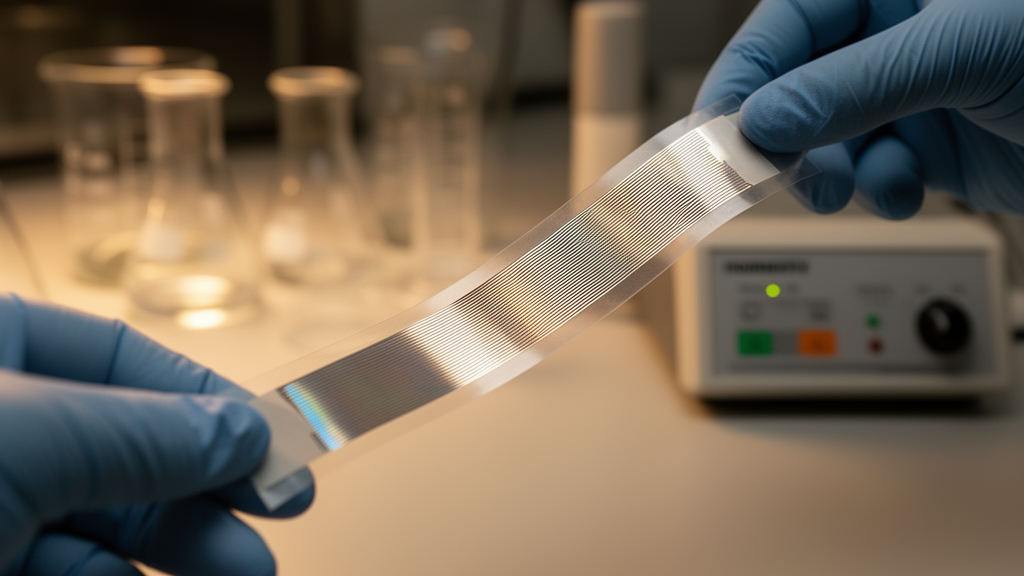
Researchers have developed a flexible, metal-free humidity sensor that combines lithographically patterned electrodes made of two-dimensional Ti3C2Tx MXene nanosheets with an ultrathin active layer of 2D anatase TiO2 nanosheets, all built on a cyclic olefin copolymer substrate. The device, described in Advanced Composites and Hybrid Materials, delivers a highly linear and reversible impedance and capacitance response across a broad humidity range of 6 to 86 percent relative humidity.
The sensor’s performance figures are striking. It achieves a sensitivity of 4.41 × 10^5 ohms per percent relative humidity at a measurement frequency of 1 kilohertz, with low hysteresis and minimal change in output over 24 hours. The team reports fast, repeatable response and recovery characteristics, which they attribute to the rapid transport of protons through the water adsorbed on the sensing layer.
Each material in the stack plays a defined role. The solution-processed MXene interdigital electrodes provide high electrical conductivity, mechanical robustness and scalable patterning, replacing conventional metal electrodes and keeping the entire device free of metallic components. The TiO2 nanosheet film forms a continuous, hydroxyl-rich and chemically robust surface network that supports reversible water adsorption, the key step in humidity detection.
To understand why the device performs so well, the researchers turned to computational modelling. According to the authors, these theoretical insights agree closely with the experimentally observed fast and repeatable response and recovery behaviour, providing a mechanistic explanation of the sensor’s high performance.
The choice of substrate matters as much as the materials themselves. Because the sensor is built on a flexible cyclic olefin copolymer film and uses an all-two-dimensional-materials architecture, it can bend and flex without losing function, making it suitable for wearable applications.
Linearity has long been a pain point in resistive and impedance-type humidity sensing, where poor linearity limits rapid and precise detection. The reported sensor addresses this directly, maintaining a linear impedance response across its operating range, which the authors identify as vital for next-generation wearable electronics and environmental monitoring.
The work also points to a broader design strategy. By coupling patterned MXene electrodes with an engineered two-dimensional sensing layer, the researchers demonstrate a scalable route to metal-free, flexible humidity sensors.
The study is published as open access, with the version shared early to provide faster access to peer-reviewed, accepted research; it carries a permanent DOI and is subject to further edits before the final version of record appears. For researchers working on wearable and intelligent sensing systems, the reported sensor offers a promising platform: a fully two-dimensional, flexible, metal-free device whose measured sensitivity, linearity and fast response are backed by both experimental characterisation and supporting simulations.
Subject of Research: A flexible metal-free humidity sensor using patterned Ti3C2Tx MXene interdigital electrodes and a 2D TiO2 nanosheet sensing layer on a COC substrate
Article Title: 2D Ti3C2Tx-MXene-patterned electrode enables highly sensitive humidity sensing
Article References: Anwer, S., Khan, M. U., Agha, A., Hussain, A., Sajjad, M., Alazzam, A., & Mohammad, B. (2026). 2D Ti3C2Tx-MXene-patterned electrode enables highly sensitive humidity sensing. Advanced Composites and Hybrid Materials. https://doi.org/10.1007/s42114-026-02136-4
Image Credits: AI Generated
DOI: 10.1007/s42114-026-02136-4
Keywords: MXene, Ti3C2Tx, humidity sensor, TiO2 nanosheets, interdigital electrodes, flexible electronics, wearable sensors, impedance sensing, proton transport, DFT calculations, COC substrate, physiological monitoring
News Source: Denise Maddox. (October 28, 2026). MXene-patterned electrode drives highly sensitive flexible humidity sensor. Scienmag.