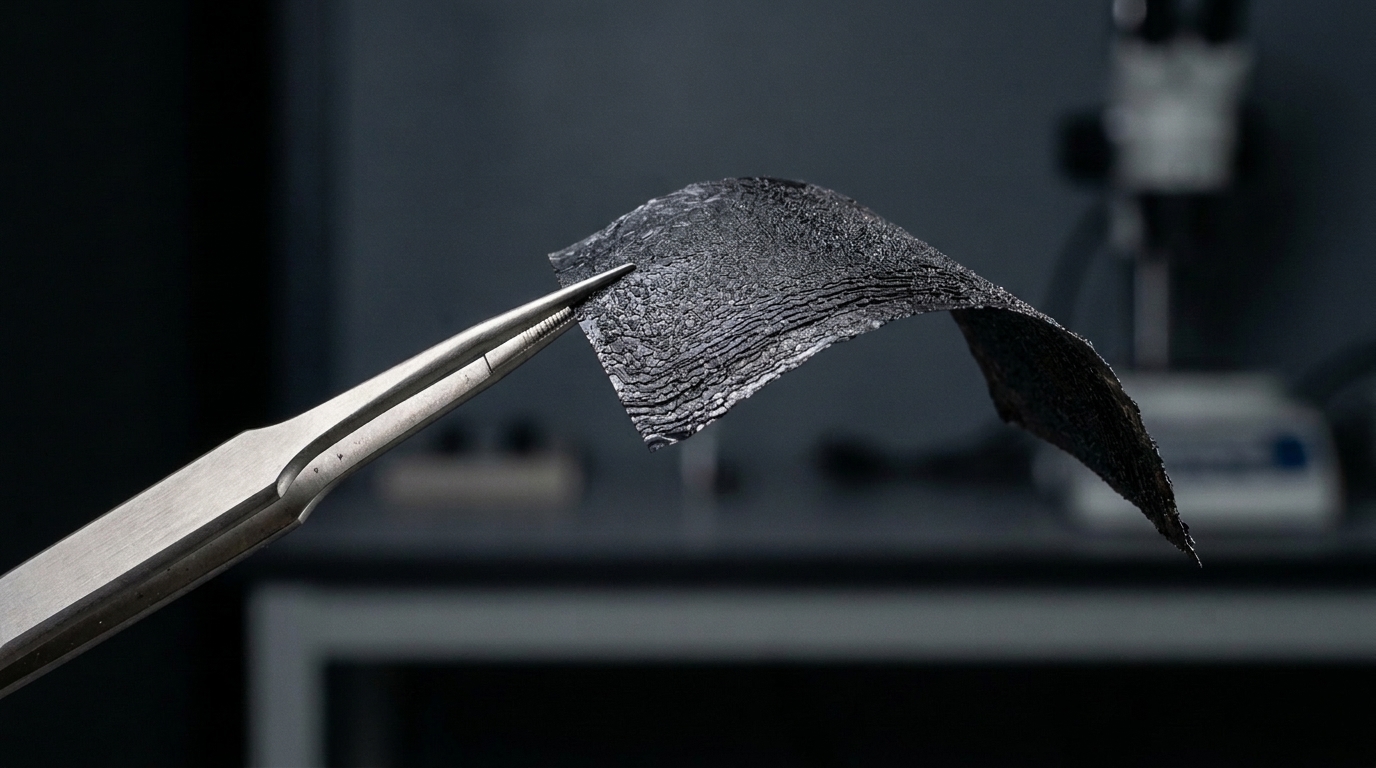
In a three-electrode laboratory evaluation conducted in an aqueous electrolyte of three-molar potassium hydroxide, a synthesized delaminated titanium carbide MXene and cobalt oxide nanocomposite achieved an electrochemical specific capacitance of 871.04 farads per gram at a potential sweep rate of 75 millivolts per second across an operational window between 0.0 and 0.5 volts against a saturated calomel reference electrode. Fabricated by combining equal ten-milligram portions of exfoliated two-dimensional titanium carbide sheets with cubic spinel cobalt oxide nanoparticles, the resulting hybrid material demonstrated marked improvements over both isolated components tested under identical conditions. Pristine delaminated titanium carbide exhibited an initial capacitance of only 28.65 farads per gram, whereas bare cobalt oxide reached 212.79 farads per gram at the same sweep rate. This composite architecture pairs the metallic conductivity and rapid ion-transport channels of layered carbide nanosheets with the faradaic redox transitions of cobalt oxide, directly addressing the low energy density that restricts conventional electrochemical capacitors.
Developing advanced electrode materials to resolve the persistent trade-off between power delivery and energy storage capacity represents a critical priority in contemporary electrochemical research. While supercapacitors provide rapid charge-discharge capabilities alongside high power densities and robust cycling longevity compared with standard chemical batteries, their practical utility remains constrained by limited energy density. Prior investigations identified two-dimensional transition metal carbides alongside transition metal oxides as promising candidates to bridge this gap. For instance, earlier studies cited in the paper highlighted cobalt-decorated MXene systems synthesized through hydrothermal processing that achieved 732.5 farads per gram at one ampere per gram with approximately 83 percent capacitance retention across 5000 cycles. Another cited composite incorporating hollow carbon nanofibers, MXene, and textured cobalt oxide delivered 374.4 farads per gram at 0.5 amperes per gram with 88.5 percent retention over 5000 cycles, while ice-bath-assisted sonication applied to parent titanium carbide increased areal capacitance by 61.3 percent to 91.8 millifarads per square centimeter and enhanced energy density 4.2-fold.
Preparation of the delaminated titanium carbide phase began with the synthesis of the ternary MAX precursor through mechanical ball milling of titanium hydride, graphite, and elemental aluminum powders in a 3:2:1.5 molar proportion using toluene as the milling fluid for two hours. Following drying, the consolidated powder was pelletized and sintered at 1350 degrees Celsius for five hours inside an argon atmosphere at a heating rate of 10 degrees Celsius per minute before being pulverized and re-milled for twenty-four hours to produce fine Ti3AlC2 powder. To selectively remove aluminum atomic layers, one gram of this powder was immersed in ten milliliters of forty percent hydrofluoric acid under continuous stirring for forty hours. The etched sediment was washed and centrifuged using double-distilled water and ethanol until reaching a neutral pH, followed by drying at 50 degrees Celsius for ten hours. Subsequent delamination was completed by dispersing half a gram of exfoliated material into dimethyl sulfoxide and sonicating for twenty hours, yielding few-layer titanium carbide nanosheets.
Nanoscale cobalt oxide particles were concurrently produced through a sol-gel auto-combustion procedure to ensure high structural purity and homogeneous crystallization. Cobalt nitrate hexahydrate was dissolved in double-distilled water under magnetic stirring, followed by the addition of citric acid monohydrate acting as a chelating agent and combustion fuel in an exact 1:1 molar ratio with the dissolved metal nitrate. The aqueous mixture was heated between 80 and 90 degrees Celsius to induce gelation, whereupon further heating initiated self-propagating combustion that converted the xerogel into precursor powder that was subsequently calcined at elevated temperatures to yield phase-pure cubic spinel cobalt oxide. To construct the final hybrid material, equal ten-milligram quantities of delaminated titanium carbide and synthesized cobalt oxide were dispersed into fifty milliliters of chloroform under continuous stirring to ensure uniform mixing. After complete solvent evaporation, the composite powder underwent thermal annealing at 70 degrees Celsius before working electrode fabrication using the doctor blade technique.
Working electrodes were fabricated on commercial nickel foam substrates that underwent surface cleaning to eliminate residual surface impurities. The metal substrates were ultrasonically cleaned in dilute hydrochloric acid solution prepared with double-distilled water at 30 degrees Celsius for thirty minutes, followed by thorough rinsing and drying. The electrode slurry was compounded by manually grinding the annealed hybrid nanocomposite, a polyvinylidene fluoride binder, and an activated carbon conductive additive in an 8:1:1 weight proportion inside a mortar with a pestle. Adding a small volume of N-methyl-2-pyrrolidone solvent produced a homogeneous slurry that was uniformly coated onto the nickel foam using the doctor blade technique. Electrochemical evaluations were executed utilizing an Ivium Vertex potentiostat operating within a standard three-electrode cell configuration containing three-molar potassium hydroxide aqueous electrolyte. The coated nickel foam served as the working electrode, a platinum wire functioned as the counter electrode, and a saturated calomel electrode served as the calibrated reference standard across a potential range from 0.0 to 0.5 volts.
Crystalline structures and phase purities of the synthesized materials were validated through powder X-ray diffraction utilizing copper K-alpha radiation with a wavelength of 1.5406 angstroms alongside Fourier transform infrared spectroscopy. Diffraction patterns confirmed the conversion of crystalline Ti3AlC2 into delaminated MXene, where the intense (104) plane reflection from aluminum layers disappeared after hydrofluoric acid etching while the (002) reflection shifted toward smaller angles with broadened profile. Applying the Scherrer formula revealed that crystallite dimensions decreased from 40.77 nanometers in the parent MAX precursor to 10.68 nanometers in exfoliated MXene, whereas synthesized cobalt oxide nanoparticles exhibited an average crystallite size of 24.33 nanometers. Diffractograms of cobalt oxide displayed peaks matching cubic spinel planes (220), (311), (400), (422), (511), and (440) corresponding to standard JCPDS card 42-1467. Infrared spectra confirmed MXene surface terminations with bands at 3402, 1652, 1121, 924, 654, and 584 reciprocal centimeters, while cobalt oxide displayed characteristic tetrahedral and octahedral metal-oxygen vibrations at 660 and 560 reciprocal centimeters.
Optical absorption profiles recorded by ultraviolet-visible spectroscopy revealed distinct differences in the electronic structures of the constituent materials, yielding optical band gap values of 2.20 electron volts for delaminated titanium carbide and 1.86 electron volts for cobalt oxide nanoparticles. Transmission electron microscopy and energy-dispersive X-ray spectroscopy tracked the structural transformation from dense, irregular Ti3AlC2 precursor particles containing titanium, aluminum, and carbon into thin, separated MXene nanosheets functionalized with oxygen and fluorine surface terminations. Micrographs of synthesized cobalt oxide revealed uniform, rod-like nanoparticles with measured dimensions of 53.0 nanometers, 14.7 nanometers, and 11.7 nanometers composed of cobalt and oxygen without detectable impurities. Field-emission scanning electron microscopy further illustrated the structural integration of the composite, showing synthetic titanium carbide sheets exhibiting characteristic accordion-like layered stacks with particle dimensions near 10 micrometers. In the hybrid architecture, granular clusters of cobalt oxide nanoparticles were uniformly dispersed across the planar surfaces and interlayer spaces of the conductive carbide sheets, creating abundant electroactive sites and facilitating electrolyte penetration.
Cyclic voltammetry recorded across sweep rates ranging from 75 to 250 millivolts per second illustrated distinct charge storage mechanisms governing the individual constituents and their composite assembly. Delaminated titanium carbide exhibited quasi-rectangular voltammetric loops characteristic of electric double-layer capacitance, generating specific capacitances that declined from 28.65368 farads per gram at 75 millivolts per second to 23.12359 at 100, 21.17097 at 150, 19.40004 at 200, and 17.84325 farads per gram at 250 millivolts per second. In comparison, cobalt oxide electrodes produced pronounced redox peaks arising from reversible divalent and trivalent cobalt transitions, recording 212.7898 farads per gram at 75 millivolts per second, which attenuated to 179.2364 at 100, 162.9953 at 150, 141.3682 at 200, and 121.3262 farads per gram at 250 millivolts per second due to diffusion limitations. Combining the two materials yielded expanded hybrid voltammetric curves and superior specific capacitances across all tested rates: 871.0443 farads per gram at 75 millivolts per second, 692.9505 at 100, 539.1708 at 150, 432.1879 at 200, and 363.8601 farads per gram at 250 millivolts per second.
Galvanostatic charge-discharge measurements conducted at current densities of 17, 23, and 30 amperes per gram corroborated the kinetic responsiveness and charge storage capacity of the composite architecture. At an operational current density of 17 amperes per gram, the hybrid electrode achieved a specific capacitance of 300.05 farads per gram along with an energy density of 6.67 watt-hours per kilogram at a power density of 34 kilowatts per kilogram. Under identical operating parameters, pristine titanium carbide delivered 62.475 farads per gram with an energy density of 1.39 watt-hours per kilogram, while bare cobalt oxide delivered 71.825 farads per gram and an energy density of 1.60 watt-hours per kilogram. When the current density was increased to 23 amperes per gram, the composite maintained a capacitance of 205.85 farads per gram, an energy density of 4.57 watt-hours per kilogram, and a power density of 46 kilowatts per kilogram. At the maximum evaluated current density of 30 amperes per gram, the composite registered 151.5 farads per gram and 3.37 watt-hours per kilogram while sustaining 60 kilowatts per kilogram of power delivery.
Electrochemical impedance spectroscopy conducted across a frequency span from 0.1 hertz to 100 kilohertz at open-circuit potential with a five-millivolt perturbation clarified internal charge-transfer and diffusion dynamics. Fitting the experimental Nyquist data with a Voigt-type equivalent circuit consisting of an uncompensated solution resistance and three parallel resistance-capacitance loops yielded a low chi-square value of 0.0124 and confirmed a small solution resistance of 1.09 ohms. The depressed high-frequency semicircle reflected interfacial double-layer capacitive phenomena and faradaic charge transfer, while the steep low-frequency slope demonstrated rapid ion diffusion into the porous electrode matrix without requiring an independent Warburg diffusion impedance element. While these three-electrode measurements in basic aqueous electrolyte demonstrate clear interfacial synergy between the conductive carbide network and redox-active metal oxide clusters, practical deployment in full device cells must continue to address known operational vulnerabilities of two-dimensional carbides, including nanosheet restacking and oxidative degradation under sustained environmental exposure.
Subject of Research: Electrochemical performance of delaminated titanium carbide MXene and cobalt oxide composite supercapacitor electrodes
Article Title: Synergistic Ti₃C₂Tₓ MXene@Co₃O₄ nanocomposite for efficient energy storage devices
Article References: Anarse, D. A., Sunatkari, A. L., Kadam, M. B., Jagadale, S. K., Mehere, A. C., & Sunatkari, S. A. (2026). Synergistic Ti₃C₂Tₓ MXene@Co₃O₄ nanocomposite for efficient energy storage devices. Results in Chemistry, 32, Article 104101. https://doi.org/10.1016/j.rechem.2026.104101
Image Credits: AI Generated
DOI: 10.1016/j.rechem.2026.104101
Keywords: supercapacitors, energy storage, Ti3C2Tx MXene, cobalt oxide, nanocomposites, pseudocapacitance, specific capacitance, cyclic voltammetry, galvanostatic charge-discharge, electrochemical impedance spectroscopy, potassium hydroxide electrolyte, sol-gel combustion, hydrofluoric acid etching, energy density, power density, crystallite size, X-ray diffraction, transition metal oxides
News Source: Bethany Barker. (November 27, 2026). MXene and Cobalt Oxide Composite Electrode Achieves 871 Farads per Gram. Scienmag.