• HOME
  • NEWS
  • EXPLORE
    • CAREER
      • Companies
      • Jobs
    • EVENTS
    • iGEM
      • News
      • Team
    • PHOTOS
    • VIDEO
    • WIKI
  • BLOG
  • COMMUNITY
    • FACEBOOK
    • INSTAGRAM
    • TWITTER
Sunday, August 16, 2026
BIOENGINEER.ORG
No Result
View All Result
  • Login
  • HOME
  • NEWS
  • EXPLORE
    • CAREER
      • Companies
      • Jobs
        • Lecturer
        • PhD Studentship
        • Postdoc
        • Research Assistant
    • EVENTS
    • iGEM
      • News
      • Team
    • PHOTOS
    • VIDEO
    • WIKI
  • BLOG
  • COMMUNITY
    • FACEBOOK
    • INSTAGRAM
    • TWITTER
  • HOME
  • NEWS
  • EXPLORE
    • CAREER
      • Companies
      • Jobs
        • Lecturer
        • PhD Studentship
        • Postdoc
        • Research Assistant
    • EVENTS
    • iGEM
      • News
      • Team
    • PHOTOS
    • VIDEO
    • WIKI
  • BLOG
  • COMMUNITY
    • FACEBOOK
    • INSTAGRAM
    • TWITTER
No Result
View All Result
Bioengineer.org
No Result
View All Result
Home NEWS Science News Health

Musical perception: nature or nurture?

Bioengineer by Bioengineer
October 10, 2019
in Health
Reading Time: 2 mins read
0
IMAGE
Share on FacebookShare on TwitterShare on LinkedinShare on RedditShare on Telegram

This is the subject of the research by Juan Manuel Toro (ICREA) and Carlota Pagès Portabella, researchers at the Center for Brain and Cognition, published in the journal Psychophysiology as part of a H2020 project
IMAGE

Credit: Juan M. Toro (UPF)


From a general perspective, harmony in music is the balance of the proportions between the different parts of a whole, which causes a feeling of pleasure. “When we listen to music, each sound we hear helps us to imagine what is coming next. It what we expect is fulfilled, we feel satisfied. But if not, we may be pleasantly surprised or upset”, comments Carlota Pagès Portabella, a researcher with the Language and Comparative Cognition research group (LCC) at the Center for Brain and Cognition (CBC).

A study by Joan M. Toro, director of the LCC and ICREA research professor at the Department of Information and Communication Technologies (DTIC) at UPF and Carlota Pagès Portabella, published in the journal Psychophysiology, studies human musical perception comparing how the brain reacts when the musical sequences perceived do not finish as might be expected. The study is part of a H2020 international European project which the CBC is conducting the with Fundació Bial to understand the bases of musical cognition.

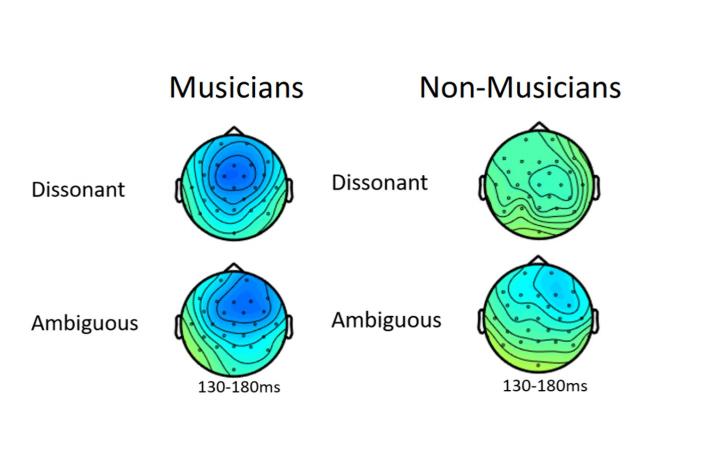
The results of the study have shown that although the perception of music is universal, training in music alters its perception. To reach this conclusion, the researchers used encephalographic registers to record what happened in the brains of 28 people, with and without musical training, when they listened to melodies with various unexpected endings.

A specific response to any irregularity

First, the researchers showed that regardless of the subjects’ musical training, in the event of any irregularity in musical sequences the brain produces a specific response known as early right anterior negativity (ERAN).

Furthermore, the authors observed that people with no musical training do not distinguish between a simply unexpected and a musically unacceptable ending. Nevertheless, when the musically trained participants heard an utterly unacceptable ending with regard to harmony, their brain underwent a stronger response than when they were presented with simply unexpected endings.

These results show that while the perception of music is a relatively universal experience, musical training alters how humans perceive music. The brains of musicians distinguish between different types of musical irregularities that untrained listeners do not differentiate.

###

Media Contact
UPF
[email protected]

Original Source

https://www.upf.edu/web/e-noticies/home/-/asset_publisher/wEpPxsVRD6Vt/content/id/228941091/maximized#.XZ7gIUYzbcs

Related Journal Article

http://dx.doi.org/10.1111/psyp.13476

Tags: BiochemistryBiologyMemory/Cognitive ProcessesNeurochemistry
Share12Tweet8Share2ShareShareShare2

Related Posts

PARP1 Drives Neuropathic Pain Through GPX4-Dependent Ferroptosis in Injured Mice’s Sensory Neurons

August 15, 2026

Genome-wide skin pQTL map reveals genetic regulators and mechanisms underlying skin disorders

August 15, 2026

Levistilide A Drives Ferroptosis via RNF40-HSP90α Axis, Suppressing Colorectal Cancer Lung Metastasis

August 15, 2026

Sintilimab, IBI305, and Chemotherapy Show Promise in First-Line Advanced Gastric and GEJ Adenocarcinoma

August 15, 2026
Please login to join discussion

POPULAR NEWS

  • KAIST develops semiconductor neuron that harnesses noise to selectively process signals

    29 shares
    Share 12 Tweet 7
  • Imagining natural and extra robotic thumbs together strengthens kinesthetic sensorimotor networks

    29 shares
    Share 12 Tweet 7
  • PARP1 Drives Neuropathic Pain Through GPX4-Dependent Ferroptosis in Injured Mice’s Sensory Neurons

    29 shares
    Share 12 Tweet 7
  • Strubbelig–NHL3 Receptor Complex Helps Arabidopsis Respond to Cellulose Deficiency

    29 shares
    Share 12 Tweet 7

About

We bring you the latest biotechnology news from best research centers and universities around the world. Check our website.

Follow us

Recent News

KAIST develops semiconductor neuron that harnesses noise to selectively process signals

Imagining natural and extra robotic thumbs together strengthens kinesthetic sensorimotor networks

PARP1 Drives Neuropathic Pain Through GPX4-Dependent Ferroptosis in Injured Mice’s Sensory Neurons

Subscribe to Blog via Email

Success! An email was just sent to confirm your subscription. Please find the email now and click 'Confirm' to start subscribing.

Join 85 other subscribers
  • Contact Us

Bioengineer.org © Copyright 2023 All Rights Reserved.

Welcome Back!

Login to your account below

Forgotten Password?

Retrieve your password

Please enter your username or email address to reset your password.

Log In
No Result
View All Result
  • Homepages
    • Home Page 1
    • Home Page 2
  • News
  • National
  • Business
  • Health
  • Lifestyle
  • Science

Bioengineer.org © Copyright 2023 All Rights Reserved.