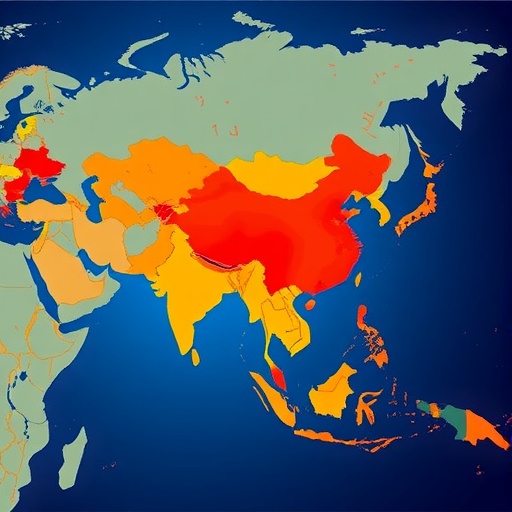
Musculoskeletal disorders now constitute one of the largest and most expensive health challenges on the planet, and a sweeping new analysis shows that Asia bears more than half of the weight. Drawing on the latest Global Burden of Disease Study 2023 (GBD 2023), a research team led by Yuming Yao and Yusheng Li of Central South University has produced the first comprehensive assessment of musculoskeletal (MSK) burden across all 47 Asian countries and territories, combining epidemiological trends, risk-factor attribution, and—for the first time—model-based estimates of direct economic costs. The findings, published in iScience, reveal that in 2023 alone, roughly 203 million people in Asia developed a new musculoskeletal condition and nearly 1 billion were living with one, figures that together account for about 55 to 58 percent of the global totals.
The scale of the problem is difficult to overstate. Worldwide, GBD 2023 estimates 372 million incident cases and 1.72 billion prevalent cases of MSK disorders in 2023, generating 161 million years lived with disability (YLDs), the standard metric for quantifying non-fatal health loss. Asia’s share—999 million prevalent cases and 91.6 million YLDs—translates into age-standardized rates that closely mirror global averages: an age-standardized incidence rate of 4,091.62 per 100,000 population, an age-standardized prevalence rate of 19,856 per 100,000, and an age-standardized YLDs rate of 1,828.1 per 100,000. But while age-standardized incidence in Asia actually declined slightly between 1990 and 2023, falling 8.4 percent, the absolute numbers tell a very different story. Incident cases rose 83.1 percent, prevalent cases 118 percent, and YLDs 106.3 percent over the 33-year period—growth rates that all exceeded the corresponding global increases. The divergence reflects a demographic engine that is running at full throttle: rapid population growth in South Asia and profound population aging in East Asia are multiplying case counts even as age-adjusted rates hold steady or drift downward.
The analysis disentangles six GBD-defined categories of MSK disorders: rheumatoid arthritis, osteoarthritis (OA), low back pain (LBP), neck pain, gout, and a residual group of other MSK conditions that includes systemic lupus erythematosus and axial spondyloarthritis. Each dominates a different corner of the burden landscape. Low back pain generated the most new cases in Asia in 2023—142 million—while osteoarthritis topped the prevalence ranking with 369 million existing cases. Disability burden was split between low back pain (36.87 million YLDs) and other MSK disorders (27.52 million YLDs), with osteoarthritis contributing a further 12.94 million. These distinct dominance patterns carry direct implications for health-system planning: LBP’s grip on incidence signals demand for acute primary care, early physiotherapy and recurrence prevention, whereas OA’s dominance in prevalence and its outsized economic footprint call for long-term pain management, weight-control programs and, in advanced disease, joint replacement surgery.
Perhaps the most striking epidemiological detail is the age at which low back pain strikes. Among Asian adolescents aged 10 to 14, LBP accounted for 87.5 percent of all MSK incident cases—the highest proportion of any age group. The authors link this to the region’s intense academic pressures and prolonged sedentary time in schools, where adjustable furniture and backpack-weight limits are rarely implemented. Overall, MSK disorders affected every age group except children under five, with incident cases, prevalent cases and YLDs peaking in the 50-to-59 age bracket for both sexes. Rates themselves rose with age, peaked at 75 to 84 years, and then declined—with one telling exception. Gout, unlike every other MSK category, showed incidence, prevalence and YLDs that climbed continuously with age, with no late-life plateau.
Sex differences were equally pronounced. For all MSK disorders except gout, the burden was higher in women than in men, a pattern the researchers attribute to hormonal factors such as post-menopausal bone loss, the higher prevalence of rheumatoid arthritis and osteoarthritis among women, and the concentration of female workers in labor-intensive agricultural and garment-sector jobs across lower-income Asian countries. Georgia recorded the highest female-to-male ratios for prevalent cases (1.88) and YLDs (1.98), while India showed the largest gender gap in incident cases, also at 1.88. Conversely, in several Gulf states—the United Arab Emirates, Qatar, Bahrain, Oman, Saudi Arabia and Kuwait—and the Maldives, the ratios dipped below 1, meaning men carried a somewhat heavier burden.
Geographically, the continent is far from uniform. East Asia carried the largest absolute burden, followed by South Asia, Southeast Asia, Western Asia and Central Asia. Yet when rates were age-standardized, the ordering inverted: Western Asia recorded the highest incidence (9,745.3 per 100,000), prevalence (40,426.62 per 100,000) and YLDs rates (3,873.61 per 100,000), while East Asia posted the lowest. At the country level, China, India, Indonesia and Japan bore the heaviest absolute caseloads, while Japan (5,741.99 per 100,000), Iran and Israel reported the highest age-standardized incidence rates. Temporal trajectories diverged sharply as well: Qatar’s incident cases in 2023 were 7.82 times its 1990 figure, and the United Arab Emirates saw prevalent cases explode by 924.4 percent, while Georgia was the lone country recording declines across the board. Israel stood out as the only nation with a negative estimated annual percentage change in age-standardized prevalence.
The study also probes why. Using the population-attributable fraction method, the team quantified how much disability could theoretically be prevented by reducing exposure to four modifiable risk factors: occupational ergonomic stressors, smoking, high body mass index (BMI) and kidney dysfunction. High BMI emerged as the fastest-growing threat, with BMI-attributable YLDs rising in all 47 countries—up 301 percent in India, 190 percent in Vietnam and 148 percent in Timor-Leste since 1990. Kuwait recorded the highest current proportion of BMI-attributable burden at 15.95 percent of MSK YLDs. Occupational ergonomic factors dominated in Central and Southeast Asia, peaking in Georgia (10.77 percent), while smoking’s contribution was concentrated in East and West Asia, led by Lebanon at 9.48 percent. Kidney dysfunction, though the smallest contributor overall (0.19 percent globally), was most prominent in Malaysia. The researchers suggest the BMI trajectory in developing Asia parallels the obesity epidemics that swept Latin America in the 1990s and 2000s, driven by nutrition transition and urbanization.
The economic dimension of the analysis is its most novel contribution. Because GBD does not directly report healthcare spending, the team extrapolated from United States per-patient expenditure data for 2019, adjusting for each country’s total health spending relative to that of the US and expressing results in inflation-adjusted dollars. The resulting model estimates global direct medical costs of MSK disorders at roughly $751.2 billion in 2023, of which Asia accounted for $419.6 billion—about 0.55 percent of regional GDP and 55.9 percent of the global total. Osteoarthritis was the costliest single condition in Asia at approximately $88.8 billion, ahead of low back pain ($66.2 billion), neck pain ($49.0 billion) and rheumatoid arthritis ($29.7 billion), with gout cheapest at $2.5 billion. East Asia shouldered $342.4 billion of the regional total, led by China at $320.98 billion, while Bhutan, Timor-Leste and Brunei combined for a mere $96,000 under the model. The authors caution that lower labor costs, lower uptake of expensive procedures and drug-price differences in low- and middle-income countries mean their Asia figure is likely an upper bound. Still, the chronic nature of OA and the price of joint replacement in aging societies such as China and Japan explain why the condition, though less incident than back pain, dominates the ledger—and why early conservative management could yield substantial savings.
Correlation analysis with the socio-demographic index (SDI), a composite measure of income, education and fertility, added another layer of nuance. Osteoarthritis rates correlated strongly and positively with SDI (Spearman coefficients of 0.74 to 0.77), reflecting the aging affluence of high-income societies, while total MSK rates showed only weak-to-moderate associations. The authors translate these gradients into differentiated policy prescriptions: high-SDI settings such as Japan and China should prioritize tertiary orthopedic capacity, joint replacement access and geriatric care including fall prevention, whereas low-SDI settings in South and Southeast Asia should focus on primary prevention—community weight-loss programs, workplace ergonomics in manufacturing and agriculture, and school-based posture education. Specific proposals include adjustable desks and backpack-weight limits for Asian schools, early OA management pathways in aging nations, and obesity strategies featuring tools such as sugar-sweetened beverage taxes in high-burden countries like Kuwait and India.
The team is candid about limitations. Data completeness varies across the continent, particularly in Central and South Asia; the GBD framework lacks quality-of-life data beyond YLDs; evolving diagnostic technologies and coding practices over 33 years may compromise comparability; and as a secondary descriptive analysis, the study identifies associations rather than causal mechanisms. The economic figures, built on a macro-level extrapolation, are order-of-magnitude estimates rather than precise accounting. Even so, the study marks a milestone: the first to integrate disease burden, risk attribution and modeled economic cost across the whole of Asia using GBD 2023 data, at a moment when low back pain has climbed into the top ten causes of global disability. With a billion Asians already living with musculoskeletal disease and obesity rising across the developing half of the continent, the authors argue that the window for affordable prevention is narrowing. What happens in Asian classrooms, workplaces and clinics over the coming decade will shape the disability profile of more than half of humanity.
Subject of Research: The global and Asian regional burden of musculoskeletal disorders from 1990 to 2023, including disease distribution, temporal trends, risk-factor attribution and direct economic costs across 47 Asian countries and territories, analyzed using GBD 2023 data.
Subject of Research: Technology and Engineering
Article Title: Global and Asian regional burden of musculoskeletal disorders from 1990 to 2023
Article References: Yao, Y., Xie, W., Arthur Vithran, D. T., Yang, G., Zhong, D., & Li, Y. (2026). Global and Asian regional burden of musculoskeletal disorders from 1990 to 2023. iScience, 29(9), Article 117456. https://doi.org/10.1016/j.isci.2026.117456
Image Credits: AI Generated
DOI: 10.1016/j.isci.2026.117456
Keywords: musculoskeletal disorders, Global Burden of Disease 2023, low back pain, osteoarthritis, years lived with disability, high body mass index, Asia, economic burden, age-standardized rates, population aging, risk factors, iScience
Cite Scienmag News
APA MLA Chicago
Beatrice Stafford. (September 8, 2026). Musculoskeletal disorder burden rises globally and across Asia through 2023. Scienmag. https://scienmag.com/musculoskeletal-disorder-burden-rises-globally-and-across-asia-through-2023/
Beatrice Stafford. “Musculoskeletal disorder burden rises globally and across Asia through 2023.” Scienmag, 8 September 2026, https://scienmag.com/musculoskeletal-disorder-burden-rises-globally-and-across-asia-through-2023/. Accessed 8 September 2026.
Beatrice Stafford. “Musculoskeletal disorder burden rises globally and across Asia through 2023.” Scienmag. September 8, 2026. https://scienmag.com/musculoskeletal-disorder-burden-rises-globally-and-across-asia-through-2023/
Copy citation Download RIS
Tags: age-related musculoskeletal disease trendsaging population and musculoskeletal healthAsia-specific musculoskeletal health challengesburden of musculoskeletal disorders in Asiaburden of musculoskeletal disorders in Asian countriescost analysis of musculoskeletal disordersdisability metrics related to musculoskeletal conditionsdisability-adjusted life years for musculoskeletal conditionseconomic costs of musculoskeletal health issueseconomic impact of musculoskeletal disordersepidemiology of musculoskeletal conditions in Asiaglobal burden of musculoskeletal diseasesglobal disease burden study 2023 findingsglobal health challenges of musculoskeletal disordershealth metrics for musculoskeletal diseaseshealth policy implications for musculoskeletal disordersMusculoskeletal disorder global burdenMusculoskeletal disorder prevalence in Asiaprevalence and incidence of MSK disorders worldwidepublic health strategies for musculoskeletal disease preventionrisk factors for musculoskeletal health