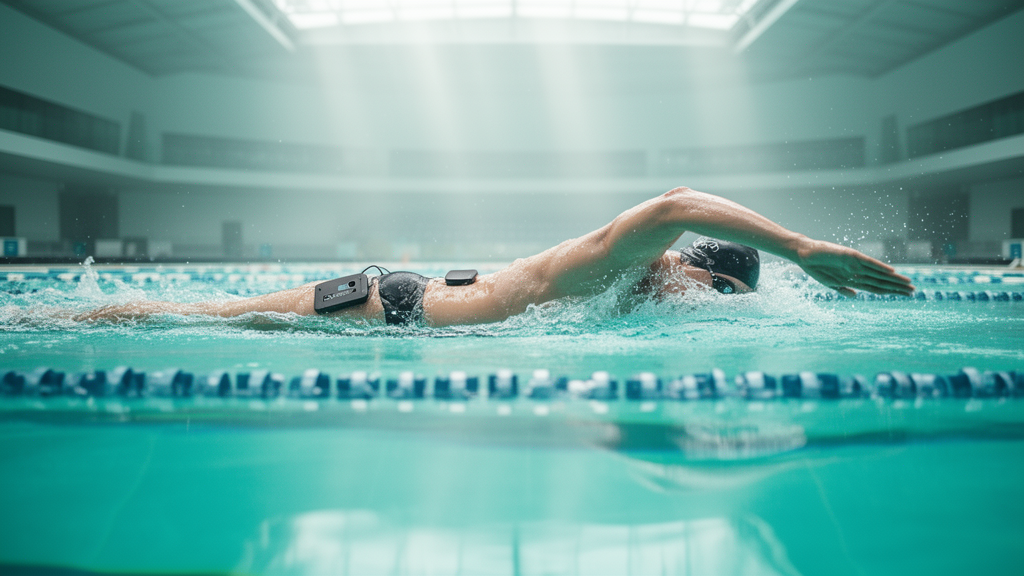
Near-infrared spectroscopy provides non-invasive, site-specific measurements of local muscle oxygenation that can offer valuable physiological data alongside traditional metrics such as heart rate, blood lactate concentration, and swimming velocity. In a newly published perspective in Frontiers in Sports and Active Living, researcher Athanasios A. Dalamitros argues that simply demonstrating an optical signal’s responsiveness to swimming exercise is insufficient to establish it as a standalone key performance indicator for athletic preparation. The optical technology functions by projecting near-infrared light into skeletal muscle tissue to quantify the differential absorption properties of oxygenated and deoxygenated forms of hemoglobin and myoglobin. Because conventional continuous-wave devices capture overlapping optical signals from both chromophores without distinguishing their individual contributions, practical swimming monitoring relies on device-derived variables, primarily muscle oxygen saturation. While portable waterproof sensors now permit data acquisition directly in the water, current scientific evidence across swimming cohorts remains fragmented across disparate sensor locations, varied hardware platforms, heterogeneous participant demographics, and non-standardized measurement protocols.
To bridge the gap between basic physiological monitoring and sports analytics, candidate monitoring metrics must satisfy established performance criteria before coaches rely on them to adjust training prescriptions. In elite sports science, a key performance indicator is formally defined as a reproducible, task-specific variable that directly links to an explicit performance objective and informs a prespecified operational intervention. An exercise-responsive muscle oxygenation trace currently remains an unverified physiological marker rather than an actionable performance indicator because research has not yet demonstrated its longitudinal test-retest reliability, within-swimmer responsiveness, incremental predictive power, or practical coaching utility. Rather than assuming that local optical fluctuations directly mirror whole-body adaptation or competitive capacity, sports scientists must evaluate candidate near-infrared spectroscopy variables through a structured validation pathway. This progression requires establishing measurement quality and signal repeatability first, verifying responsiveness to meaningful within-swimmer physiological shifts second, confirming direct performance relevance third, and ultimately proving added decision value for pool-deck training interventions.
Initial investigations examining in-water muscle oxygenation have confirmed the physical feasibility of continuous recording during sprint tasks, but they also highlight substantial interpretive boundaries. For example, early waterproofing and validation research enabled Jones and colleagues to track vastus lateralis oxygenation during repeated high-intensity swimming sprints in fourteen adolescent swimmers across an eight-week endurance training cycle. While training-induced improvements in sprint times were accompanied by measurable alterations in local deoxygenation and reoxygenation rates, and faster muscle reoxygenation correlated with greater time gains, the authors emphasized that these preliminary associations do not establish standardized reference ranges, individual coaching thresholds, or autonomous diagnostic value. Subsequent postexercise poolside investigations further illustrate why isolated oxygenation values cannot be interpreted without contextual performance data. Dalamitros and colleagues observed no statistically significant changes in rectus femoris muscle oxygen saturation or total hemoglobin following loaded jump interventions in adult male swimmers, even though fifty-meter breaststroke times improved in untrained participants, underscoring that local optical measures frequently dissociate from external sprint output.
Similar interpretive challenges appear across varied interval swimming sets and warm-up regimens evaluated in competitive cohorts. When post-set muscle oxygen saturation was recorded alongside heart rate and blood lactate concentration in twelve national-level swimmers completing interval sets, researchers discovered that poolside measurements primarily characterized passive recovery kinetics rather than true exercise-phase metabolic demands. In another study examining formerly trained swimmers completing six sessions of sprint interval training, postexercise deltoid muscle oxygen saturation decreased after a four-hundred-meter trial but increased after a fifty-meter trial relative to baseline, while performance improved exclusively in the longer distance. More recently, a randomized crossover trial involving fifteen competitive swimmers demonstrated that sprint-based and critical-speed warm-up routines generated distinct blood lactate and perceived exertion values without producing statistically significant differences in postexercise deltoid oxygenation. Together, these divergent responses caution scientists and practitioners against treating localized oxygen saturation fluctuations as inherently beneficial or generalizable across different swimming distances, training states, and competitive levels.
Laboratory-based assessments of intrinsic muscle characteristics similarly address distinct physiological constructs that cannot be equated with routine training metrics. Villanova and colleagues evaluated an arterial occlusion protocol on the triceps brachii to estimate muscle oxidative capacity, finding that the occlusion-derived recovery rate constant was associated with one-hundred-meter freestyle performance and was significantly higher in national and international competitors than in recreational swimmers. However, the researchers noted that relative resistance to oxygen diffusion did not correlate with performance, and the occlusion-derived recovery rate constant cannot be substituted for active exercise saturation, ordinary post-bout reoxygenation, or daily training guidance. Controlled swim-bench ergometer studies have likewise detailed the relationship between muscle activation, mechanical power output, and optical oxygenation, yet transferring those findings to free swimming requires separate validation. Methodological lessons from cycling, kayaking, and cross-country skiing demonstrate that reoxygenation kinetics vary substantially by muscle group and exercise intensity, reinforcing that localized findings cannot be transferred uncritically across sporting environments.
Critical methodological hurdles inherent to aquatic environments further complicate the recording and interpretation of muscle oxygenation during swimming. Foremost among these is the rapid onset of tissue reoxygenation, which initiates immediately upon the cessation of mechanical exertion. Because oxygenation values rebound rapidly once a swimmer touches the wall or exits the water, delayed poolside measurements routinely miss peak exercise deoxygenation and early recovery dynamics, meaning that poolside values cannot reconstruct continuous in-water kinetics. Furthermore, placing an optical sensor over a single muscle group, such as the deltoid or vastus lateralis, captures localized metabolic conditions within a limited tissue volume rather than reflecting the integrated physiological demands of all muscles driving aquatic propulsion. Signal quality is also vulnerable to motion artifacts during vigorous arm strokes, hydrostatic pressure changes, variations in overlying adipose tissue thickness, sensor detachment during turns, and optical coupling degradation from water ingress, necessitating standardized fixation methods, transparent data-cleaning rules, and rigorous signal-quality verification.
Substantial technical discrepancies across commercial near-infrared spectroscopy platforms introduce additional analytical complexity into multicenter swimming research and long-term athlete monitoring. Available portable systems differ widely in optical configurations, discrete light wavelengths, light-penetration depths, source-to-detector separations, sampling frequencies, and proprietary motion-filtering algorithms. As a result, muscle oxygen saturation and the tissue saturation index represent hardware-specific estimates that operate on distinct numerical scales and cannot be treated as equivalent mathematical values. Apparent differences in resting baselines or exercise recovery curves often reflect device filtering characteristics rather than authentic physiological differences between swimmers. Investigators must avoid pooling absolute saturation percentages across uncalibrated systems and should instead report comprehensive hardware specifications, firmware versions, individual normalization strategies, and usable data proportions. When tracking squads longitudinally or transitioning between monitoring hardware, sports programs must conduct concurrent bridging measurements on the same athletes to ensure that hardware shifts are not misinterpreted as training adaptations.
To establish scientific rigor, the perspective highlights four candidate indicators derived from near-infrared spectroscopy that warrant structured validation: exercise-related oxygenation changes during pace-matched bouts, inter-repetition reoxygenation kinetics across recovery intervals, oxygenation drift profiles across successive set repetitions, and oxygenation breakpoints during incremental step tests. The primary research priority is establishing test-retest reliability, absolute measurement error, and typical within-swimmer variability using standardized aquatic protocols. Reports must clearly distinguish relative reliability, such as the intraclass correlation coefficient, from absolute metrics like the standard error of measurement and minimum detectable change. Meta-analytic evidence synthesized by Liu and colleagues across twenty-seven investigations revealed that no training modality differed significantly from nonexercise controls for pooled oxygenation outcomes, highlighting broad methodological heterogeneity. Furthermore, cycling research indicates that measurement error fluctuates with exercise intensity, demonstrating that swimming-specific error margins must be empirically quantified in representative aquatic settings.
The evaluation of oxygenation breakpoints as individualized intensity thresholds requires far more rigorous statistical validation than simple correlation analysis. While Iskra and Paravlić reported moderate-to-strong correlations between optical breakpoints and ventilatory thresholds in twenty-seven male cyclists, those associations did not establish interchangeability during swimming. In female collegiate rowers, Eserhaut and colleagues failed to demonstrate statistical equivalence between optical breakpoints and blood lactate thresholds, observing poor agreement at the first threshold. Correlation merely indicates that two continuous variables share a directional trajectory, whereas agreement assesses how closely numerical estimates align for an individual swimmer, and equivalence confirms that differences fall within predefined physiological margins. Because blood lactate threshold calculations themselves vary widely depending on mathematical curve-fitting models, optical threshold algorithms must be prespecified and evaluated against explicit reference methods. Studies must also report the proportion of tests with undetectable breakpoints, as high failure rates severely limit everyday coaching utility.
Research must also account for demographic variation across age groups, biological maturation stages, and biological sexes, while exploring emerging disciplines such as finswimming. Investigating oxygenation trajectories across children, adolescents, and adult competitors demands longitudinal designs capable of distinguishing somatic growth and biological maturation from true training adaptations. Potential sex-related differences must be assessed under identical training and testing constraints, carefully controlling for differences in adipose tissue thickness and sensor placement geometry. In finswimming, where specialized propulsion places massive biomechanical demands on lower-limb musculature, monitoring vastus lateralis oxygenation may provide novel insights into localized metabolic stress across different kicking techniques and event distances. Nevertheless, researchers emphasize that finswimming applications remain entirely theoretical, requiring dedicated protocol validation rather than hasty extrapolation from conventional pool swimming or cycling literature.
Practical adoption of near-infrared spectroscopy ultimately depends on whether its operational benefits justify the substantial financial, logistical, and technical burdens imposed on swimming programs. An extensive international survey of swimming coaches across forty-one nations revealed that muscle oxygenation is among the least utilized monitoring tools in everyday competitive environments. Barriers to uptake include high equipment costs, time-consuming sensor waterproofing, complex data cleaning, and the specialized technical knowledge needed to interpret optical signals accurately. Demonstrating true incremental value requires showing that optical data improves performance prediction or training analysis beyond what coaches already extract from swimming pace, stroke rate, heart rate, blood lactate, and perceived exertion. If a coach observes an unexpected oxygenation drop during a standardized interval set, that signal should prompt careful examination of stroke mechanics, turn efficiency, pacing discipline, or sensor placement before any unvalidated reduction in training volume is prescribed.
To resolve these lingering uncertainties and establish whether near-infrared spectroscopy offers genuine added value, the perspective proposes an actionable, three-stage empirical research program for competitive swimming. In the first stage, researchers must conduct repeated, pace-matched front-crawl interval sets under standardized conditions to define the minimum detectable change for within-set deoxygenation and inter-repetition recovery kinetics. In the second stage, prospective longitudinal tracking studies must test whether these localized indices improve the statistical prediction of independent time-trial or competition outcomes beyond conventional physiological and workload markers, utilizing robust out-of-sample validation data. Finally, sports scientists should execute pragmatic randomized controlled trials allocating swim teams to either standard monitoring or monitoring supplemented by prespecified oxygenation decision algorithms. Only by demonstrating that near-infrared spectroscopy measurably improves coaching decisions and subsequent competition performance can this non-invasive optical technology advance from a complementary monitoring tool to a validated key performance indicator.
Subject of Research: Validation standards for muscle oxygenation monitoring in competitive swimming
Article Title: Muscle oxygenation in competitive swimming: a roadmap for validating key performance indicators
Article References: Dalamitros, A. A. (2026). Muscle oxygenation in competitive swimming: a roadmap for validating key performance indicators. Frontiers in Sports and Active Living, 8, Article 2030268. https://doi.org/10.3389/fspor.2026.2030268
Image Credits: AI Generated
DOI: 10.3389/fspor.2026.2030268
Keywords: near-infrared spectroscopy, muscle oxygen saturation, competitive swimming, key performance indicators, training monitoring, in-water physiological testing, reoxygenation kinetics, vastus lateralis, deltoid muscle, lactate threshold, ventilatory threshold, optical spectroscopy, swimming performance analytics, tissue saturation index, minimum detectable change, finswimming
News Source: Ophelia Keating. (November 26, 2026). Muscle Oxygenation Remains Complementary Tool Rather Than Key Indicator in Competitive Swimming. Scienmag.