Agricultural researchers in Ethiopia have established that substituting conventional cottonseed cake with locally sourced mung bean straw in sheep rations maintains growth performance while significantly lowering feed costs. Inadequate nutrition and seasonal shortages of quality forage remain primary constraints limiting smallholder livestock productivity across the country. Because commercial protein supplements such as oilseed cakes are expensive and scarce for smallholders, crop residues with favorable nutritional profiles present a practical intervention. The findings confirm that mung bean straw constitutes a nutritionally viable and financially advantageous alternative feed resource for sheep fattening.
Ethiopia maintains one of the largest livestock populations in Africa, supporting an estimated seventy million cattle, fifty-two point five million goats, forty-two point nine million sheep, and fifty-seven million chickens. Livestock production supplies rural households with meat, milk, draft power, manure, hides, skins, and income. Small ruminants, particularly sheep, are valued for their adaptability across varied agroecological zones, rapid growth rates, short reproductive cycles, and low investment requirements compared with large ruminants. Approximately seventy-five percent of Ethiopia’s sheep population is raised within highland mixed crop-livestock farming systems, while the remaining twenty-five percent is maintained in lowland pastoral areas. Despite this large inventory, average sheep carcass weights in Ethiopia reach only about ten kilograms, lagging behind the African average of thirteen kilograms and global average of fifteen point eight kilograms due to nutritional deficiencies and low-quality basal forages.
Among indigenous sheep breeds, Simien sheep represent an important genetic resource uniquely adapted to highland environments in northwestern Ethiopia, particularly within the Simien Mountains and neighboring districts including Beyeda, Debark, Wogera, Dabat, and Janamora. Characterized by a short fat tail and predominantly brown coat coloration, the breed possesses adaptive traits that support survival under harsh environmental conditions with limited inputs. Feed resources accessible to smallholders in these highland systems consist primarily of native pasture grasses, stubble grazing, and fibrous crop residues that suffer from severe seasonal fluctuations in crude protein concentration and biomass. In response to expanding domestic consumption and export markets, mung bean cultivation has increased across Ethiopia, yielding substantial straw residues. Because mung bean straw contains relatively high crude protein levels compared with cereal straws, researchers evaluated whether it could replace costly cottonseed cake in smallholder feeding regimes.
The feeding and digestion experiments were conducted at the University of Gondar Livestock Farm, situated within the Atse Tewodros campus in Gondar Town within Amhara National Regional State, Ethiopia. Geographically positioned in North Gondar zone north of Lake Tana and southwest of the Simien Mountains at twelve degrees thirty-six minutes north latitude and thirty-seven degrees twenty-eight minutes east longitude, the site lies at an elevation of roughly two thousand one hundred thirty-three meters above sea level. Gondar is situated about seven hundred forty-two kilometers from Addis Ababa and approximately one hundred seventy-one point seven kilometers from Bahir Dar. Climatically, the area experiences a sub-humid tropical highland regime with annual rainfall ranging between eight hundred seventy-five and one thousand twenty-five millimeters and temperatures fluctuating from eighteen to thirty-five degrees Celsius, providing an appropriate setting for examining highland livestock performance.
To conduct the feeding trial during 2025–2026, researchers procured twenty yearling intact male Simien sheep displaying an average initial body weight of sixteen point zero plus or minus zero point seven one kilograms from rural markets in Dega Musite and Dara districts. Animal ages were established through dentition characteristics combined with owner information. Following arrival at the facility, the sheep underwent a fifteen-day quarantine and acclimatization protocol during which they were dewormed with albendazole, treated with twenty percent oxytetracycline against bacterial infections, and sprayed against external parasites. The sheep were housed individually in well-ventilated pens equipped with separate feeding and watering troughs to permit daily measurement of feed allocations and refusals. Throughout the experimental period, all animals received unrestricted access to clean drinking water and supplemental common salt, maintaining standardized management conditions.
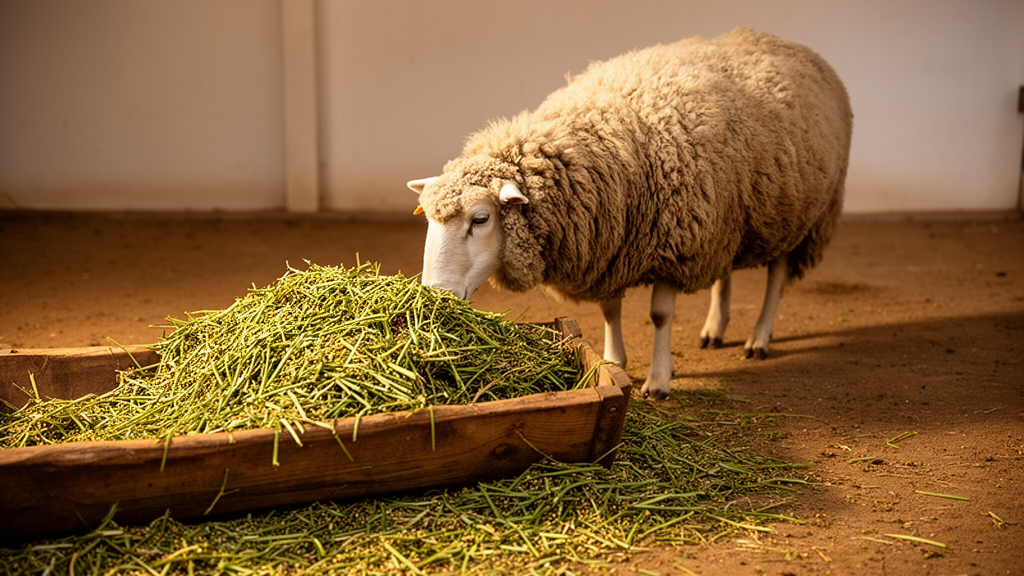
The feeding trial was executed across ninety days using a randomized complete block design involving five dietary treatments with four replications, with sheep blocked by initial body weights determined after overnight fasting. Diets featured a basal ration of natural pasture hay chopped to lengths of three to ten centimeters to reduce feed wastage. Cottonseed cake was procured from Azozo, ten kilometers south of Gondar, whereas mung bean straw was collected from farmers in Kinfaz Begela District and ground for uniform intake. Supplement mixtures were provided at three hundred grams per head daily on an as-fed basis divided into two equal feedings at zero eight hundred and sixteen hundred hours. Treatments evaluated were T1 with one hundred percent cottonseed cake, T2 with seventy-five percent cake and twenty-five percent straw, T3 with equal fifty percent proportions, T4 with twenty-five percent cake and seventy-five percent straw, and T5 with one hundred percent mung bean straw.
Laboratory analysis revealed substantial differences in nutrient composition across feedstuffs, with natural pasture hay containing six point seven five percent crude protein on a dry matter basis, falling below the critical threshold of seven to eight percent required for efficient rumen microbial activity. Cottonseed cake exhibited the highest crude protein content at twenty-eight point three one percent alongside lower fiber fractions, whereas mung bean straw contained twenty-one point four eight percent crude protein alongside higher concentrations of neutral detergent fiber, acid detergent fiber, and acid detergent lignin. As the proportion of mung bean straw expanded across supplements, crude protein concentrations diminished while structural fiber fractions increased. Hay refusals exhibited consistently lower protein and elevated fiber percentages compared with offered forage, indicating selective feeding behavior. Daily intake measurements demonstrated that total dry matter intake differed significantly across diets, peaking in T4 at eight hundred eighty-four point six zero grams daily.
Crude protein intake varied significantly among the five groups, ranging from ninety-four point nine seven grams per day in T5 to one hundred thirteen point six six grams per day in T2. Following the feeding trial, researchers conducted a seven-day digestibility trial with the same sheep using fecal collection bags after three days of adaptation. Fecal outputs were weighed each morning, and twenty percent aliquot samples were dried at sixty-five degrees Celsius for seventy-two hours before chemical determination. Apparent digestibility coefficients for dry matter and organic matter showed no statistically significant differences among treatments, demonstrating that substituting cottonseed cake with mung bean straw maintained overall digestive utilization. However, crude protein digestibility was highest in T1 receiving sole cottonseed cake, whereas neutral detergent fiber digestibility was highest in T4, and acid detergent fiber digestibility was higher in T2, T3, and T4 than in T1.
Growth monitoring revealed that final body weight, cumulative body weight gain, average daily gain, and feed conversion efficiency were significantly affected by dietary treatment. Animals receiving T4 containing twenty-five percent cottonseed cake and seventy-five percent mung bean straw attained the highest numerical values across all growth parameters, recording a final body weight of twenty-six point six seven kilograms, a total gain of ten point seven five kilograms, an average daily gain of one hundred nineteen point four three grams, and a feed conversion efficiency of zero point one three five. These outcomes were statistically comparable to sheep receiving T2 with seventy-five percent cottonseed cake, and both groups significantly outperformed animals on T1, T3, and T5. Sheep consuming intermediate T3 experienced the lowest growth performance, while sheep receiving sole mung bean straw in T5 sustained positive weight gains throughout the trial, confirming the nutritional adequacy of the legume straw.
Statistical evaluation performed using analysis of variance via the General Linear Model procedure in SAS and mean separation through the Least Significant Difference test established key associations linking intake, digestibility, and animal performance. Total dry matter intake correlated positively with nutrient intake, digestibility metrics, and average daily weight gain across experimental animals. Dry matter digestibility exhibited positive associations with organic matter digestibility, neutral detergent fiber digestibility, and acid detergent fiber digestibility, while crude protein intake was positively associated with crude protein digestibility coefficients. Furthermore, average daily weight gain was positively correlated with total dry matter intake, dry matter digestibility, and organic matter intake, indicating that enhancing feed consumption and digestive utilization directly supported animal growth rates.
Economic feasibility assessment using partial budget analysis based on CIMMYT methodology demonstrated that dietary profitability was governed jointly by animal weight gains and prevailing supplemental feed expenditures. Total return calculations incorporated animal purchase and selling prices, while total variable costs captured animal purchase and feed expenses while excluding common overhead costs such as housing, labor, transport, veterinary care, and mineral salt. The highest net return was achieved by sheep receiving sole mung bean straw supplementation in T5 at two thousand four hundred fifteen point six zero Ethiopian birr per head, closely followed by T4 at two thousand three hundred seventy-eight point seven zero Ethiopian birr per head. Conversely, the lowest net return occurred in T2, and control T1 generated lower profitability due to expensive cottonseed cake. The researchers concluded that mung bean straw represents an economically attractive alternative feed resource for sheep fattening, recommending further verification under differing agroecological environments.
Subject of Research: Evaluation of mung bean straw as an alternative protein supplement for Simien sheep
Article Title: Effects of replacing cottonseed cake with mung bean straw on feed intake, nutrient digestibility, growth performance, and economic returns of simien sheep fed natural pasture hay
Article References: Moges, D., Temesgen, A. B., Chekun, A. D., Zewudu, Y. D., Shiferaw, L. A., Woldemariam, G. A., & Teshager, A. A. (2026). Effects of replacing cottonseed cake with mung bean straw on feed intake, nutrient digestibility, growth performance, and economic returns of simien sheep fed natural pasture hay. Discover Animals, 3(1), Article 110. https://doi.org/10.1007/s44338-026-00273-0
Image Credits: AI Generated
DOI: 10.1007/s44338-026-00273-0
Keywords: Simien sheep, mung bean straw, cottonseed cake, feed intake, nutrient digestibility, growth performance, feed conversion efficiency, partial budget analysis, Effects, replacing, cottonseed, cake
News Source: Drew Townsend. (November 7, 2026). Mung Bean Straw Can Replace Costly Cottonseed Cake in Sheep Rations. Scienmag.