• HOME
  • NEWS
  • EXPLORE
    • CAREER
      • Companies
      • Jobs
    • EVENTS
    • iGEM
      • News
      • Team
    • PHOTOS
    • VIDEO
    • WIKI
  • BLOG
  • COMMUNITY
    • FACEBOOK
    • INSTAGRAM
    • TWITTER
Wednesday, May 20, 2026
BIOENGINEER.ORG
No Result
View All Result
  • Login
  • HOME
  • NEWS
  • EXPLORE
    • CAREER
      • Companies
      • Jobs
        • Lecturer
        • PhD Studentship
        • Postdoc
        • Research Assistant
    • EVENTS
    • iGEM
      • News
      • Team
    • PHOTOS
    • VIDEO
    • WIKI
  • BLOG
  • COMMUNITY
    • FACEBOOK
    • INSTAGRAM
    • TWITTER
  • HOME
  • NEWS
  • EXPLORE
    • CAREER
      • Companies
      • Jobs
        • Lecturer
        • PhD Studentship
        • Postdoc
        • Research Assistant
    • EVENTS
    • iGEM
      • News
      • Team
    • PHOTOS
    • VIDEO
    • WIKI
  • BLOG
  • COMMUNITY
    • FACEBOOK
    • INSTAGRAM
    • TWITTER
No Result
View All Result
Bioengineer.org
No Result
View All Result
Home NEWS Science News Chemistry

Multiplication and division of the orbital angular momentum of light

Bioengineer by Bioengineer
December 11, 2019
in Chemistry
Reading Time: 2 mins read
0
IMAGE
Share on FacebookShare on TwitterShare on LinkedinShare on RedditShare on Telegram

IMAGE

Credit: Credited by Dr. Gianluca Ruffato,Dr.Michele Massari , Prof.Filippo Romanato


Optical beams carrying orbital angular momentum (OAM) have attracted a growing attention during the last decades, exhibiting disruptive applications in a wide range of fields: particle trapping and tweezing, high-resolution microscopy, astronomical coronagraphy, high-capacity telecommunication and security.

Light beams carrying OAM are endowed with peculiar twisted wavefronts, and modes with different OAM are orthogonal to each other and can carry independent information channels at the same frequency without any interference. Then, in the telecom field, the potentially unbounded state space provided by this even-unexploited degree of freedom offers a promising solution to increase the information capacity of optical networks and solve in a sustainable way the impelling problem of frequency saturation, otherwise called as the ‘optical crunch’, this approach being valid both for free-space and optical fibre propagation.

Currently, it is urgent to further develop novel devices that can reconfigure and switch between distinct OAM modes to fully exploit the extra degree of freedom provided by the OAM both for classical and quantum communications. So far, conventional methods are useful for implementing only shift operations on the OAM, i.e., addition or subtraction.

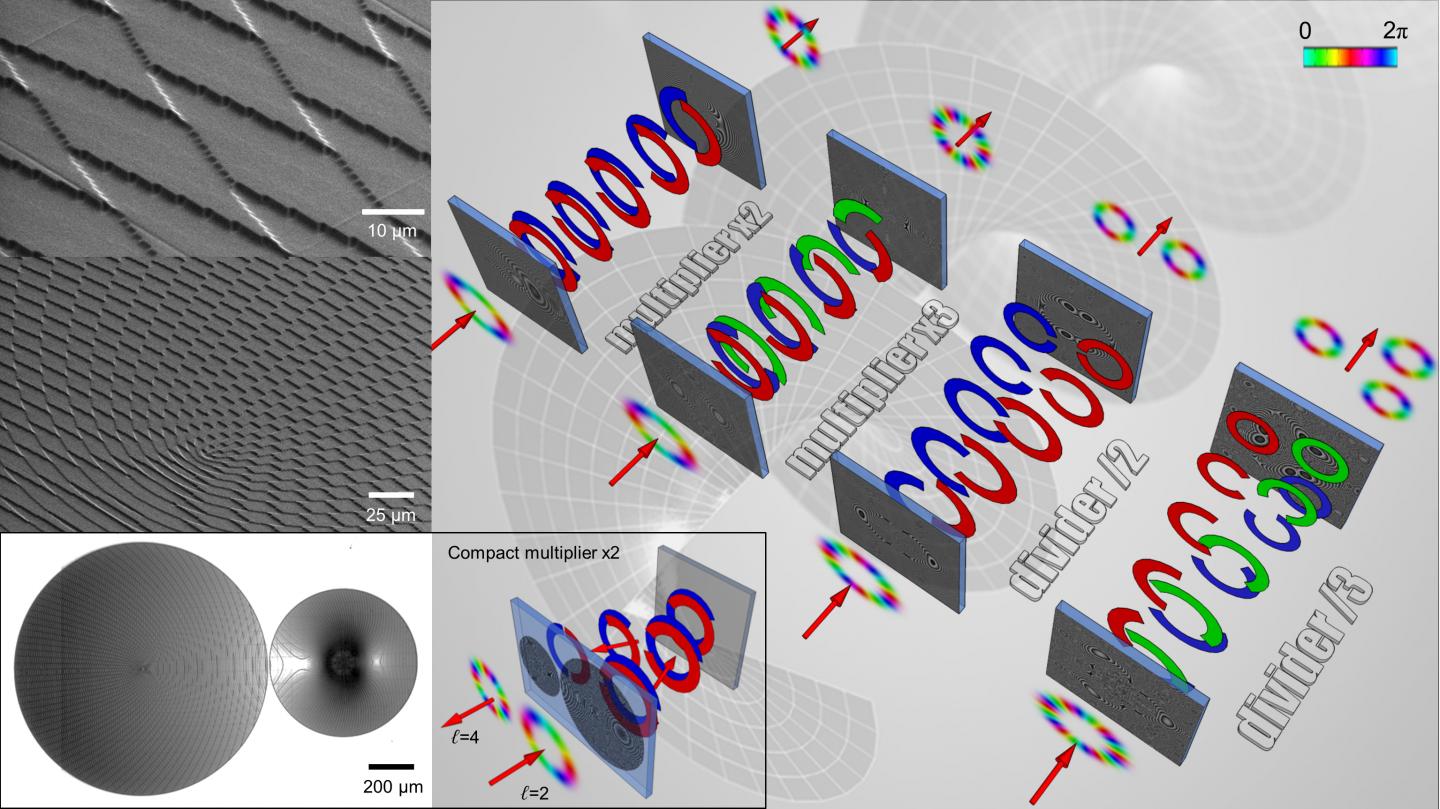
For the first time, novel optical elements have been designed and fabricated to perform the multiplication and division of the orbital angular momentum of light in a compact and efficient way. The study has been conducted by Dr. Gianluca Ruffato, Dr. Michele Massari, and Prof. Filippo Romanato at the Department of Physics and Astronomy of Padova University, in Italy. The research results have been recently published in Light: Science and Applications.

The key element of these optics is represented by an optical transformation mapping the azimuthal phase gradient of the input OAM beam onto a circular sector. By combining multiple circular-sector transformations into a single optical element, it is possible to multiply the value of the input OAM state by splitting and mapping the phase onto complementary circular sectors. Conversely, by combining multiple inverse transformations, the division of the initial OAM value is achievable by mapping distinct complementary circular sectors of the input beam into an equal number of circular phase gradients.

The designed optical elements have been fabricated in the form of miniaturized and compact phase-only diffractive optics with high-resolution electron-beam lithography, and optically characterized in the visible range to demonstrate the expected capability to either multiply or divide the OAM of the input beam.

This study can find promising applications for the multiplicative generation of higher-order OAM modes, optical information processing based on OAM-beam transmission, and optical routing/switching in telecom, both in the classical and single-photon regimes.

###

Media Contact
Gianluca Ruffato
[email protected]

Original Source

https://www.nature.com/articles/s41377-019-0222-2

Related Journal Article

http://dx.doi.org/10.1038/s41377-019-0222-2

Tags: Chemistry/Physics/Materials SciencesOptics
Share12Tweet8Share2ShareShareShare2

Related Posts

Scientists Observe Massive Light-Conversion Effect in Chiral Carbon Nanotubes — Chemistry

Scientists Observe Massive Light-Conversion Effect in Chiral Carbon Nanotubes

May 19, 2026
TransEuroOGS Project to Connect Optical Ground Stations Across Europe — Chemistry

TransEuroOGS Project to Connect Optical Ground Stations Across Europe

May 19, 2026

Decarbonizing the Grid: The Essential First Step to Capturing Carbon from the Environment

May 19, 2026

Overcoming Mid-Infrared Interconnection Challenges: Durable Bonding Technique for High-Power Optics Using Liquid-Like Chalcogenide Glass

May 19, 2026
Please login to join discussion

POPULAR NEWS

  • blank

    New Study Reveals Plants Can Detect the Sound of Rain

    732 shares
    Share 292 Tweet 183
  • Research Indicates Potential Connection Between Prenatal Medication Exposure and Elevated Autism Risk

    846 shares
    Share 338 Tweet 212
  • Breastmilk Balances E. coli and Beneficial Bacteria in Infant Gut Microbiomes

    58 shares
    Share 23 Tweet 15
  • ESMO 2025: mRNA COVID Vaccines Enhance Efficacy of Cancer Immunotherapy

    245 shares
    Share 98 Tweet 61

About

We bring you the latest biotechnology news from best research centers and universities around the world. Check our website.

Follow us

Recent News

Faecal Transplants Show Promise for Parkinson’s Safety, Efficacy

Kynurenic Acid Links Epicardial Fat to Atrial Dysfunction

ELMO1 Boosts Kidney Repair After Toxic Injury

Subscribe to Blog via Email

Enter your email address to subscribe to this blog and receive notifications of new posts by email.

Join 82 other subscribers
  • Contact Us

Bioengineer.org © Copyright 2023 All Rights Reserved.

Welcome Back!

Login to your account below

Forgotten Password?

Retrieve your password

Please enter your username or email address to reset your password.

Log In
No Result
View All Result
  • Homepages
    • Home Page 1
    • Home Page 2
  • News
  • National
  • Business
  • Health
  • Lifestyle
  • Science

Bioengineer.org © Copyright 2023 All Rights Reserved.