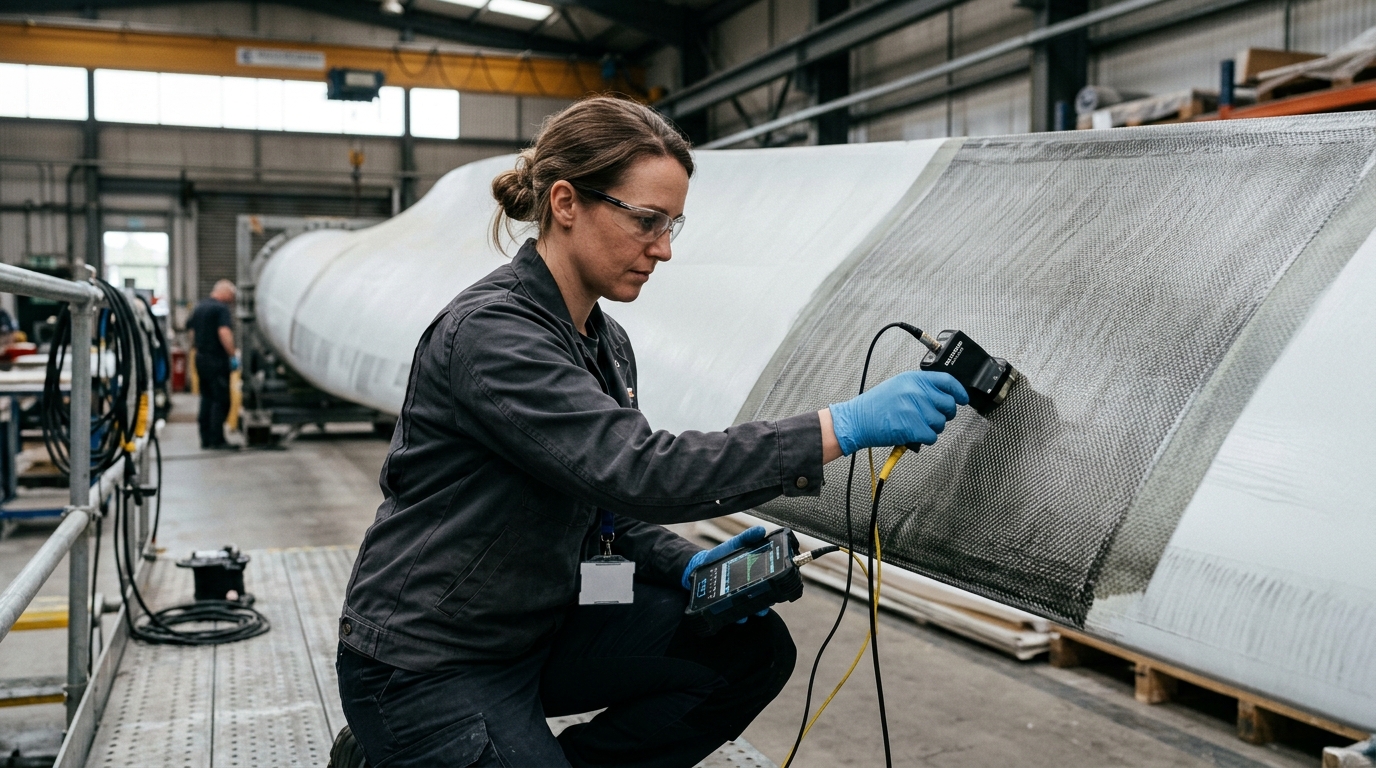
Composite wind turbine blades serve as complex structural systems that must retain their integrity under rigorous cyclic aerodynamic and gravitational loading, as well as periodic extreme weather events. These blades are manufactured from intricate combinations of laminates, sandwich panels, and adhesive joints, creating environments where structural damage can initiate and evolve beneath a seemingly intact surface. Manufacturing imperfections, such as voids, wrinkles, or incomplete bonding, can establish potential failure sites that interact with service-induced issues like matrix cracking, fiber failure, and delamination. Furthermore, the harsh offshore environment, characterized by moisture, thermal cycling, and limited physical access, complicates the frequency and depth of necessary inspections. Because visible external features often provide an unreliable proxy for internal condition—a small surface mark might mask extensive internal delamination—the field relies on nondestructive evaluation (NDE) and structural health monitoring (SHM) to acquire reliable condition data. A recent review synthesizes the current capabilities of these inspection technologies, evaluating how different methods respond to the physical consequences of damage and highlighting the critical necessity for relating signal outputs to the structural consequence of a defect.
Optical imaging and thermal inspection remain primary tools for broad surface screening, each addressing distinct physical effects. Visual inspection, augmented by cameras or unmanned aerial vehicles (UAVs), directly records surface morphology, identifying coating erosion, open cracks, and geometric changes through reflected light. While these methods are adept at mapping external features, they are inherently limited by their line of sight and lack of sensitivity to internal interfaces buried within the blade structure. Thermography complements this by measuring surface temperature fields associated with heat transport through the composite. By monitoring either passive environmental warming or active, controlled thermal excitation, thermography can detect anomalies where subsurface damage disturbs heat flow. However, interpretation remains conditional, as heating uniformity, material emissivity, and surface ambient conditions can create signals that mimic or obscure internal anomalies. Consequently, thermal indications are best utilized to locate suspect regions that require further, more detailed inspection rather than as a standalone method for determining remaining structural capacity.
Ultrasonic and acoustic methods provide deeper insight by interrogating internal structural interfaces through elastic-wave interactions. Local ultrasonic pulse-echo and through-transmission scans are highly sensitive to delaminations and adhesive debonding, as these defects reflect or scatter elastic waves in ways that differ from homogeneous laminates. By combining these local measurements into spatial maps, inspectors can estimate the lateral extent of internal discontinuities. Guided waves offer an alternative for longer-path interrogation, enabling the monitoring of larger structural regions between fixed transducers, though this requires careful baseline definition to account for temperature and load-induced changes. Acoustic emission (AE) sensors take a passive approach, capturing the elastic energy transients released when damage processes, such as fiber breakage or cracking, occur during operation. While AE is useful for identifying active damage growth during a defined loading interval, its utility is constrained by the challenge of filtering out operational noise and the reality that dormant damage typically remains silent.
Electromagnetic techniques, including microwave and radar-based methods, detect material or interface anomalies by measuring variations in dielectric or conductive behavior. These methods offer a physical contrast independent of the optical appearance or elastic-wave scattering characteristics that dominate other NDT approaches. In compatible composite configurations, electromagnetic sensing can identify material anomalies in regions where conventional ultrasonic coupling is impractical. However, these techniques are sensitive to the sensor’s stand-off distance from the blade surface and the underlying material composition, which can significantly affect the depth and volume of the inspection. For instance, conductive carbon-fiber composites present different electromagnetic responses compared to non-conductive glass-fiber materials. Therefore, the implementation of electromagnetic inspection requires rigorous calibration for the specific blade lay-up and architecture to ensure that observed contrast can be reliably related to a distinct defect state rather than simply reflecting normal geometric variations in the blade.
Structural health monitoring, through strain and vibration sensors, connects measurements directly to the blade’s dynamic load transfer characteristics. Fiber-optic sensors, such as fiber Bragg gratings, allow for precise, repeated strain observations at critical joints and load-carrying regions. When compared under matched operating states, localized changes in strain patterns can indicate structural alterations, though these signals are also influenced by aerodynamic loading and pitch actions. Vibration monitoring provides a broader surveillance tool by tracking changes in frequencies and mode shapes, which are sensitive to shifts in global stiffness and mass. Yet, because these dynamic features reflect the behavior of the entire blade, they are prone to inverse-problem challenges, where a global feature shift may arise from multiple causes, making precise damage localization difficult. Successful SHM implementation requires isolating persistent structural changes from the complex background of operational and environmental effects recorded by supervisory control and data acquisition systems.
The integration of these diverse datasets through multimodal fusion is an area of significant research, aiming to constrain ambiguities that persist in single-method inspections. Combining responses—such as using optical coordinates to guide a deeper ultrasonic scan or thermal contrast to refine the interpretation of a strain alert—can potentially improve identification metrics. However, published fusion results indicate that such gains are often conditional and do not automatically establish general improvements in blade sizing or the assessment of residual structural strength. Disparate measurements often share common sources of uncertainty, including spatial registration errors or environmental influences, meaning that independent physical responses are not always present. Decision-level fusion, which retains separate interpretations for engineering review, often proves more robust than attempting to force different physical signals into a single, combined numerical metric that may obscure their individual strengths and limitations.
Advancements in inspection platforms, particularly UAVs and contact robots, are essential for automating acquisition and ensuring the repeatability required for monitoring campaigns. UAVs capable of carrying thermal and optical sensors cover vast exterior areas, but their performance is limited by wind-induced motion, varying stand-off distances, and the complexity of registering images on a curved blade. Robotic manipulators can maintain the stable coupling necessary for local ultrasonic or radar scans, but their deployment is constrained by the need for secure attachment, power, and the navigation challenges posed by the scale and geometry of an installed offshore blade. The goal of coordination—using a broad UAV survey to identify potential issues, followed by targeted local robotic or manual inspection—depends heavily on the precision of the coordinate systems used to transfer the defect position between different platforms without losing the spatial context needed for follow-up.
Translating laboratory findings to the field represents one of the most critical challenges in the current research landscape. Laboratory validation frequently utilizes machined or artificial defects in coupons, which, while useful for establishing sensitivity, fail to replicate the complexity of real service-induced damage, such as closed interface cracks, irregular defect boundaries, or the material attenuation encountered over a full blade span. Furthermore, demonstration in a controlled laboratory setting does not account for the operational and environmental envelope of an offshore wind farm. Field readiness must be validated through tests that include variations in blade curvature, thickness, and structural joints, alongside independent damage references established without relying on the sensor output being tested. Reporting measurement uncertainty and capturing data on inaccessible regions or failed acquisitions are just as critical for validating performance as documenting successful detections.
The transition from a detected indication to an engineering assessment of structural consequence requires mapping the measured geometry to the relevant failure mechanism. This step demands not only an inspection output but also knowledge of local material properties, design loads, and structural geometry. For instance, the consequence of a delamination depends strongly on its depth through the laminate thickness, as the interface depth fundamentally alters the remaining load-carrying capacity. If an inspection technique cannot distinguish between different interface depths with sufficient confidence, the assessment must carry that uncertainty forward. Consequently, current research emphasizes the need for mechanism-specific failure models that can propagate these uncertainties, rather than relying on qualitative labels or signal amplitude thresholds that lack a direct, validated relationship to the residual life or capacity of the blade.
Maintenance decisions and inspection strategies remain inherently tied to economic and operational constraints, including weather windows, vessel availability, and the cost of energy production losses. A rapid survey might provide high maintenance value if it effectively reduces unnecessary close-access inspections, but redundant modalities that increase mobilization effort without providing meaningful diagnostic refinement should be carefully evaluated. Predictive maintenance and digital twin frameworks offer promising system-level context, yet the integrity of these models depends on the reliability of the local data streams. As research progresses, the emphasis is shifting toward reliable long-term sensing, where the stability of sensor bonds and the ability to distinguish structural damage from environmental drift or monitoring-system failure become the most pressing priorities for ensuring sustained structural integrity over the design life of the turbine.
Ultimately, there is no universal inspection or monitoring tool; the choice of methodology must be dictated by the specific damage question and the required output, whether it be screening for visible surface deterioration or characterizing the geometry of internal interfaces. The strength of the field lies in its variety of physical bases, from heat-flow contrast and elastic-wave scattering to electromagnetic dielectric responses. Future advances will likely come not from the discovery of a single dominant modality, but from the rigorous qualification of integrated procedures that connect repeatable acquisition, calibrated detection, and mechanism-specific structural assessment. Establishing maintenance value against existing practice remains the final requirement, ensuring that the transition from academic feasibility to field-ready assessment provides real-world assurance of structural safety under the demanding conditions of offshore operation.
Subject of Research: Nondestructive evaluation methods for wind turbine blade structural assessment.
Article Title: Multimodal nondestructive evaluation for structural assessment of composite wind turbine blades
Article References: Meng, K., Yi, S., Sun, J., Zhang, D., & Wang, Y. (2026). Multimodal nondestructive evaluation for structural assessment of composite wind turbine blades. Frontiers in Mechanical Engineering, 12, 2040645. https://doi.org/10.3389/fmech.2026.2040645
Image Credits: AI Generated
DOI: 10.3389/fmech.2026.2040645
Keywords: wind turbine blades, composite materials, nondestructive evaluation, structural health monitoring, thermography, ultrasonic inspection, optical imaging, acoustic emission, strain sensing, vibration monitoring, multimodal fusion, structural integrity, damage detection, offshore wind, turbine maintenance, inspection automation, interface delamination, load transfer, structural assessment, uncertainty quantification
News Source: Faith Mcneil. (November 17, 2026). Multimodal Nondestructive Evaluation Techniques for Assessing Composite Wind Turbine Blade Integrity. Scienmag.