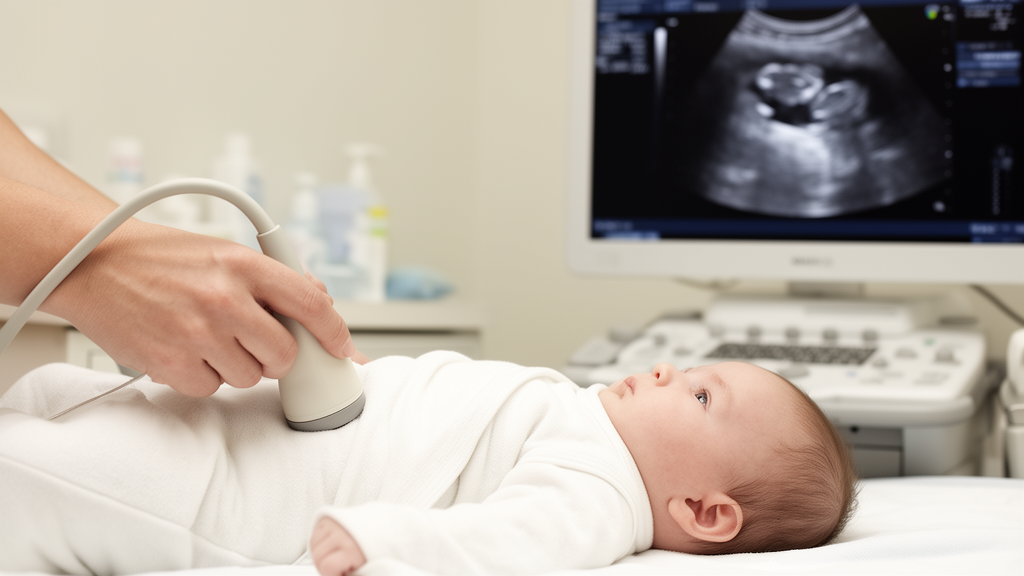
Every year, thousands of infants undergo ultrasound scans of their hips to catch a sneaky condition called developmental dysplasia of the hip, or DDH, before it causes lifelong problems. The gold-standard method, known as Graf ultrasonography, asks sonographers to trace anatomical landmarks on grainy images and measure two angles, α and β, that reveal how well the hip joint is forming. It sounds straightforward, but it demands years of experience with complex infant anatomy, and even seasoned clinicians show measurement variability, with standard deviations of up to 3 degrees for the α angle and 6 degrees for the β angle. Now a team in Beijing has built an artificial intelligence system that performs this entire assessment automatically, and its performance is turning heads in pediatric imaging.
The system, called MultiHipPoseNet, was developed by Wenjing Chi, Shuai Zheng, and colleagues at Haidian District Maternal and Child Health Hospital, working with partners at the Fourth Medical Center of PLA General Hospital. Their study, published in Frontiers in Pediatrics, describes an end-to-end deep learning network that reads a hip ultrasound image and outputs seven anatomical masks and six landmark predictions in one pass. From those outputs, a deterministic post-processing step computes the α and β angles and classifies the hip as Graf type I or type II. No manual cropping, no interactive correction, no human in the loop at any stage.
What makes the approach technically interesting is that it is a multi-task network. Instead of learning landmarks in isolation, it jointly learns structure segmentation and landmark localization, exploiting the fact that structure boundaries and landmark positions are inherently coupled in hip anatomy. The backbone is ResNet-50 combined with a feature pyramid network, augmented with a contextual semantic fusion module that passes the highest-level feature map through parallel dilated convolutions with dilation rates of 1, 3, and 5, then fuses global anatomical context into each up-sampled pyramid level. This preserves fine spatial detail for weak boundaries and small targets, which are notoriously difficult in ultrasound images plagued by speckle noise and low contrast.
But sharing parameters across tasks can backfire. When tasks conflict, extensive parameter sharing causes negative transfer, degrading performance on at least some objectives. To manage this, the team designed a multi-expert gated channel transformation unit, or ME-GCT. Inspired by Multi-gate Mixture-of-Experts, it runs three expert ResNet-50-FPN extractors and uses gating networks to produce input-dependent weights over the experts’ channels, so each task assembles its own expert-channel combination. When tasks are less related, expert sharing is penalized, prompting the gates to rely on different experts. The unit divides the input space into regions corresponding to experts’ channel features while adding only a negligible number of gating parameters, making the task-channel relationships explicit and interpretable.
On top of that sits a second innovation, the multi-task graph adaptive learning mechanism, MT-GALM. Each image-feature channel is treated as a node in a graph, and the network learns adaptive adjacency matrices among 256 channel nodes using learnable node embeddings, with ReLU removing weak connections and SoftMax normalizing the result. Graph convolution then propagates information across the structure-segmentation and landmark-localization branches, fusing complementary cross-task features while preserving task-specific cues. The team adapted this principle from temporal dynamic graph networks originally built for multivariate time series, applying it here to cross-task image-feature channels and optimizing the learned graphs jointly with the prediction heads.
Training details reveal a carefully engineered pipeline. The models were implemented in PyTorch and trained on a single NVIDIA GeForce RTX 3090 GPU, with inputs resized to 512 by 384 pixels. The loss combined a focal loss and a Dice loss for structures, with a focusing parameter of 2 and a class-balancing weight compensating for thin foregrounds, and a distance-weighted mean-squared-error loss for landmarks with a heatmap weighting factor of 5. Task weights were updated dynamically using the coefficient of variation of each task loss, ensuring the weights sum to one and decoupling loss weighting from the learning rate. Data augmentation included random horizontal flipping, rotation within ±10 degrees, scaling, gamma adjustment, and additive speckle noise to emulate ultrasound artefacts.
The evidence base consisted of two retrospective datasets totaling 1,355 annotated Graf hip ultrasound images from 566 infants, collected on two ultrasound machines at a single institution. Dataset A, with 1,129 images from 470 infants, was used for five-fold patient-level cross-validation, meaning every image from a given infant stayed in exactly one partition to prevent information leakage. Dataset B, with 226 images from 96 infants, was held out entirely as an external test set never seen during training. Each image was annotated by experienced pediatric sonographers with seven anatomical structures and six landmarks.
The results are striking. Across the patient-level cross-validation test folds, 97.97 percent of estimated α angles and 96.81 percent of estimated β angles fell within 5 degrees of the expert reference, a tolerance chosen because it lies within the previously reported inter-observer variability of experienced sonographers. Mean absolute errors were 1.662 degrees for α and 1.756 degrees for β, with Pearson correlations of 0.92 and 0.91 respectively, and Bland-Altman biases of just −0.11 and −0.17 degrees. For automated Graf classification, the model achieved accuracy, precision, and recall of 97.79, 92.11, and 88.46 percent. Landmark detection reached a successful detection rate of 83.08 percent within 1 millimeter, and segmentation Dice coefficients across the seven structures ranged from 0.819 to 0.947.
Ablation experiments confirmed that both innovations contribute. The full model beat a single-task variant, HipPoseNet, and a multi-task variant with ME-GCT but without MT-GALM on landmark detection at all three radial thresholds, and improved most structure-specific edge accuracies. Robustness testing told an equally compelling story: as salt-and-pepper noise drove peak signal-to-noise ratios down from 63 to about 20 decibels, the gap between the full model and the hard-parameter-sharing variant widened, suggesting that modelling cross-task dependencies is less sensitive to image degradation than conventional sharing. Performance also held up across good, medium, and poor image qualities, across hip types, and on the external machine-2 dataset, where the model achieved a Dice of 0.861 and angle errors of 2.306 and 2.678 degrees.
The authors are careful about what these numbers mean. Because the cohort contained predominantly Graf type I hips, only 26 type II images per fold, and no type III or type IV hips at all, the findings establish technical feasibility on normal and mildly dysplastic hips rather than established clinical utility. The clinical purpose of DDH screening is precisely to detect abnormal and dislocated hips, so evaluation on type III and type IV hips is required before any clinical deployment, and no reader study was performed to claim equivalence with a professional sonographer. Still, the direction is clear: a fully automatic pipeline that segments hip anatomy, localizes landmarks, verifies the standard plane, and measures diagnostic angles could one day ease the burden on sonographers and guide inexperienced clinicians, particularly in low-resource settings where fast two-dimensional sonography remains the practical choice. The team plans to collect more cases, including frankly dislocated hips, and to extend the framework toward three-dimensional DDH analysis.
Subject of Research: Developmental dysplasia of the hip
Article Title: Multihipposenet: multi-task deep learning for automated DDH assessment in infant hip ultrasound
Article References: Chi, W., Qi, H., Zhao, H., Cheng, H., Yuan, Q., & Zheng, S. (2026). Multihipposenet: multi-task deep learning for automated DDH assessment in infant hip ultrasound. Frontiers in Pediatrics, 14, Article 1939157. https://doi.org/10.3389/fped.2026.1939157
Image Credits: AI Generated
DOI: 10.3389/fped.2026.1939157
Keywords: DDH, Graf ultrasonography, multi-task learning, landmark detection, structure segmentation, pediatric orthopedics, hip ultrasound, Multihipposenet, multi-task, deep, learning, automated
News Source: Harold Sullivan. (October 17, 2026). Multihipposenet: multi-task deep learning for automated DDH assessment in infant hip ultrasound. Scienmag.