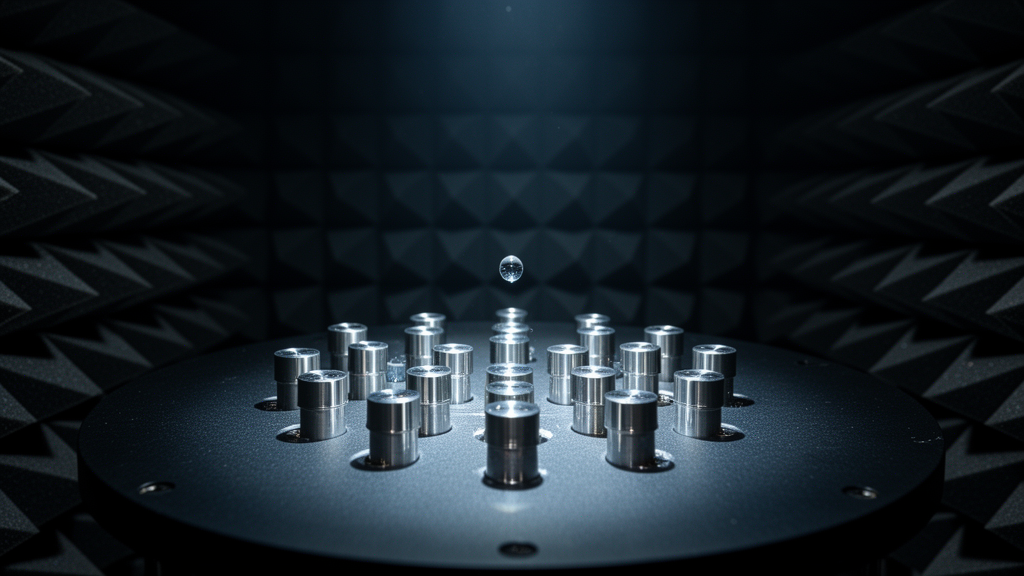
A multielement ultrasonic array operating in the low-frequency acoustic spectrum has demonstrated the generation of high-intensity focused ultrasound in air, reaching focal pressure levels of 173 decibels. Developed to overcome the physical barriers that have historically limited airborne acoustic intensity, the system employs 128 individual piezoelectric transducers distributed across a concave spherical surface. High-intensity focused ultrasound has long served as an established modality within medical therapy, where megahertz-frequency beams converge within liquid or biological tissue to achieve focal pressures exceeding 100 megapascals for targeted ablation. Similar high-intensity focused ultrasound transducers for air environments do not yet have a wide range of design implementations and applications. Previous efforts to construct multielement airborne arrays achieved peak amplitudes between 150 and 163 decibels, falling short of the 175-decibel thresholds produced by single-element industrial plate radiators. By optimizing element placement and phase coherence, this experimental design produces an intense acoustic field concentrated into a focal zone measuring approximately one centimeter across.
To generate this concentrated acoustic field, the researchers constructed a spherical shell with a diameter of 500 millimeters and an identical radius of curvature of 500 millimeters, fabricated from transparent acrylic. Within this spherical bowl, 128 commercial piezoelectric transducers were arranged in an eight-arm spiral configuration. Arranging radiating elements along spiral pathways breaks the spatial periodicity common to regular grid arrays, suppressing parasitic grating lobes and secondary diffraction maxima that otherwise disperse wave energy away from the intended focal volume. Each radiating element possesses a diameter of 30 millimeters and operates at a nominal center resonance frequency of 35.5 kilohertz, corresponding to an airborne acoustic wavelength of approximately 9.6 millimeters. Because the 50-centimeter aperture and focal length substantially exceed this operating wavelength, the geometric configuration enables sharp angular convergence. The resulting geometric concentration localizes acoustic energy into a compact focal volume whose lateral dimensions closely match the wavelength of the emitted sound waves, establishing the spatial foundation for extreme energy density.
Because all 128 piezoelectric transducers were wired in parallel to a single electrical excitation source, conventional electronic phase adjustment across separate digital channels was impossible. To guarantee constructive wave interference at the focal point, the investigative team implemented an individual mechanical alignment mechanism for every element. Each transducer was secured inside an externally threaded tubular holder that screwed directly into pre-tapped openings penetrating the acrylic housing. Rotating these holders enabled axial displacement over an adjustment travel range of 40 millimeters with a positioning precision of 0.1 millimeters, which is significantly smaller than one-tenth of the operating acoustic wavelength. Alignment was conducted by positioning a calibrated measurement microphone directly at the geometric focus while activating individual elements sequentially with a continuous 35.5-kilohertz signal. By monitoring the acoustic waveform on an oscilloscope against a stable reference oscillation, technicians turned each threaded mount until the acoustic wave arrived in precise phase coherence with the reference signal, eliminating phase errors stemming from fabrication tolerances.
Connecting 128 piezoelectric transducers in parallel significantly reduced the overall electrical impedance of the system, creating a challenging electrical load for the driving laboratory hardware. While an individual transducer exhibited an impedance of roughly 80 ohms at its 35.5-kilohertz mechanical resonance and 3500 ohms at its 37-kilohertz antiresonance, the entire 128-element parallel network presented a net resistance on the order of 1 ohm. Standard laboratory power amplifiers are designed to drive nominal loads of 8 ohms, making direct connection inefficient and potentially damaging to the amplifier circuitry. To overcome this impedance mismatch, an intermediate passive matching network composed of inductive and capacitive reactive elements was inserted between the power amplifier and the transducer array. Electrical impedance spectroscopy confirmed that this network shifted the real component of the input load to 7 ohms while driving the imaginary reactive component near zero. Operating signals were produced by an Agilent signal generator and amplified through an Atoll power amplifier delivering 45 watts, respecting the 10-volt maximum operating threshold.
Characterization of the radiated sound field relied on transient acoustic holography conducted within a computer-controlled three-dimensional micropositioning scanner possessing six-micron spatial positioning accuracy. A calibrated quarter-inch condenser microphone was mounted inside a 90-degree conical metal shield designed to eliminate backscattered acoustic reflections from the mounting apparatus. The scanning system translated the microphone across a square transverse grid comprising 101 by 101 measurement nodes spaced at four-millimeter increments, creating an overall scanning aperture of 400 by 400 millimeters positioned 240 millimeters from the array center. The array received twenty-cycle tone bursts at 35.5 kilohertz with a repetition period of 10 milliseconds, averaging sixteen individual acquisitions per position on an oscilloscope using a four-millisecond recording window. By applying the Fourier transform to the recorded time-domain pressure waveforms, the researchers extracted two-dimensional complex pressure distributions across the measurement plane, providing the raw spatial data necessary to reconstruct the entire three-dimensional acoustic beam.
Using the monochromatic holograms recorded across the scanning plane, the researchers calculated acoustic backpropagation toward the source surface via the Rayleigh integral to reconstruct particle velocity distributions. This reconstruction revealed that approximately 70 percent of the piezoelectric elements operated at optimal amplitude, while a minority exhibited weaker vibration owing to minor variations in their individual electromechanical resonant frequencies. The reconstructed phase distribution confirmed that mechanical holder adjustments successfully aligned the majority of radiating elements into a uniform phase front at 35.5 kilohertz. Spatial intensity distributions in the focal plane demonstrated the critical importance of this alignment: normalized acoustic intensity at the adjusted 35.5-kilohertz frequency proved 30 percent higher than the intensity recorded at 36 kilohertz, where elements lacked phase synchrony. Integrating the angular spectrum of the forward-projected acoustic pressure field yielded a total radiated acoustic power of approximately 0.045 watts at an excitation level of 1 volt, providing a comprehensive quantitative benchmark of the radiated acoustic energy.
To provide independent validation of the microphone measurements, the investigators implemented an acoustic radiometer system that evaluated total acoustic power by measuring radiation force exerted upon a conical reflector. An aluminum conical reflector featuring an opening angle of 90 degrees and a base diameter of 210 millimeters was suspended directly above the upward-radiating ultrasonic array. The reflector was mounted on the suspension of a digital scale that detected changes in weight corresponding to the vertical component of the radiation force. Continuous harmonic acoustic excitation produced a measurable vertical radiation force directly proportional to the radiated acoustic power divided by the speed of sound. At an excitation amplitude of 1 volt, the radiation force balance indicated an acoustic power roughly half that calculated from the complete hologram. This difference matched theoretical expectations because the 210-millimeter reflector captured only a central subregion of the spreading 400-millimeter beam, closely matching spatial holographic integrations restricted to a corresponding 180-millimeter circular aperture.
Simultaneous measurements of delivered electrical power using an in-line wattmeter and radiated acoustic power enabled direct calculation of the electroacoustic conversion efficiency across varying frequencies. The experimental measurements revealed that the electroacoustic efficiency of the 128-element focusing array reached a maximum value of approximately 13 percent at 35.7 kilohertz, while maintaining an efficiency of roughly 12 percent at the 35.5-kilohertz operating design point. This conversion performance is considerably lower than the 75 to 80 percent efficiencies achieved by industrial single-element airborne systems that utilize bending vibrations of profiled plates driven by Langevin vibrators. Nevertheless, the array efficiency substantially exceeds the performance of conventional audio loudspeakers, which typically convert only a small percentage of electrical power into acoustic energy. Because the large spherical aperture concentrates energy radiated from 128 distinct phased sources, the system generates extreme localized acoustic intensities despite this modest intrinsic electroacoustic conversion rate.
Direct physical measurement of the highest focal pressures was ultimately restricted by the operational limitations of physical microphones, as the GRAS condenser unit exhibited severe distortion beyond its 160-decibel dynamic range limit. When element excitation was raised to 5.8 volts, the measured focal pressure reached 2500 pascals, equivalent to 162 decibels, while higher drive levels of 7.7 volts caused clipping of the positive pressure peaks. To accurately evaluate the sound field at maximum driving voltage without instrumentation artifacts, the researchers employed the open-source numerical simulation software HIFU Beam. This modeling tool computes nonlinear acoustic wave propagation governed by the Westervelt equation for an equivalent circular piston source with a central aperture. Parameters for the equivalent piston model were selected by fitting calculated linear pressure profiles to low-amplitude experimental scans. Driving the simulated transducer to the allowable continuous-wave limit of 10 volts predicted strong acoustic waveform distortion, characterized by steep shock fronts, shortened positive compression peaks reaching 8.6 kilopascals, and an overall focal intensity of 173 decibels.
Simulating a peak pressure of 173 decibels within a focal spot measuring 10 millimeters across approaches the pressure outputs previously reported for single-element industrial transducers. Operating at maximum voltage produced an estimated five watts of acoustic power, yielding an acoustic radiation force of two millinewtons on the suspended target. This magnitude of steady radiation force highlights the potential of multielement arrays for non-contact material manipulation, including the stable acoustic levitation of objects significantly heavier than the milligram-scale droplets handled by conventional standing-wave traps. Furthermore, the capacity to reposition threaded element holders introduces geometric versatility, enabling physical tuning of focal distance and the synthesis of complex acoustic phase distributions such as vortex beams. The emergence of finite-amplitude nonlinear shock waves in open air opens practical avenues for industrial defoaming, enhanced drying, and laboratory investigations into nonlinear wave-matter interactions using compact, low-frequency phased apertures.
Subject of Research: Acoustic and electrical characterization of a 128-element low-frequency focusing ultrasonic transducer array in air.
Article Title: A Multielement Low-Frequency Ultrasonic Transducer as a Source of High-Intensity Focused Ultrasound in Air
Article References: Asfandiyarov, S. A., Tsysar, S. A., & Sapozhnikov, O. A. (2024). A Multielement Low-Frequency Ultrasonic Transducer as a Source of High-Intensity Focused Ultrasound in Air. Acoustical Physics, 70(4), 759-768. https://doi.org/10.1134/s1063771024601936
Image Credits: AI Generated
DOI: 10.1134/S1063771024601936
Keywords: airborne ultrasound, high-intensity focused ultrasound, piezoelectric transducers, acoustic holography, radiation force balance, acoustic levitation, nonlinear acoustics, Westervelt equation, focal spot localization, electroacoustic efficiency, spiral antenna array, mechanical phase alignment, acoustic pressure, shock waves, low-frequency ultrasound, equivalent piston source, transient acoustic holography
News Source: Denise Maddox. (November 24, 2026). Multielement Ultrasonic Array Reaches 173 Decibels in Air. Scienmag.