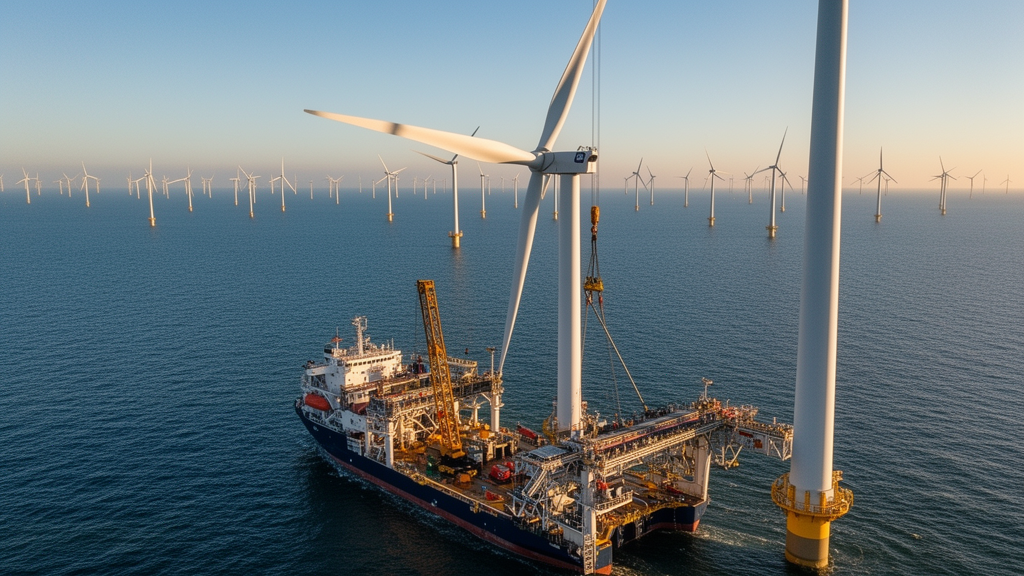
A transparent and reproducible scenario model linking turbine reliability, availability, energy yield, and the levelised cost of energy shows that next-generation offshore wind installations could achieve substantial cost reductions driven primarily by scale and financing. Developed by researchers Adriano García Piquero and Miguel Ángel Pardo Picazo, the model evaluates offshore wind deployment in deeper water with floating foundations. The study quantifies how much of the projected cost reduction stems from reliability and turbine scale versus exogenous cost and financing assumptions.
To establish baseline behavior, the authors translated subsystem failure rates from a 97-turbine onshore fleet of 1.5-megawatt turbines offshore using published stress factors. These failure rates were extrapolated to 8-megawatt and 15-megawatt ratings using explicit scaling laws. Availability was determined through a Monte Carlo failure-and-repair simulation running for 10,000 turbine-years with a fixed random seed. The simulated availability directly informed the net capacity factor and final levelised cost calculations.
Four operational scenarios were examined: an onshore reference designated as S1, its offshore translation designated as S2, a 640-megawatt fixed-bottom farm designated as S3, and a 900-megawatt floating farm designated as S4. Central levelised cost of energy values reached 119 euros per megawatt-hour for S2, 79.5 euros per megawatt-hour for S3, and 65.8 euros per megawatt-hour for S4. Input-uncertainty 90 percent intervals spanned 102 to 141 euros per megawatt-hour for S2, 68 to 95 euros per megawatt-hour for S3, and 56 to 88 euros per megawatt-hour for S4.
A Shapley decomposition attributed the 53 euro per megawatt-hour cost reduction from S2 to S4 across multiple drivers. Gains in gross capacity factor contributed a 17.8 euro per megawatt-hour reduction, lower operations and maintenance costs per megawatt saved 15.4 euros per megawatt-hour, reduced capital expenditure per megawatt saved 14.1 euros per megawatt-hour, and favorable financing terms lowered costs by 13.8 euros per megawatt-hour. Lower operational availability partially offset these savings by adding 7.4 euros per megawatt-hour.
Across every evaluated offshore scenario, the weighted average cost of capital, capacity factor, and capital expenditure emerged as the three most influential inputs determining the levelised cost of energy. Turbine failure rate ranked fourth in overall input sensitivity. These results demonstrate that financing conditions, resource yield, and capital outlays exert substantially greater leverage over offshore wind generation costs than incremental variations in subsystem component reliability.
The authors emphasize strict boundaries regarding these technological projections. The favorable cost ranking of the 900-megawatt floating farm over the fixed-bottom farm holds only for mechanical scaling exponents up to approximately 0.8, and only if floating capital expenditure remains below 2.7 million euros per megawatt. Because these comparative advantages rely on specific mechanical and cost thresholds, the findings for future fixed-bottom and floating installations serve as conditional scenario projections rather than definitive forecasts.
Subject of Research: Predictive modeling of offshore wind farm reliability and energy costs
Article Title: Comprehensive predictive models for offshore wind farm performance: integrating reliability, energy production and cost analysis for current and next-generation installations
Article References: Piquero, A. G., & Picazo, M. Á. P. (2026). Comprehensive predictive models for offshore wind farm performance: integrating reliability, energy production and cost analysis for current and next-generation installations. Energy Informatics. https://doi.org/10.1186/s42162-026-00712-y
Image Credits: AI Generated
DOI: 10.1186/s42162-026-00712-y
Keywords: offshore wind energy, levelised cost of energy, floating wind farms, fixed-bottom wind farms, turbine reliability, Monte Carlo simulation, net capacity factor, subsystem failure rates, Shapley decomposition, capital expenditure, operational expenditure, weighted average cost of capital, scaling laws, energy yield, predictive modeling, turbine availability, scenario analysis
News Source: Denise Maddox. (November 24, 2026). Offshore Wind Cost Projections Depend on Scale and Capital Thresholds. Scienmag.