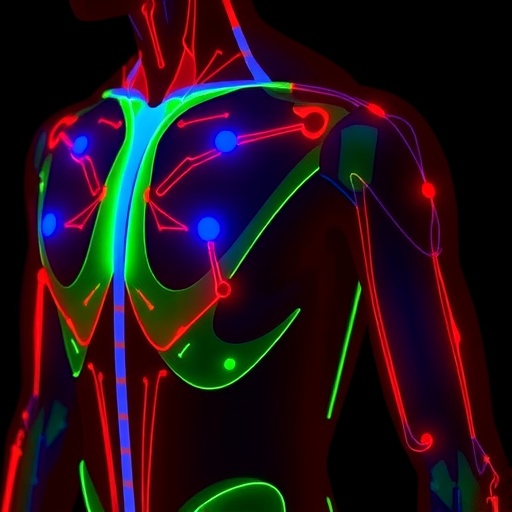
Researchers have unveiled a new approach to making soft robots and wearable machines look and move more like living organisms: flexible actuators that combine muscle-like motion with skin-like color changes. The study, published in npj Flexible Electronics, describes multicolor electrochromic actuators designed for biomimetic “skin-muscle coupling,” an architecture in which an artificial muscle does not merely move but also visually communicates its state through changes in color. The concept could help transform soft robotics from systems that quietly perform mechanical tasks into machines that visibly react, signal stress, display information and interact more naturally with people.
The work by Sun, Eom, Kim and colleagues addresses a persistent challenge in bioinspired engineering. In the human body, movement and appearance are tightly linked. Muscles contract beneath skin, while the skin can change color in response to temperature, emotion, circulation or injury. Most artificial actuators, by contrast, produce motion through motors, pneumatic chambers, shape-memory materials or electrically driven polymers, while visual feedback is handled by separate displays, LEDs or sensors. That separation adds weight, wiring, energy demands and mechanical complexity. The new device seeks to merge these functions into a single flexible platform, allowing actuation and optical signaling to occur within the same soft structure.
Electrochromism is the key technology behind the visual response. Electrochromic materials change their optical properties when a small electrical voltage drives ions and electrons through an active layer. Depending on the chemistry and device design, the material may switch between transparent and colored states or move among several distinct colors. Unlike conventional light-emitting displays, electrochromic systems do not need to continuously generate light to remain in a switched state. They can therefore offer low-power visual information, a particularly attractive feature for wearable electronics, robotic skins and autonomous devices that must operate with limited batteries.
In the reported architecture, the electrochromic component is integrated with a flexible actuator so that electrical stimulation can produce both deformation and color variation. The mechanical action may arise from electrochemical expansion, contraction or interfacial forces generated inside layered materials. When voltage is applied, the device changes shape while its optical state shifts, creating a direct connection between “muscle” activity and “skin” appearance. This coupling is technically important because it can eliminate the need for an external indicator that interprets actuator movement after the fact. Instead, the material itself becomes a visible record of its own operation.
A multicolor response expands the idea beyond a simple on-or-off signal. In a biomimetic robot, different colors could represent different levels of contraction, operating modes, temperature conditions or warning states. A gentle color shift might indicate a small movement, while a stronger response could signal a larger deformation or rising load. In wearable technology, the same mechanism could provide unobtrusive feedback without a conventional screen. A sleeve, patch or artificial limb might change color as it bends, responds to pressure or reaches a programmed condition. The device could thus function simultaneously as an actuator, a low-power display and a form of embodied sensing.
The researchers’ strategy is especially relevant to soft robotics, a field built around compliant materials that bend, stretch and deform rather than relying exclusively on rigid joints. Soft robots are being developed for delicate grasping, medical assistance, rehabilitation, adaptive interfaces and exploration in environments where conventional machines may be too heavy or dangerous. Yet their softness also makes it difficult to know what is happening inside them. Rigid robots can expose position through encoders and screens; a deformable robot may require distributed sensors, complex electronics and sophisticated control algorithms. A color-changing actuator offers a more immediate channel of information. Its surface could provide a visual map of activity, making the machine easier to interpret.
The design also reflects a broader movement toward multifunctional materials in flexible electronics. Rather than building a device from separate layers for movement, sensing, energy storage, communication and display, researchers are increasingly trying to make each layer perform more than one role. This reduces the number of components and may improve mechanical compatibility, because a monolithic or closely integrated system can bend more naturally than a collection of rigid parts connected by wires. For artificial skin, that integration is crucial. Human skin stretches over moving muscles without losing contact; an engineered equivalent must maintain electrical and mechanical function while repeatedly deforming.
The road from laboratory demonstration to practical biomimetic systems will depend on several engineering questions. Electrochromic materials must switch rapidly enough for responsive motion and remain stable through many cycles of bending and color change. The actuator must generate useful force or displacement without becoming too thick, rigid or power-hungry. Researchers must also control color uniformity across flexible surfaces, prevent material degradation and protect the active layers from moisture, oxygen and mechanical damage. For wearable applications, safety is equally important: operating voltages, encapsulation, skin contact and long-term durability will all influence whether the technology can leave the laboratory.
Even with those challenges, the concept points toward machines that communicate through appearance as naturally as they move through space. A robotic hand could visibly express how strongly it is gripping. An artificial muscle could show whether it is relaxed, activated or overloaded. A prosthetic interface might provide visual feedback without requiring a separate display, while a soft medical device could signal its state through a change in color on the body. In more theatrical applications, robotic surfaces could imitate the visual behavior of animals, insects or human tissue, creating machines that are not only functional but also socially legible.
The significance of the study lies in its attempt to close the gap between artificial mechanics and biological organization. Living systems rarely isolate movement from sensation and appearance; their tissues operate as interconnected structures in which force, feedback and visual change reinforce one another. Multicolor electrochromic actuators move flexible electronics closer to that model by giving an artificial “muscle” a responsive “skin.” If future versions improve speed, durability, scalability and color control, the technology could become part of a new generation of soft robots and wearable systems that do more than move on command. They could reveal what they are doing, communicate their condition and respond to the world through motion and color in one integrated act.
Subject of Research: Multicolor electrochromic actuators for biomimetic skin-muscle coupling in flexible electronics, soft robotics and wearable systems.
Article Title: Multicolor electrochromic actuators for biomimetic skin-muscle coupling
Article References: Sun, F., Eom, S.Y., Kim, M.J. et al. “Multicolor electrochromic actuators for biomimetic skin-muscle coupling.” npj Flexible Electronics (2026). https://doi.org/10.1038/s41528-026-00639-0
Image Credits: AI Generated
DOI: 10.1038/s41528-026-00639-0
Keywords: electrochromic actuators, multicolor electronics, biomimetic skin, artificial muscles, flexible electronics, soft robotics, wearable technology, electrochromism, robotic skin, bioinspired devices
Tags: bioinspired artificial musclesbiomimetic skin-muscle couplingbiomimetic soft roboticscolor-changing soft actuatorsflexible electrochromic devicesflexible electronic skinintegrated motion and visual feedbackmulticolor electrochromic actuatorsmultifunctional soft actuatorssoft robot signal communicationsoft robotic actuatorswearable soft robots