A single woman with advanced secondary progressive multiple sclerosis walked nearly twice as fast after completing an 18-week rehabilitation program built around a multichannel functional electrical stimulation system, according to a retrospective case report published in Frontiers in Rehabilitation Sciences. The report, which analyzed prospectively collected data from routine clinical care, describes how the participant progressed from a supervised clinic-based phase to a supervised home phase and finally to unsupervised home training, completing all 58 planned sessions without dropping out. The authors emphasize that the findings concern one person and cannot establish whether the intervention works in general, but they argue the case demonstrates that this kind of hybrid clinic-to-home program is feasible and well tolerated in someone with significant disability.
The participant was a 61-year-old woman diagnosed with secondary progressive multiple sclerosis in 2001. At the time of the intervention she had an Expanded Disability Status Scale score of 6, which corresponds to needing a unilateral walking aid such as a cane to ambulate approximately 100 meters. Her primary complaint was progressively worsening gait and balance. Clinically, she showed mild weakness of the right lower limb, reduced foot clearance during the swing phase of walking, reduced propulsion, impaired balance, and fatigue-related deterioration of gait, a pattern the authors describe as consistent with monoparesis rather than hemiplegia or paraplegia. She had mild spasticity in both calf muscles, rated 1 on the Modified Ashworth Scale, occurring mainly at night, and was taking oral baclofen. She had received ongoing physiotherapy for her multiple sclerosis but had never previously used functional electrical stimulation. She required a cane for community ambulation and provided written informed consent for the use of her clinical data in research.
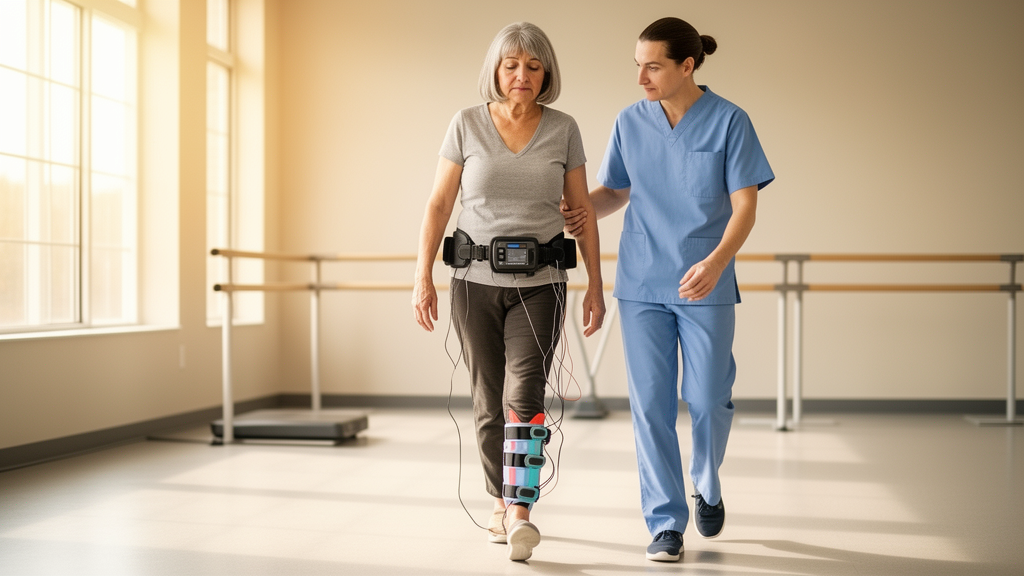
Functional electrical stimulation, or FES, delivers electrical pulses that trigger muscle contractions, and when timed to the walking cycle it can support gait in people with neurological conditions. The device used here, NeuroSkin, is a CE-marked wearable system that differs in two important ways. It is multichannel, with dry electrodes positioned over six major muscle groups on each leg, including the gluteus maximus, quadriceps, hamstrings, tibialis anterior, fibularis longus, and triceps surae. It also embeds seven inertial measurement units and instrumented insoles with eight plantar pressure sensors per foot, allowing a real-time gait-phase detector to synchronize stimulation to the wearer’s own walking pattern while simultaneously recording quantified gait analysis data.
Stimulation was delivered in a gait-phase-specific manner at 40 Hz, with pulse widths ranging from 200 to 400 microseconds depending on the muscle group: 400 microseconds for the quadriceps, gluteals, and hamstrings, 250 microseconds for the triceps surae, and 200 microseconds for the tibialis anterior and fibularis longus. Mean stimulation intensities across the program were modest, ranging from about 17 to 26 milliamperes depending on the muscle. Before training began, the participant completed a calibration procedure determining the maximum tolerable stimulation level for each muscle, confirmed by the physiotherapist as producing a visible, non-painful motor response, and a short recalibration was performed at the start of every session. The system’s general gait model, initially developed from recordings of healthy and post-stroke individuals, was personalized to her gait through a short walking trial without stimulation.
The program itself was multimodal. Each of the 58 sessions lasted 60 to 80 minutes and began with a 10-minute seated warm-up in which alternating multichannel stimulation was applied in a walking-like pattern while the participant performed motor imagery with her eyes closed. This was followed by 15 minutes of FES-assisted sit-to-stand training, four sets of ten repetitions with external weights progressing from 2 to 9 kilograms, then 20 minutes of FES-assisted cycling on a recumbent bike at a self-selected cadence, with stimulation intensity adjusted to the maximum tolerable level. The final active phase consisted of up to 10 minutes of FES-assisted overground gait training, including obstacle negotiation and stair ascent and descent, with outdoor walking when feasible; the therapist could extend this to 30 minutes depending on the participant’s fatigue. Each session ended with a five-minute semi-recumbent recovery period. The 18 weeks were divided into a 7-week clinic-based phase of 23 sessions, a 6-week supervised home-based phase of 20 sessions, and a 5-week unsupervised home-based phase of 15 sessions, at three to five sessions per week.
Functional outcomes were assessed at four time points: baseline, after the clinic phase, after the supervised home phase, and after the unsupervised home phase, all under identical conditions by the same trained examiner. Walking speed on the 10-meter Walk Test rose steadily from 0.53 meters per second at baseline to 0.84 after the clinic phase, 1.01 after the supervised home phase, and 1.04 meters per second at the end, a 96 percent increase. Timed Up and Go time, which integrates standing up, walking three meters, turning, and sitting down, fell from 17 seconds at baseline to 11 seconds at the end, a 35 percent improvement, with the fastest time of 10.6 seconds recorded after the supervised home phase. The authors report that both changes exceeded published minimal detectable change thresholds for these measures in multiple sclerosis, meaning they were larger than the measurement error of the tests, although those thresholds were derived in populations with generally lower disability levels than this participant.
The balance results were more complicated. Performance on the Functional Reach Test improved from 32 centimeters at baseline to 40 centimeters after the clinic phase and 42 centimeters after the supervised home phase, gains of 25 and 31 percent, but returned to the baseline value of 32 centimeters by the end of the unsupervised home phase. The authors interpret this as suggesting initial gains in dynamic balance that were not fully maintained. The embedded quantified gait analysis added another layer: during the clinic-based phase, gait speeds ranged roughly from 25 to 80 centimeters per second, while the supervised home phase showed higher speeds of up to more than 75 centimeters per second and step lengths up to 60 centimeters with greater session-to-session variability. During the unsupervised home phase, gait speed clustered between 50 and 60 centimeters per second and step length between 35 and 45 centimeters, lower than during either supervised phase. The authors caution that with a single-case design the reasons for this difference remain speculative and may reflect supervision, motivation, day-to-day variability, fatigue, or training progression.
On safety and tolerability, no serious adverse events occurred across the entire 18-week period. The participant experienced transient skin redness after some sessions, which the authors note was not systematic and might be attributable to exercise-induced changes in skin vascularization; the duration and recurrence of these episodes were not systematically documented. Device deficiencies, defined as technical malfunctions not affecting safety, occurred in 3 of the 58 sessions and were resolved promptly without preventing completion. The participant completed all planned sessions, and the documented clinical record notes that she reported being able to cover longer distances in her neighborhood even without wearing the device, and that her performance felt better when the physiotherapist was present to motivate her.
The authors are explicit about the limits of what this case can show. As a retrospective analysis of a single case, it precludes causal inference and generalization, and no follow-up assessment was conducted to test whether the gains persisted after the program ended, although the participant has since continued home-based FES sessions, which was not formally evaluated. The assessments were routine clinical follow-up evaluations rather than predefined research timepoints, and values represent a single trial per timepoint without replicate-trial variability. Family history and psychosocial context were not available in the retrospective record. The authors also note that the participant was selected for review precisely because she completed the entire program and had already been equipped with a personal device as part of routine care, which introduces selection considerations. They conclude that a hybrid clinic-to-home multichannel FES rehabilitation program is feasible and well tolerated in a person with advanced secondary progressive multiple sclerosis across care settings, and that controlled studies with larger cohorts, longer follow-up, and appropriate designs are needed to establish whether the observed functional changes reflect a genuine treatment effect.
Subject of Research: Feasibility of a clinic-to-home multichannel functional electrical stimulation gait rehabilitation program in a single person with secondary progressive multiple sclerosis
Article Title: Case Report: Feasibility of clinic-to-home multichannel FES-assisted gait rehabilitation in secondary progressive multiple sclerosis
Article References: Leal, M., Metani, A., Séguin, P., & Descollonges, M. (2026). Case Report: Feasibility of clinic-to-home multichannel FES-assisted gait rehabilitation in secondary progressive multiple sclerosis. Frontiers in Rehabilitation Sciences, 7, Article 1939617. https://doi.org/10.3389/fresc.2026.1939617
Image Credits: AI Generated
DOI: 10.3389/fresc.2026.1939617
Keywords: multiple sclerosis, functional electrical stimulation, gait rehabilitation, case report, secondary progressive MS, NeuroSkin, home-based rehabilitation, walking speed, Timed Up and Go, balance, tele-rehabilitation, neurorehabilitation
News Source: Ophelia Keating. (October 29, 2026). Multichannel FES Gait Rehabilitation Feasible Across Clinic and Home in Advanced MS Case. Scienmag.