A multicenter observational study conducted across two major medical institutions in China has demonstrated that a cerebral revascularization strategy focused systematically on superficial temporal artery patency provides an acceptable surgical approach for preventing recurrent strokes in adult patients diagnosed with moyamoya disease. The retrospective investigation, undertaken by neurosurgical researchers at Beijing Hospital and Nanjing Drum Tower Hospital, tracked 303 adult patients treated between January 2019 and December 2021. Moyamoya disease represents a rare cerebrovascular condition characterized by chronic, progressive stenosis of the intracranial arteries alongside the compensatory formation of fragile networks of moyamoya vessels at the skull base. Without surgical intervention, the natural course of the disorder carries severe risks of intracranial hemorrhage, ischemic events, and progressive cognitive decline. Extracranial-intracranial bypass procedures have emerged as standard treatments designed to restore adequate hemodynamic flow, and the current research sought to clarify clinical and radiological outcomes using a tailored surgical paradigm termed the superficial temporal artery patency concept.
The foundational principle behind the superficial temporal artery patency concept prioritizes the preservation and hemodynamic contribution of the functional superficial temporal artery as the primary donor vessel. Rather than applying a single rigid revascularization model across all anatomical variants, the strategy strategically directs blood supply through direct or indirect pathways to establish durable collateral neovascularization across ischemic territories. In operative practice, neurosurgeons evaluate the patency of the vessel and specifically calculate the diameter ratio between the superficial temporal artery and the recipient intracranial artery. Intraoperative microvascular Doppler ultrasonography and indocyanine green fluoroscopy are utilized during microsurgery to monitor flow velocities and cortical filling rates, ensuring that hemodynamic reconstruction precisely targets cerebral regions suffering from impaired perfusion while preserving graft viability.
Surgical decision-making within the cohort hinged upon precise intraoperative anatomical and hemodynamic thresholds measured during the intervention. When surgical teams identified an artery exhibiting minimal cortical flow velocity or the slowest fluorescence angiographic transit, it was selected as the target recipient vessel. If the anatomical ratio between the donor superficial temporal artery diameter and the recipient artery diameter exceeded 2, or if the recipient vessel measured less than 1 millimeter across, surgeons prioritized indirect revascularization using encephalo-duro-arterio-synangiosis alone. Conversely, when the diameter ratio fell below 2 and the recipient cortical artery presented a caliber greater than 1 millimeter, a combined direct and indirect approach consisting of superficial temporal artery to middle cerebral artery bypass with encephalo-duro-arterio-synangiosis was systematically performed.
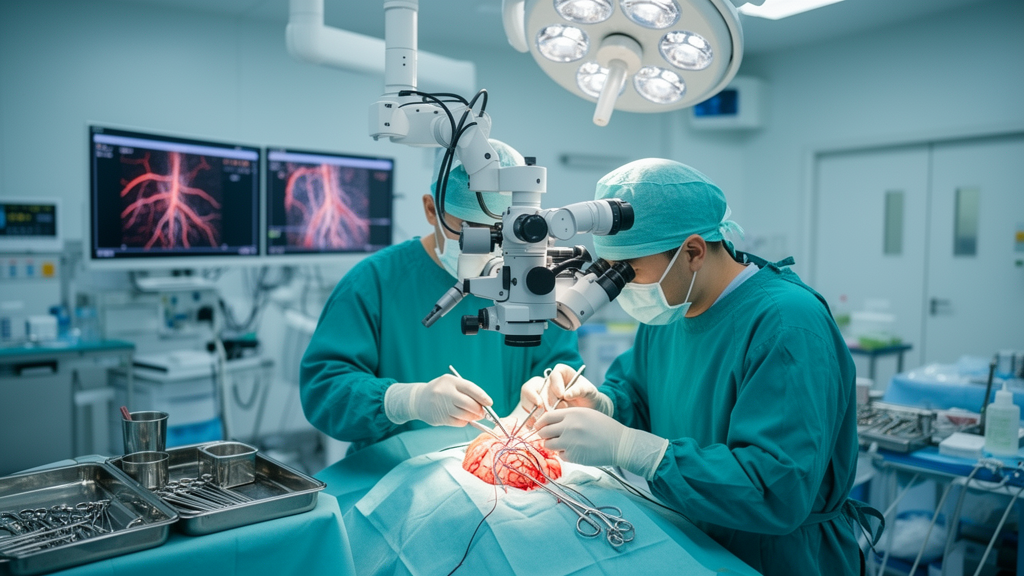
The operative protocol comprised a rigorous series of sequential microvascular steps designed to minimize donor trauma and maximize downstream patency. After patient positioning and Doppler ultrasound mapping of the frontal and parietal superficial temporal artery branches from the root of the zygomatic arch, surgeons carefully dissected the temporal fascia and administered papaverine locally to prevent vasospasm. Following a T-shaped temporalis muscle incision and a centered craniotomy over the sylvian fissure that exposed the frontal, parietal, and temporal lobes while avoiding injury to the middle meningeal artery, the dura was opened in a cross shape with minimized electrocoagulation. For combined bypass cases, the donor branch was prepared with a 2.5 to 4 millimeter fish-mouth cut and anastomosed to the M4 recipient cortical middle cerebral artery using 10-0 nylon sutures, confirmed by intraoperative indocyanine green angiography or Doppler ultrasound before securing the indirect branch to the incised arachnoid membrane.
Among the 303 enrolled adult patients, 170 individuals underwent combined direct and indirect revascularization via superficial temporal artery to middle cerebral artery bypass with encephalo-duro-arterio-synangiosis, while 133 individuals underwent indirect revascularization via encephalo-duro-arterio-synangiosis alone. At baseline, the mean age of the patient cohort was 43 years with a standard deviation of 10 years and an age range spanning from 16 to 75 years. The initial clinical presentations prompting admission included cerebral ischemia in 171 patients, cerebral hemorrhage in 105 patients, headache in 2 patients, epilepsy in 11 patients, and other symptoms in 14 cases. Among the 244 patients who underwent pre-intervention cerebral angiography, 69.97 percent exhibited advanced disease corresponding to Suzuki stages 3, 4, or 5.
Immediate postoperative evaluations documented an overall perioperative complication rate of 12.21 percent across the combined cohort, representing 37 affected patients prior to hospital discharge. In the combined surgical cohort of 170 patients, perioperative complications arose in 27 individuals, corresponding to an incidence of 15.9 percent. These events included 15 instances of newly developed cerebral infarction, 5 cases of cerebral hemorrhage, 20 cases of cerebral hyperperfusion syndrome, 3 instances of subdural effusion, and 2 superficial wound infections. Within the indirect surgery cohort of 133 patients, 10 individuals experienced perioperative complications, yielding an overall complication rate of 7.5 percent that comprised 6 cerebral infarctions, 4 subdural effusions, and 8 skin infections, with no observed cases of hyperperfusion syndrome or newly developed hemorrhage.
Functional neurological status at hospital discharge was formally categorized using the modified Rankin Scale, revealing distinct short-term recovery trajectories between the groups. In the combined bypass group, 135 patients demonstrated no disability, 31 exhibited slight to moderate disability, and 4 presented with severe disability. In the indirect bypass group, 96 patients showed no disability, 31 had slight to moderate disability, and 6 had severe disability. When comparing discharge functional status directly against preoperative neurological scores across all 303 participants, 61 individuals demonstrated distinct functional improvement, 227 remained clinically unchanged, and 15 manifested functional deterioration during the immediate postoperative window.
Serial radiological monitoring established high rates of vascular graft patency alongside progressive restoration of cerebral microvascular perfusion over time. Bypass graft patency assessed by computed tomography angiography at 3 months reached 95.29 percent across the cohort, comprising 96.1 percent in the combined group and 93.5 percent in the indirect group. By 12 months, digital subtraction angiography confirmed sustained graft patency in 96.43 percent of assessed patients, including 95.2 percent of combined bypass patients and 97.1 percent of indirect bypass patients. Concurrently, computed tomography perfusion staging revealed hemodynamic improvement in 23.76 percent of patients at 3 months postoperatively, rising to 40.17 percent of patients at 12 months, with perfusion improvements documented in 48.68 percent of combined revascularization recipients compared to 24.39 percent of indirect recipients.
Long-term clinical surveillance extending beyond 12 months was completed in 249 patients followed for a median duration of 50 months, spanning an observation range of 12 to 70 months. Within this extended follow-up cohort, recurrent neurological stroke events were recorded in 40 patients, representing an overall recurrent stroke rate of 16.06 percent and an annualized risk of 3.85 percent per year. Among the 141 followed patients in the combined revascularization cohort, recurrent stroke developed in 22 patients, reflecting an incidence of 15.41 percent and an annual stroke rate of 3.69 percent per year. These recurrent events included 16 ischemic episodes comprising transient ischemic attacks or infarctions, 6 intracranial hemorrhages, and 3 rebleeding-related fatalities.
Among the 108 followed patients who underwent indirect revascularization alone, recurrent stroke events occurred in 18 cases, translating to a recurrent stroke rate of 16.67 percent and an annualized risk of 3.92 percent per year. The recurring events in the indirect bypass group consisted of 15 ischemic stroke episodes and 3 hemorrhagic recurrences. Long-term functional assessments at final follow-up confirmed that favorable functional independence was widely maintained, with 88.65 percent of combined bypass patients and 77.78 percent of indirect bypass patients achieving scores corresponding to normal neurological function on the modified Rankin Scale, while severe disability remained limited to 2.13 percent and 7.41 percent of patients in the respective groups.
In analyzing their postoperative outcomes, the investigative team noted a distinct absence of postoperative seizures across all 303 cases, a notable divergence from historical literature where postoperative seizure rates have reached up to 18.9 percent. The authors hypothesized that this difference reflected comprehensive preoperative hemodynamic staging, careful stabilization of the temporal artery fascia to prevent bone flap compression, the routine administration of prophylactic anti-epileptic agents such as sodium valproate or levetiracetam, and controlled blood pressure and hydration protocols. The researchers also cautioned against excessively aggressive lowering of postoperative blood pressure within normal ranges, hypothesizing that steep reductions might compromise autoregulation and precipitate secondary ischemic infarctions in distant vascular beds.
The study authors acknowledged significant methodological limitations inherent in the observational, retrospective design. The non-randomized allocation between combined and indirect revascularization meant that patients assigned to each cohort possessed baseline differences in cerebral hemodynamics and vessel dimensions, precluding direct causal superiority claims between the two techniques. Furthermore, the analysis restricted inclusion strictly to unilateral revascularization procedures, excluding bilateral surgical cases and patients with previous surgical history. Hemispheric perfusion assessment via computed tomography perfusion represented a semi-quantitative measurement without standardized absolute numerical thresholds, and loss to follow-up affected a portion of the original cohort, underscoring the necessity for future prospective, randomized multicenter trials to fully establish the clinical role of this protocol.
Subject of Research: Cerebral revascularization outcomes using the superficial temporal artery patency concept in adult moyamoya disease
Article Title: A novel superficial temporal artery patency concept of cerebral revascularization for patients with moyamoya disease: a multicenter study
Article References: Shi, Z., Li, X., Chen, X., Wu, L., Wang, R., Hang, C., Yang, Y., & Zhang, D. (2026). A novel superficial temporal artery patency concept of cerebral revascularization for patients with moyamoya disease: a multicenter study. Chinese Neurosurgical Journal, 12(1), Article 5. https://doi.org/10.1186/s41016-025-00424-4
Image Credits: AI Generated
DOI: 10.1186/s41016-025-00424-4
Keywords: moyamoya disease, cerebral revascularization, superficial temporal artery, stroke prevention, STA-MCA bypass, encephalo-duro-arterio-synangiosis, CT perfusion, neurosurgery, novel, superficial, temporal, artery
News Source: Ophelia Keating. (November 13, 2026). Multicenter Study Evaluates Donor Artery Patency Technique in Moyamoya Disease Surgery. Scienmag.