Increased concern over the sustainability of handling mine waste has led to a joint venture dedicated to mine tailings research and education
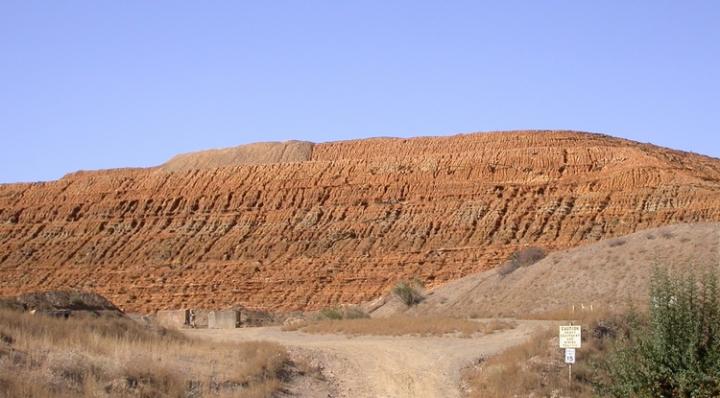
Credit: University of Arizona Superfund Research Center
As the global demand for minerals and metals continues to grow, so too does the proliferation of mine tailings – the waste materials left over when mining is complete. Tailings storage facilities, which typically remain long after the life of a mine is over, use dams to contain ground-up rock, sand, silt and water left over from processing valuable minerals such as copper, gold and phosphate. However, the storage facilities have the potential to fail.
Many of the world’s 15,000 mine tailings storage facilities are more prone to failure than other types of water storage embankments. In one of the worst failures of the last several decades, Brazil’s Córrego do Feijão iron ore mine near Brumadinho tailings dam collapsed in early 2019. A total of 270 people were killed in a tidal wave of mud that plastered more than 623 acres with sludge and contaminated hundreds of miles of river systems.
In an effort to minimize the risk and better prepare mining engineers and operators for managing tailings facilities, the University of Arizona, Colorado State University and the Colorado School of Mines have joined forces to launch the Tailings Center of Excellence. The center is focused on educating engineers on responsible and sustainable mine waste management and advancing research-backed best practices.
“The Department of Mining and Geological Engineering at the University of Arizona has established a longstanding expertise and international reputation in monitoring the health and safety of mining and civil engineering infrastructure,” said Moe Momayez, interim department head and David & Edith Lowell Chair in Mining and Geological Engineering. “We currently have several projects inside and outside Arizona that employ digital technologies, the industrial internet of things and artificial intelligence customized for each site to provide mine operators with real-time insight regarding water quality, seepage and mechanical stability of tailings storage facilities.”
Since its founding in 1885, the University of Arizona has been home to one of the world’s top mining programs. The Colorado School of Mines and Colorado State University also have high-ranking mining programs and tailings-related training and education. The new center’s educational offerings will include online and in-person short courses and workshops, interuniversity certificates and both undergraduate and graduate outreach. The universities will also leverage industry partnerships to keep pace with real-world needs.
Michael Geddis, corporate hydrogeologist at KGHM International, explained that continually tracking conditions such as pore pressures, seepage gradients and flow rates is imperative to preventing failures.
“Near real-time monitoring of critical parameters that correlate to these operational practices can lead to detection of internal changes in the tailings storage facility that could lead to failure,” he said. “Properly designed and maintained automated monitoring systems can provide this critical link.”
The Tailings Center of Excellence also will coordinate closely with the Tailings and Waste Engineering Center, a newly established consortium of faculty from Georgia Tech, UC Berkeley, the University of Illinois at Urbana-Champaign and Colorado State University.
“At the University of Arizona, we shape engineers who will shape the future,” said David W. Hahn, Craig M. Berge Dean of the UArizona College of Engineering. “Mined materials are essential for building our world – including advanced technologies such as solar panels, wind turbines and electric cars. This center furthers our commitment to collaborating with industry to promote sustainability, a pillar of our mission as a land-grant institution.”
###
Media Contact
Emily Dieckman
[email protected]
Original Source
https:/