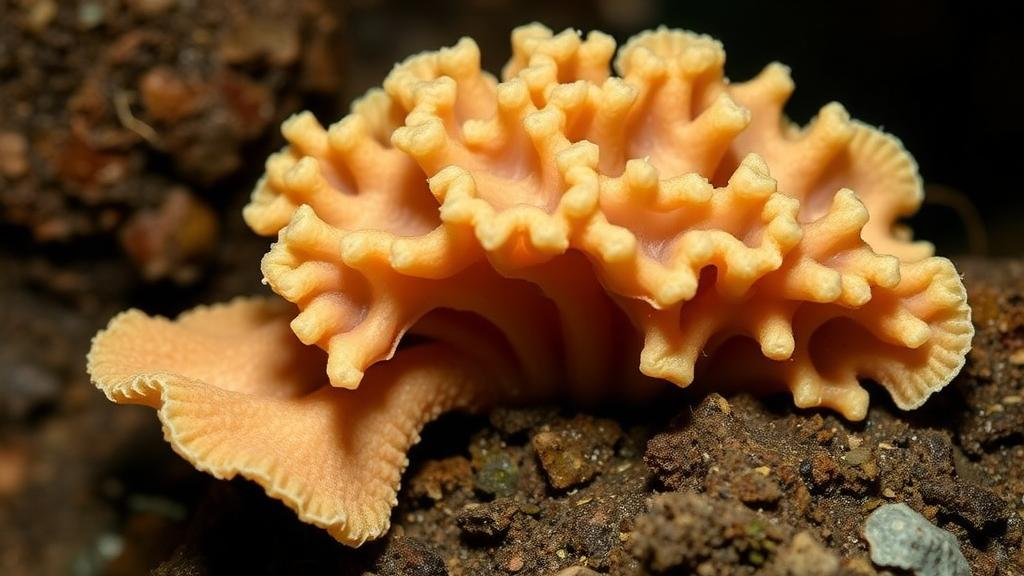
A multi-locus phylogenetic and morphological study of wood-decaying fungi in the Polyporales identified ten new species across three genera and estimated that the families Irpicaceae and Meripilaceae emerged near the boundary between the early and late Cretaceous. The taxonomic work focused primarily on Ceriporia and Meripilus , both genera known to cause white rot in angiosperm and gymnosperm wood, alongside the related genus Meruliopsis . Researchers used DNA sequences from six gene regions to reconstruct relationships among Ceriporia , Meripilus and other related fungi.
These included the internal transcribed spacer region, nuclear large and small subunit ribosomal RNA genes, translation elongation factor 1-alpha, and the RNA polymerase subunits RPB1 and RPB2. Separate five-locus combined datasets were assembled for Ceriporia and Meripilus . Their results supported the description and illustration of three new Ceriporia species, one new Meruliopsis species and six new Meripilus species.
Both have a monomitic hyphal system containing cyanophilous generative hyphae with simple septa. Ceriporia typically has resupinate basidiomata with a white or brightly colored pore surface when fresh, usually without a color change when bruised, and cylindrical to allantoid basidiospores. Meripilus instead ranges from resupinate and effused-reflexed to pileate basidiomata; its pore surface can turn red when bruised, and it produces ellipsoid to globose basidiospores.
These combined observations were evaluated alongside the molecular phylogenies in the taxonomic assessment. The researchers also estimated evolutionary timing for Polyporales, including Irpicaceae and Meripilaceae, through Bayesian analysis of conserved ITS, nLSU and TEF1 sequences. The analysis assigned Irpicaceae a mean crown age of 108.9 million years and Meripilaceae a mean crown age of 97.23 million years, placing their estimated emergence at the early–late Cretaceous junction.
The estimated mean crown age of Ceriporia was 83.61 million years, with a 95% highest posterior density interval of 65.25–106.35 million years. For Meripilus , the mean crown age was 81.38 million years, with a 95% interval of 61.89–105.78 million years. These model-based estimates indicate that the initial diversification of both genera occurred during the late Cretaceous, while the ten new taxa expand the documented diversity of the sampled fungal lineages.
Subject of Research: Phylogeny, divergence times, and taxonomy of fungi in Irpicaceae and Meripilaceae
Article Title: Studies in phylogeny and divergence times of Irpicaceae and Meripilaceae (Polyporales, Basidiomycota), with an emphasis on Ceriporia and Meripilus including ten new species
Article References: Wang, C.-G., Wu, Y.-D., Zhang, X., Dai, Y.-C., Li, Z.-H., & Yuan, Y. (2025). Studies in phylogeny and divergence times of Irpicaceae and Meripilaceae (Polyporales, Basidiomycota), with an emphasis on Ceriporia and Meripilus including ten new species. IMA Fungus, 16, Article e161336. https://doi.org/10.3897/imafungus.16.161336
Image Credits: AI Generated
DOI: 10.3897/imafungus.16.161336
Keywords: Fungal phylogeny, Ceriporia, Meripilus, Meruliopsis, White rot, New species, Bayesian dating, Cretaceous diversification, Basidiomycota, Polyporales, Studies, phylogeny
News Source: Roger Howard. (October 20, 2026). Multi-locus study of Polyporales maps lineages and describes ten new species. Scienmag.