• HOME
  • NEWS
  • EXPLORE
    • CAREER
      • Companies
      • Jobs
    • EVENTS
    • iGEM
      • News
      • Team
    • PHOTOS
    • VIDEO
    • WIKI
  • BLOG
  • COMMUNITY
    • FACEBOOK
    • INSTAGRAM
    • TWITTER
Thursday, June 25, 2026
BIOENGINEER.ORG
No Result
View All Result
  • Login
  • HOME
  • NEWS
  • EXPLORE
    • CAREER
      • Companies
      • Jobs
        • Lecturer
        • PhD Studentship
        • Postdoc
        • Research Assistant
    • EVENTS
    • iGEM
      • News
      • Team
    • PHOTOS
    • VIDEO
    • WIKI
  • BLOG
  • COMMUNITY
    • FACEBOOK
    • INSTAGRAM
    • TWITTER
  • HOME
  • NEWS
  • EXPLORE
    • CAREER
      • Companies
      • Jobs
        • Lecturer
        • PhD Studentship
        • Postdoc
        • Research Assistant
    • EVENTS
    • iGEM
      • News
      • Team
    • PHOTOS
    • VIDEO
    • WIKI
  • BLOG
  • COMMUNITY
    • FACEBOOK
    • INSTAGRAM
    • TWITTER
No Result
View All Result
Bioengineer.org
No Result
View All Result
Home NEWS Science News Health

MRI and computer modeling reveals how wrist bones move

Bioengineer by Bioengineer
February 13, 2019
in Health
Reading Time: 3 mins read
0
IMAGE
Share on FacebookShare on TwitterShare on LinkedinShare on RedditShare on Telegram

IMAGE

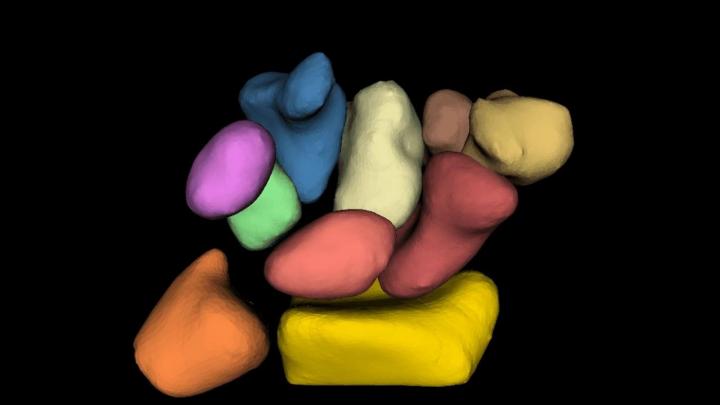
Credit: Brent Foster and Abhijit Chaudhari, UC Davis

We use our wrists constantly, but how do they work? In a just-published Journal of Biomechanics article, the researchers proved a longtime assumption about individuals’ right and left wrists, while also finding differences between wrists of males and females: discoveries that could help inform and guide future treatments.

“If someone has dysfunction of the wrist, it really impacts their quality of life,” said UC Davis Biomedical Engineering Graduate Group member and article first author Brent Foster, who also was selected for a prestigious National Science Foundation Graduate Research Fellowship to create a wrist-anatomy model. Foster currently is a graduate student in Dr. Abhijit Chaudhari’s lab in the UC Davis Department of Radiology, and his co-authors include orthopedic surgeons, a radiologist and medical-imaging experts at UC Davis and the University of Southern California.

Foster and his team scanned both wrists of 18 individuals – nine men and nine women of varying ages – with no history of wrist injuries, disease or pain. Using innovative MRI (magnetic resonance imaging) techniques, which allow 3-D views of wrists in motion, the researchers had individuals move their wrists in five ways while being scanned to track the movement of the wrist bones and joint. They then used advanced mathematical techniques to analyze the images to generate robust models of wrist motion.

“While each wrist bone had been studied individually before, our work really focuses on how wrist bones move and act together,” Foster said.

Wrists mirror each other

The results showed that while individual’s left and right wrists are similar, there were gender-based wrist differences. While wrist-based therapies had assumed that individuals’ left and right wrists mirrored each other, there has been insufficient evidence to back this assumption up until now.

The researchers initially hypothesized that there would not be significant wrist differences found between the male and female volunteers. But their measurements changed their minds: “While there is literature about scaling differences between male and female wrists, we are able to examine if bone trajectories during wrist motion differ by gender,” said Foster.

Wrist conditions such as carpal tunnel syndrome do disproportionately affect women, although it’s not clear why, Chaudhari said.

“There have historically been several theories about what wrist bones do during motion, and some cadaveric studies to support them. Analysis performed based on some of these theories illustrates sex differences, but that based on others doesn’t,” he said. The new fast MRI and CT scanning techniques allow researchers to study live wrist bones in motion for the first time.

Foster, Chaudhari and colleagues look forward to continuing their efforts to help people experiencing wrist pain and disorders like osteoarthritis and carpal-tunnel syndrome.

“By scanning just five basic wrist movements, we were able to explain over 91 percent of wrist variation across individuals,” he said. “We’re excited to use these innovative MRI and analysis methods to make a difference in managing wrist disorders.”

###

Media Contact
Andy Fell
[email protected]
530-752-4533

Original Source

http://blogs.ucdavis.edu/egghead/2019/02/13/mri-computer-modeling-reveals-wrist-bones-move/

Related Journal Article

http://dx.doi.org/10.1016/j.jbiomech.2019.01.030

Tags: Biomedical/Environmental/Chemical EngineeringMedicine/HealthOrthopedic Medicine
Share12Tweet8Share2ShareShareShare2

Related Posts

Post-COVID Surge: Obesity Inequalities in England Widen, with Sharpest Rise Among Young Adults

June 25, 2026

Asian Working Group Revises Sarcopenia Criteria 2019-2025

June 25, 2026

AI-Powered Platform Advances Structure-Based Drug Discovery

June 25, 2026

BALatrine Reduces Helminth Infections: Central Java Trial

June 24, 2026
Please login to join discussion

POPULAR NEWS

  • Saying Goodbye to PGY-6: Pediatric Fellowship Realities

    103 shares
    Share 41 Tweet 26
  • Multi-Hospital Study Reveals Long Covid Burden Is Twice as High as Current Estimates

    92 shares
    Share 36 Tweet 23
  • Detection of EDCs in Breast Milk and Infant Urine Up to Six Months Highlights Early Exposure Risks

    77 shares
    Share 31 Tweet 19
  • New Drug Candidate Developed at McMaster Shows Potential for Treating Brain Cancer

    58 shares
    Share 23 Tweet 15

About

We bring you the latest biotechnology news from best research centers and universities around the world. Check our website.

Follow us

Recent News

New UK Study Reveals Plant-Based Alternatives Have Twice the Additives Compared to Animal Products

FDA Approves New Treatment for HR+, HER2+ Advanced Breast Cancer Following Promising Results from the PATINA Trial by Alliance Foundation

New Study Uncovers Key Factors Driving Water Chemistry in Nanoscale Environments

Subscribe to Blog via Email

Enter your email address to subscribe to this blog and receive notifications of new posts by email.

Join 82 other subscribers
  • Contact Us

Bioengineer.org © Copyright 2023 All Rights Reserved.

Welcome Back!

Login to your account below

Forgotten Password?

Retrieve your password

Please enter your username or email address to reset your password.

Log In
No Result
View All Result
  • Homepages
    • Home Page 1
    • Home Page 2
  • News
  • National
  • Business
  • Health
  • Lifestyle
  • Science

Bioengineer.org © Copyright 2023 All Rights Reserved.