• HOME
  • NEWS
  • EXPLORE
    • CAREER
      • Companies
      • Jobs
    • EVENTS
    • iGEM
      • News
      • Team
    • PHOTOS
    • VIDEO
    • WIKI
  • BLOG
  • COMMUNITY
    • FACEBOOK
    • INSTAGRAM
    • TWITTER
Tuesday, July 7, 2026
BIOENGINEER.ORG
No Result
View All Result
  • Login
  • HOME
  • NEWS
  • EXPLORE
    • CAREER
      • Companies
      • Jobs
        • Lecturer
        • PhD Studentship
        • Postdoc
        • Research Assistant
    • EVENTS
    • iGEM
      • News
      • Team
    • PHOTOS
    • VIDEO
    • WIKI
  • BLOG
  • COMMUNITY
    • FACEBOOK
    • INSTAGRAM
    • TWITTER
  • HOME
  • NEWS
  • EXPLORE
    • CAREER
      • Companies
      • Jobs
        • Lecturer
        • PhD Studentship
        • Postdoc
        • Research Assistant
    • EVENTS
    • iGEM
      • News
      • Team
    • PHOTOS
    • VIDEO
    • WIKI
  • BLOG
  • COMMUNITY
    • FACEBOOK
    • INSTAGRAM
    • TWITTER
No Result
View All Result
Bioengineer.org
No Result
View All Result
Home NEWS Science News Biology

Moving artificial leaves out of the lab and into the air

Bioengineer by Bioengineer
February 12, 2019
in Biology
Reading Time: 3 mins read
0
IMAGE
Share on FacebookShare on TwitterShare on LinkedinShare on RedditShare on Telegram

IMAGE

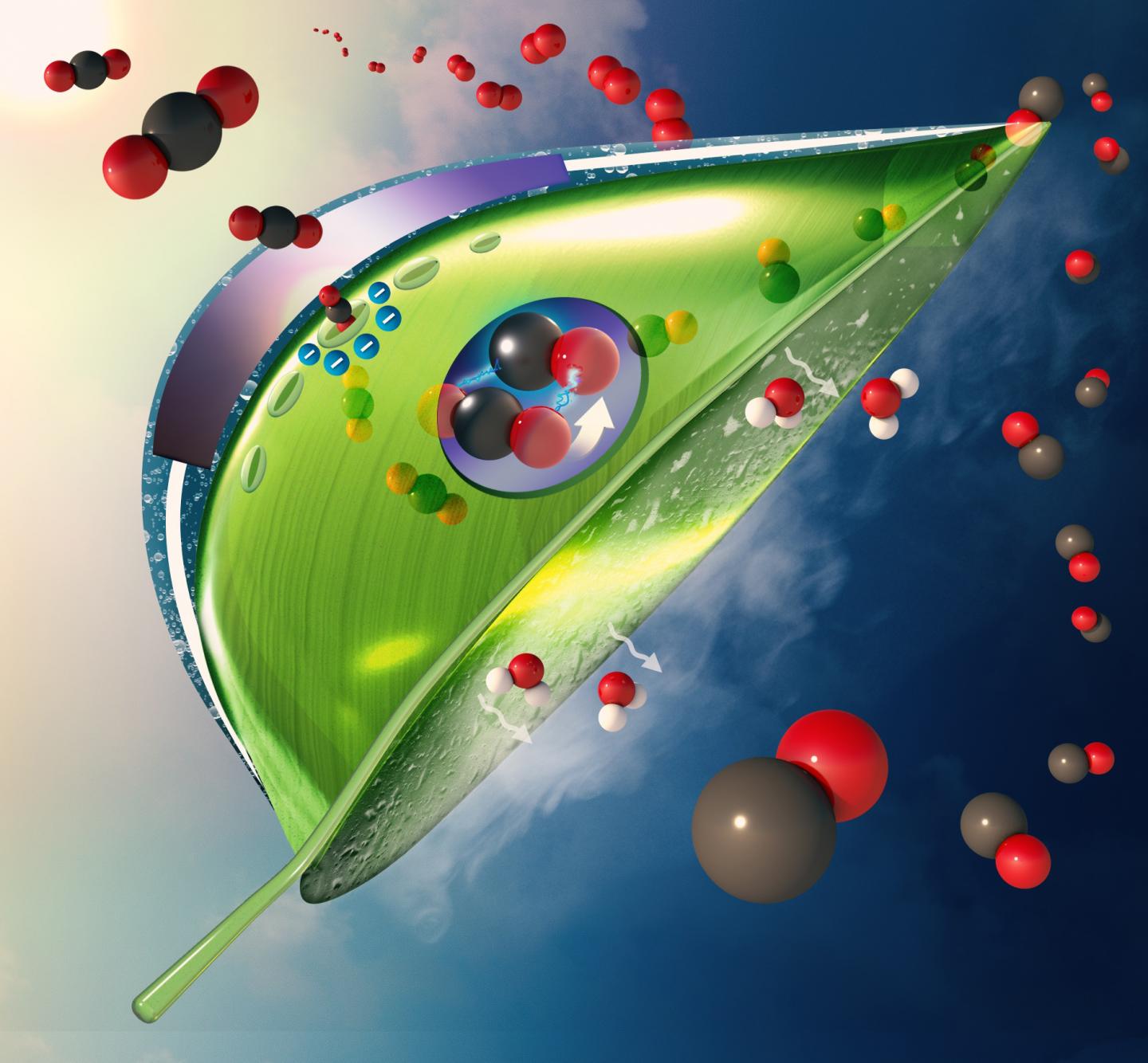
Credit: Meenesh Singh


Artificial leaves mimic photosynthesis — the process whereby plants use water and carbon dioxide from the air to produce carbohydrates using energy from the sun. But even state-of-the-art artificial leaves, which hold promise in reducing carbon dioxide from the atmosphere, only work in the laboratory because they use pure, pressurized carbon dioxide from tanks.

But now, researchers from the University of Illinois at Chicago have proposed a design solution that could bring artificial leaves out of the lab and into the environment. Their improved leaf, which would use carbon dioxide — a potent greenhouse gas — from the air, would be at least 10 times more efficient than natural leaves at converting carbon dioxide to fuel. Their findings are reported in the journal ACS Sustainable Chemistry & Engineering.

“So far, all designs for artificial leaves that have been tested in the lab use carbon dioxide from pressurized tanks. In order to implement successfully in the real world, these devices need to be able to draw carbon dioxide from much more dilute sources, such as air and flue gas, which is the gas given off by coal-burning power plants,” said Meenesh Singh, assistant professor of chemical engineering in the UIC College of Engineering and corresponding author on the paper.

Unhooking the pressurized carbon dioxide supply from these leaves means that they must have a way to collect and concentrate carbon dioxide from the air to drive their artificial photosynthetic reactions.

Singh and his colleague Aditya Prajapati, a graduate student in his lab, proposed solving this problem by encapsulating a traditional artificial leaf inside a transparent capsule made of a semi-permeable membrane of quaternary ammonium resin and filled with water. The membrane allows water from inside to evaporate out when warmed by sunlight. As water passes out through the membrane, it selectively pulls in carbon dioxide from the air. The artificial photosynthetic unit inside the capsule is made up of a light absorber coated with catalysts that convert the carbon dioxide to carbon monoxide, which can be siphoned off and used as a basis for the creation of various synthetic fuels. Oxygen is also produced and can either be collected or released into the surrounding environment.

“By enveloping traditional artificial leaf technology inside this specialized membrane, the whole unit is able to function outside, like a natural leaf,” Singh said.

According to their calculations, 360 leaves, each 1.7 meters long and 0.2 meters wide, would produce close to a half-ton of carbon monoxide per day that could be used as the basis for synthetic fuels. Three hundred and sixty of these artificial leaves covering a 500-meter square area would be able to reduce carbon dioxide levels by 10 percent in the surrounding air within 100 meters of the array in one day.

“Our conceptual design uses readily available materials and technology, that when combined can produce an artificial leaf that is ready to be deployed outside the lab where it can play a significant role in reducing greenhouse gases in the atmosphere,” Singh said.

###

This work was performed at UIC’s Materials and Systems Engineering Laboratory. The chemical engineering department provided financial support to conduct this research. A part of the funding was provided through UIC’s provost graduate research award.

Media Contact
Sharon Parmet
[email protected]
312-413-2695

Original Source

https://today.uic.edu/moving-artificial-leaves-out-of-the-lab-and-into-the-air

Related Journal Article

http://dx.doi.org/10.1021/acssuschemeng.8b04969

Tags: Biomedical/Environmental/Chemical EngineeringTechnology/Engineering/Computer Science
Share12Tweet8Share2ShareShareShare2

Related Posts

Here are a few rewritten headlines for a science magazine post, each with a slightly different tone: Intriguing & poetic: How do organs sculpt themselves? Sea stars hold the secret Direct & research-focused: Sea stars reveal the hidden rules of organ formation Metaphorical & inviting: Tiny architects beneath the waves: What sea stars teach us about building organs Short & punchy: Star-shaped clues to how our organs take shape Question-led: Could a sea star show us how organs form? Elegant & feature-style: The body’s blueprint, glimpsed in a sea star’s arm

July 6, 2026
Bacteria evolve faster with unconventional gene copies — Biology

Bacteria evolve faster with unconventional gene copies

July 6, 2026

Neighbours rewire soil feedback via root microbiome shifts

July 6, 2026

Evolution-Inspired Biosensors Revolutionize Lipid Tracking in Real Time

July 2, 2026
Please login to join discussion

POPULAR NEWS

  • Detection of EDCs in Breast Milk and Infant Urine Up to Six Months Highlights Early Exposure Risks

    77 shares
    Share 31 Tweet 19
  • New Drug Candidate Developed at McMaster Shows Potential for Treating Brain Cancer

    58 shares
    Share 23 Tweet 15
  • Saying Goodbye to PGY-6: Pediatric Fellowship Realities

    103 shares
    Share 41 Tweet 26
  • KTU Researchers Explore Ultrasound’s Role in Enhancing Blood Flow Beyond Diagnostics

    53 shares
    Share 21 Tweet 13

About

We bring you the latest biotechnology news from best research centers and universities around the world. Check our website.

Follow us

Recent News

Flame retardant BDE-209 targets molecularly linked to ulcerative colitis

Ultra-high frequency particle impacts mimic rockbursts to shatter hard rock

Kidney transplant outcomes in older adults studied by German researchers

Subscribe to Blog via Email

Enter your email address to subscribe to this blog and receive notifications of new posts by email.

Join 83 other subscribers
  • Contact Us

Bioengineer.org © Copyright 2023 All Rights Reserved.

Welcome Back!

Login to your account below

Forgotten Password?

Retrieve your password

Please enter your username or email address to reset your password.

Log In
No Result
View All Result
  • Homepages
    • Home Page 1
    • Home Page 2
  • News
  • National
  • Business
  • Health
  • Lifestyle
  • Science

Bioengineer.org © Copyright 2023 All Rights Reserved.