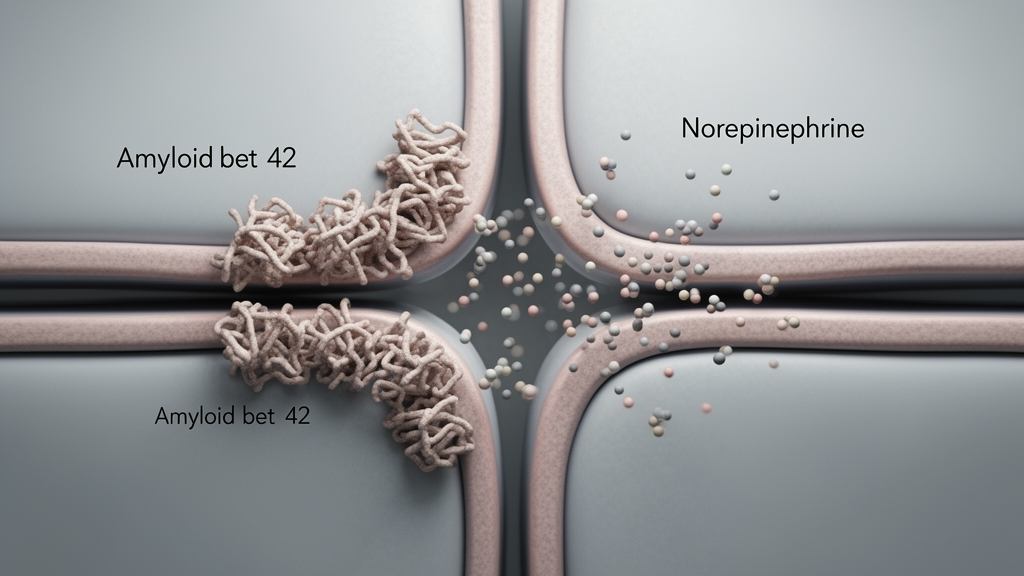
In an experimental investigation evaluating the functional connections between central neuromodulators and Alzheimer’s disease pathology, researchers have demonstrated that norepinephrine directly regulates endogenous levels of the amyloid-beta 42 peptide in adult mice. For decades, scientific investigations into Alzheimer’s disease have concentrated predominantly on the biochemical mechanisms governing the production and clearance of amyloid peptides, while devoting comparatively little attention to the neuromodulatory networks that establish the overall tempo of cortical activity. The locus coeruleus, a compact noradrenergic nucleus situated within the dorsal pons that projects widely across both the cerebral cortex and the hippocampus, consistently represents one of the earliest anatomical structures to exhibit pathological alterations during disease progression. Because previous human investigations have largely evaluated norepinephrine concentrations and amyloid pathology at isolated single time points within post-mortem tissue, the underlying direction of causality between noradrenergic degeneration and amyloid peptide accumulation had remained fundamentally unresolved.
To definitively address the direction of causality between noradrenergic signalling and amyloid dynamics, an experimental team assembled four distinct mouse models of noradrenergic manipulation. In the initial experimental paradigm, adult mice received systemic chemical lesions targeting locus coeruleus neurons via administration of the neurotoxin DSP-4, after which endogenous amyloid-beta 42 concentrations were quantified by enzyme-linked immunosorbent assay within both the locus coeruleus and the medial prefrontal cortex. In the second model, genetically modified dopamine beta-hydroxylase knockout mice, which lack the enzymatic capacity to synthesise norepinephrine, were evaluated alongside their wild-type littermates. Because conventional lesioning techniques and constitutive knockouts can complicate distinctions between catecholaminergic systems, a third genetic model was generated to eliminate norepinephrine synthesis while strictly preserving dopaminergic transmission. This targeted ablation was achieved by crossing DBH-IRES-Cre mice with floxed tyrosine hydroxylase animals, thereby isolating noradrenergic actions from dopaminergic confounding factors.
Complementing these depletion frameworks, a fourth experimental system examined mice lacking the norepinephrine transporter, a knockout condition that leads to the accumulation of synaptic norepinephrine and provides a state of potentiated noradrenergic transmission. Beyond assessing depletion and genetic elevation, the researchers also examined pharmacological restoration of norepinephrine by administering L-threo-3,4-dihydroxyphenylserine, known as L-DOPS. This chemical precursor directly bypasses the missing dopamine beta-hydroxylase hydroxylation step to restore noradrenergic signalling in depleted animals. Furthermore, to determine whether observed changes in peptide levels stemmed from altered proteolytic generation rather than differences in total steady-state abundance or elimination, the investigators specifically assayed the biochemical processing of amyloid precursor protein across the experimental cohorts.
The quantitative results demonstrated that concentrations of the amyloid-beta 42 peptide directly tracked norepinephrine availability rather than displaying an inverse or unrelated relationship. Both chemical lesioning with DSP-4 and genetic deletion of dopamine beta-hydroxylase produced significant reductions in amyloid-beta 42 abundance across the sampled brain regions. Crucially, this reduction in peptide levels persisted in the Cre-lox model that selectively eliminated norepinephrine while leaving dopamine intact, confirming that the observed biochemical suppression represents an exclusively noradrenergic phenomenon rather than a secondary consequence of dopaminergic disruption. Biochemical evaluations confirmed that amyloid precursor protein processing remained entirely unaltered across the depletion models, demonstrating that the drop in amyloid-beta 42 could not be attributed to suppressed cleavage of the precursor molecule.
Consistent with a reversible and bidirectional regulatory mechanism, pharmacological administration of the precursor L-DOPS successfully returned depressed amyloid-beta 42 concentrations back toward baseline physiological levels. In parallel, mice carrying the norepinephrine transporter knockout exhibited significantly elevated concentrations of amyloid-beta 42 relative to wild-type control animals, with tissue measurements from both the frontal cortex and the locus coeruleus demonstrating values significantly above control baselines. An examination of baseline concentrations within control animals proved similarly informative, revealing that endogenous amyloid-beta 42 was naturally higher in the locus coeruleus than in the medial prefrontal cortex. This anatomical difference further points toward a regional correlation between local noradrenergic tone and baseline peptide abundance. Comprehensive statistical testing across all genotypes and interventions identified a robust overall treatment effect, with post-hoc analyses placing noradrenergic depletion cohorts clearly below control levels.
From a conceptual and clinical perspective, these observations suggest that noradrenergic decline cannot be interpreted as an unambiguously protective occurrence in neurodegenerative contexts. Although a reduction in noradrenergic drive lowered measurable amyloid-beta 42 in the short term, the locus coeruleus plays an indispensable role in maintaining circuits that govern physiological arousal, selective attention, and stress responses. Natural age-related loss of locus coeruleus neurons or pharmacological suppression of noradrenergic signalling might diminish amyloid abundance while simultaneously destabilising essential catecholamine-dependent cognitive operations. Conversely, the finding that enhanced synaptic norepinephrine in transporter knockout mice drives an elevation in amyloid-beta 42 indicates that sustained adrenergic stimulation, such as that occurring under conditions of chronic stress, exerts opposing pressures by driving peptide levels upward outside the canonical amyloid processing axis.
The experimental team noted several clear methodological limitations that define the interpretive scope of the present findings. Peptide levels were quantified from bulk tissue homogenates rather than via real-time sampling in extracellular interstitial fluid, and the experimental systems utilised acute neurotoxic lesions or constitutive genetic knockouts rather than capturing age-dependent degenerative processes. In addition, circuit-level anatomical specificity was not confirmed through immunohistochemical tracing in this study, and the exact intermediate molecular pathways connecting adrenergic receptor activation to amyloid-beta 42 homeostasis remain to be mapped. Finally, while no significant differences between male and female mice were detected in the collected datasets, the investigators emphasised that the linearity of the regulatory relationship and potential sex-specific divergences warrant continued empirical investigation.
Subject of Research: Noradrenergic regulation of endogenous amyloid-beta 42 levels in mouse models
Article Title: Norepinephrine-mediated regulation of endogenous Aβ42 peptide levels: effects of noradrenergic depletion and restoration
Article References: Norepinephrine-mediated regulation of endogenous Aβ42 peptide levels: effects of noradrenergic depletion and restoration. Original publication (Bibliographic details unavailable.)
Image Credits: AI Generated
DOI: Not provided
Keywords: norepinephrine, locus coeruleus, amyloid-beta 42, Alzheimer's disease, dopamine beta-hydroxylase, DSP-4, norepinephrine transporter, L-DOPS, medial prefrontal cortex, tyrosine hydroxylase, enzyme-linked immunosorbent assay, amyloid precursor protein processing, catecholamine signalling, neuromodulatory systems, noradrenergic depletion, synaptic transmission
News Source: Drew Townsend. (November 24, 2026). Mouse Models Show Norepinephrine Bidirectionally Regulates Endogenous Amyloid Beta 42 Levels. Scienmag.