Credit: Ali Freibott, US Forest Service
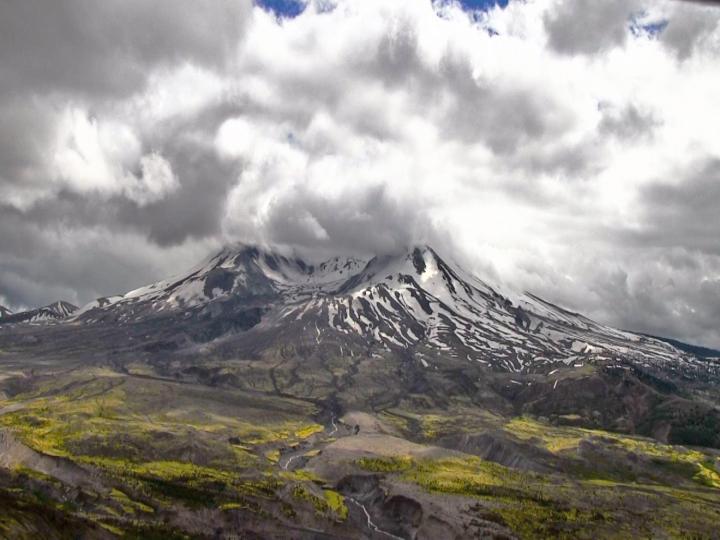
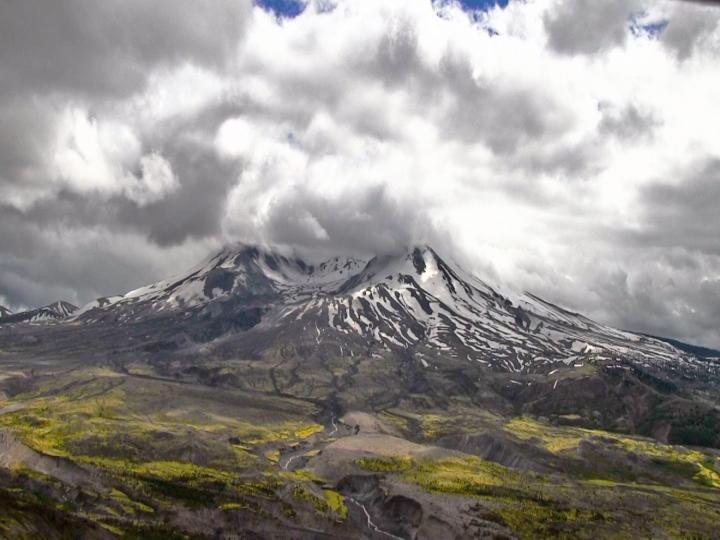
When Mount St. Helens erupted 38 years ago today, it not only dramatically transformed more than 200 square miles that previously contained vast forests, fast-flowing streams, and sparkling mountain lakes, it also created unprecedented research opportunities for scientists. Nearly four decades later, much of what has been learned at this living laboratory is revealed in a new book that presents key science lessons and messages from the volcano.
Ecological Responses at Mount St. Helens: Revisited 35 Years After the 1980 Eruption, published by Springer, features 16 chapters authored by 33 contributors from across the United States and Canada who have studied ecological responses at Mount St. Helens since 1980.
"This book is a synthesis generated by a cadre of dedicated scientists who have embarked upon decades of research to meticulously document the way in which an ecosystem responded to an intense, large-scale forest disturbance–in this case, volcanism, an agent of disturbance that has shaped Cascadian ecosystems for millennia," said Charlie Crisafulli, a research ecologist with the U.S. Forest Service's Pacific Northwest Research Station who has been conducting research at Mount St. Helens since just weeks after the 1980 eruption. Crisafulli co-edited the new book, authored several of its chapters, and is the lead research ecologist at the volcano. "This book is intended for scientists, college students, and others interested in the fascinating subject of ecological change and, in particular, the resilience of nature following a major disturbance."
The eruption of Mount St. Helens generated a gradient of disturbance intensities, which created an unprecedented scientific opportunity to study how landscapes respond initially and over time to volcanic disturbance. Since then, researchers have conducted hundreds of studies on wildlife, plant, and microbial communities and ecological processes across the volcano's terrestrial and aquatic habitats.
"I feel a great sense of achievement when viewing the ways in which the collective body of knowledge from the volcano has influenced and even reshaped our understanding of biological community assembly, successional processes, and disturbance processes," Crisafulli said.
Mount St. Helens research is helping to advance post-volcanic-eruption ecological science and management in both the United States and abroad. Crisafulli is conducting invited research at Chile's Chaitén, Cordón Caulle, and Calbuco volcanoes and has provided onsite consultation to managers in China and Alaska. This July, he will travel to Iceland's Surtsey and Hekal volcanoes to share results from Mount St. Helens and assist with plant ecology studies.
###
To learn more about Mount St. Helens research, visit http://www.fs.fed.us/pnw/research/mtsthelens.
The Pacific Northwest Research Station–headquartered in Portland, Ore.–generates and communicates scientific knowledge that helps people make informed choices about natural resources and the environment. The station has 11 laboratories and centers located in Alaska, Washington, and Oregon and about 300 employees. Learn more online at http://www.fs.fed.us/pnw.
Media Contact
Yasmeen Sands
[email protected]
503-808-2137
@usfs_pnwrs
http://www.fs.fed.us/pnw