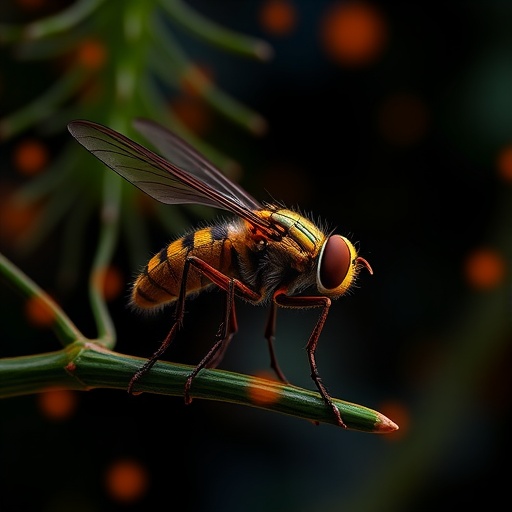
A new study in Drosophila is challenging one of neuroscience’s most familiar ideas: that motor neurons are merely the final relay stations that carry commands from the brain to muscles. Instead, researchers report that these neurons can actively organize the precise order and timing of a behavior, creating a self-propagating neural sequence that coordinates feeding movements with millisecond accuracy.
The discovery comes from simultaneous quadruple-electrode recordings made while fruit flies performed feeding behavior. By monitoring several components of the motor circuit at once, the researchers were able to observe how neural activity moved through the chain that controls the fly’s feeding muscles. Their results reveal a feedforward disinhibition cascade, a circuit mechanism in which one active neuron releases another from inhibition, allowing activity to advance in a controlled direction.
Feeding in Drosophila depends on a series of rhythmic muscle contractions that move food through the animal’s feeding apparatus. These contractions must occur in the correct sequence: muscles involved in one stage of the action need to activate before those responsible for the next stage. If the timing is disrupted, the fly may continue making feeding movements, but the behavior can become inefficient or fail to transport food properly.
The study shows that the sequence begins when food-related sensory stimuli trigger rhythmic firing in a leading motor neuron. This neuron performs two functions at the same time. Through the release of glutamate, it directly excites its target muscle, contributing to the physical movement required for feeding. At the same time, it acts on a premotor element in the circuit in a way that reduces inhibitory control over the next motor neuron. The result is a precisely timed transition from one stage of the motor pattern to the next.
This arrangement is known as disinhibition because the crucial signal is not simply an excitatory command directed at the next neuron. Instead, the active motor neuron suppresses or bypasses an inhibitory influence, effectively opening a gate for the following motor neuron to fire. Once recruited, that neuron activates its own muscle target and promotes the release of the next step in the chain. The circuit therefore behaves like a wave, with activity traveling forward through the motor system rather than being imposed independently on every muscle.
The finding expands the conventional view of motor neurons. In many textbook descriptions, motor neurons sit at the end of a hierarchy: sensory information and brain circuits generate a command, premotor neurons shape it, and motor neurons transmit the final instruction to muscles. The new work suggests that at least some motor neurons are active organizers of behavior. They can combine direct control of muscle contraction with circuit-level regulation of downstream neurons, helping construct the motor pattern as it unfolds.
The researchers also examined whether the neural sequence was simply a reflection of how quickly the fly was pumping. Feeding movements can vary in rate depending on the animal’s behavioral context, the strength of the food stimulus, or the stage of the action. Yet behavioral measurements and computational modeling indicated that the ordered motor-neuron sequence remained distinct from the pumping rate. In other words, the circuit appears to preserve the identity and order of the feeding pattern even when the overall tempo changes.
That separation may be important for biological robustness. A motor system that tied every element of a sequence rigidly to one fixed rhythm could fail whenever an animal needed to speed up, slow down, pause, or adjust its behavior. By using a propagating circuit pattern that is partly independent of the absolute pumping rate, the fly may retain reliable coordination across changing circumstances. The same underlying sequence can potentially be executed at different speeds without losing the relationships between successive muscle activations.
The work also highlights why recordings from behaving animals are essential for understanding neural circuits. Isolated preparations can reveal how individual synapses operate, but they may not show how those connections contribute to a natural action. By combining electrophysiology, behavioral analysis, and computational modeling, the researchers linked cellular signaling to the timing of an entire feeding sequence. Their results suggest that motor neurons are not passive endpoints of command pathways but dynamic components of neural computation—cells capable of initiating, shaping, and propagating the patterns that make coordinated behavior possible.
Subject of Research: Motor-neuron control and coordination of feeding sequences in Drosophila
Article Title: Motor neurons organize Drosophila feeding sequences via a disinhibitory cascade
Article References: Sui, XW., Yi, JJ., Zhou, Y. et al. “Motor neurons organize Drosophila feeding sequences via a disinhibitory cascade.” Nature Neuroscience (2026). https://doi.org/10.1038/s41593-026-02412-y
Image Credits: AI Generated
DOI: https://doi.org/10.1038/s41593-026-02412-y
Keywords: Drosophila, motor neurons, feeding behavior, disinhibition, glutamate, premotor circuits, muscle coordination, neural sequences, motor control, computational modeling
Tags: disinhibitory neural circuitsDrosophila feeding behaviorElectrophysiological recording techniquesfeedforward disinhibition cascadefruit fly neural circuitrymillisecond muscle activation timingmotor neuron coordinationmotor neuron role in behaviorneural basis of feeding sequencesneural control of feedingneural sequence organizationrhythmic muscle contractions