

• HOME
  • NEWS
  • EXPLORE
    • CAREER
      • Companies
      • Jobs
    • EVENTS
    • iGEM
      • News
      • Team
    • PHOTOS
    • VIDEO
    • WIKI
  • BLOG
  • COMMUNITY
    • FACEBOOK
    • INSTAGRAM
    • TWITTER
Sunday, May 17, 2026
BIOENGINEER.ORG
No Result
View All Result
  • Login
  • HOME
  • NEWS
  • EXPLORE
    • CAREER
      • Companies
      • Jobs
        • Lecturer
        • PhD Studentship
        • Postdoc
        • Research Assistant
    • EVENTS
    • iGEM
      • News
      • Team
    • PHOTOS
    • VIDEO
    • WIKI
  • BLOG
  • COMMUNITY
    • FACEBOOK
    • INSTAGRAM
    • TWITTER
  • HOME
  • NEWS
  • EXPLORE
    • CAREER
      • Companies
      • Jobs
        • Lecturer
        • PhD Studentship
        • Postdoc
        • Research Assistant
    • EVENTS
    • iGEM
      • News
      • Team
    • PHOTOS
    • VIDEO
    • WIKI
  • BLOG
  • COMMUNITY
    • FACEBOOK
    • INSTAGRAM
    • TWITTER
No Result
View All Result
Bioengineer.org
No Result
View All Result
Home NEWS Science News Biology

Mother-child communication in plants

Bioengineer by Bioengineer
July 20, 2018
in Biology
Reading Time: 2 mins read
0
Share on FacebookShare on TwitterShare on LinkedinShare on RedditShare on Telegram
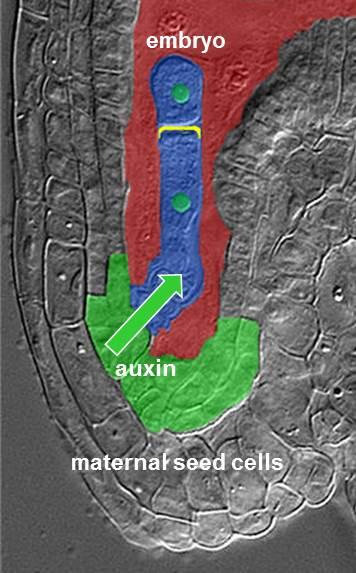
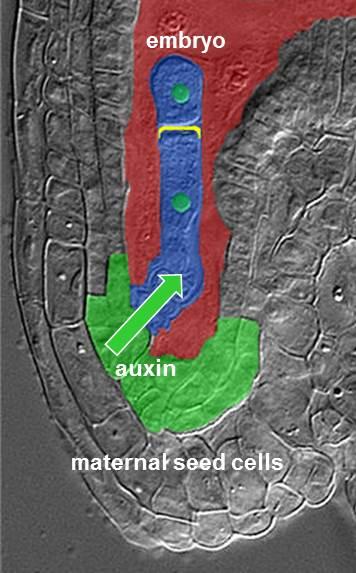
IMAGE

Credit: Source: Thomas Laux

An international team led by the Freiburg plant biologist Prof. Dr. Thomas Laux has shown that mother plants guide the development of their embryos using the hormone auxin. In the future, this result might help breeders grow plants that are more resilient in the face of environmental challenges. The researchers published their study in the journal Nature Plants.

When embryos develop inside their mother, their well-being depends on the nurture provided by the maternal tissue. Mutations in the maternal tissue may result in defective embryo development. In seed-bearing plants such as grains, the embryos develop in unison with the surrounding tissue of the mother plant. Laux and colleagues therefore posited that there must be a form of communication between the mother plant and the embryo that guides the early stages of development after fertilization.

Chulmin Park, doctoral researcher in the group of Laux, observed in pollinated flowers of the model organism Arabidopsis that the hormone auxin accumulates in the area of the seed in which the embryo is connected to the maternal tissue. Auxin is used by plants to control a variety processes ranging from organ development to defence against pathogenic microbes. The Freiburg biologists have shown that embryo development is disturbed when the production of auxin by the maternal cells is blocked. However, artificial activation of auxin biosynthesis in the embryo cells, which are normally unable to produce this hormone in early stages of development, allowed the embryos to develop normally without a maternal auxin supply. With these results, the researchers demonstrated that mother plants use this signalling molecule in order to communicate with their offspring and guide the earliest stages of their development. Since they made similar observations in maize, the researchers speculate that the mechanism they discovered may be widespread in plant species.

This finding could also contribute to the optimization of biotechnological plant propagation. "Plants could be bred faster and more efficiently so that they can adapt to unfavourable environmental conditions and climate change, for example", Laux explains.

###

Thomas Laux heads a laboratory at the Institute of Biology III and is a member of the BIOSS Excellence Cluster of the University of Freiburg.

Original Publication:

Hélène S. Robert, Chulmin Park, Carla Loreto Gutièrrez, Barbara Wójcikowska, Aleš P?nčík, Ond?ej Novák, Junyi Chen, Wim Grunewald, Thomas Dresselhaus, Ji?í Friml and Thomas Laux (2018): Maternal auxin supply contributes to early embryo patterning in Arabidopsis. In: Nature Plants. DOI: 10.1038/s41477-018-0204-z

Media Contact

Prof. Dr. Thomas Laux
[email protected]

Startseite

Original Source

https://www.pr.uni-freiburg.de/pm-en/press-releases-2018/mother-child-communication-in-plants http://dx.doi.org/10.1038/s41477-018-0204-z


Share12Tweet8Share2ShareShareShare2

Related Posts

Uncovering C. elegans Immunity via Genetic Screens — Biology

Uncovering C. elegans Immunity via Genetic Screens

May 16, 2026
Single mother must adapt swiftly — the survival of her colony depends on it — Biology

Single mother must adapt swiftly — the survival of her colony depends on it

May 15, 2026

Why Are Nearly Everyone Right-Handed? It Might Be Linked to How We Learned to Walk

May 15, 2026

Excessive Neuronal Activity Initiates Severe Autoimmune Brain Disorder

May 15, 2026
Please login to join discussion

POPULAR NEWS

  • Research Indicates Potential Connection Between Prenatal Medication Exposure and Elevated Autism Risk

    844 shares
    Share 338 Tweet 211
  • New Study Reveals Plants Can Detect the Sound of Rain

    730 shares
    Share 291 Tweet 182
  • Salmonella Haem Blocks Macrophages, Boosts Infection

    62 shares
    Share 25 Tweet 16
  • Breastmilk Balances E. coli and Beneficial Bacteria in Infant Gut Microbiomes

    58 shares
    Share 23 Tweet 15

About

We bring you the latest biotechnology news from best research centers and universities around the world. Check our website.

Follow us

Recent News

Flexible Framework Optimizes Data Center Site Planning

Short-Term Home Cognitive & Physical Training Tested in Seniors

Stress Evolution and Time Control in Retreat Roadways

Subscribe to Blog via Email

Enter your email address to subscribe to this blog and receive notifications of new posts by email.

Join 82 other subscribers
  • Contact Us

Bioengineer.org © Copyright 2023 All Rights Reserved.

Welcome Back!

Login to your account below

Forgotten Password?

Retrieve your password

Please enter your username or email address to reset your password.

Log In
No Result
View All Result
  • Homepages
    • Home Page 1
    • Home Page 2
  • News
  • National
  • Business
  • Health
  • Lifestyle
  • Science

Bioengineer.org © Copyright 2023 All Rights Reserved.
