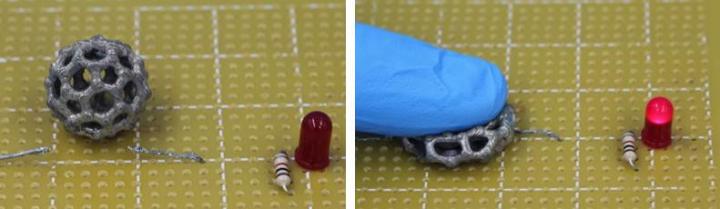
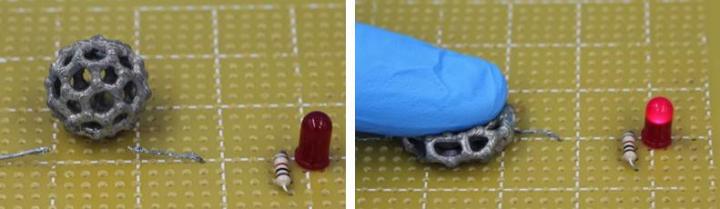
Credit: Courtesy of Dinesh K. Patel
Due to its excellent material properties of elasticity, resilience, and electrical and thermal insulation, elastomers have been used in a myriad of applications. They are especially ideal for fabricating soft robots, flexible electronics and smart biomedical devices which require soft and deformable material properties to establish safe and smooth interactions with humans externally and internally.
However, to date, the most widely used silicon rubber-based elastomers require a thermal curing process which significantly limits its fabrication in traditional ways, such as by cutting, molding and casting, which constrains design freedom and geometric complexity. In order to enrich the design and fabrication flexibility, researchers attempted to use 3D printing techniques, such as the ultraviolet (UV) curing based 3D printing techniques that solidify liquid polymer resins to 3D objects through patterned UV light, to fabricate elastomeric 3D objects. Nevertheless, most of the commercially available UV curable thus 3D printable elastomers break at less than 200% (two times the original length), which makes it unsuitable for many applications.
Recently, researchers have developed a family of highly stretchable and UV curable (SUV) elastomers that can be stretched by up to 1100%, and are suitable for UV curing based 3D printing techniques. This work is a collaborative effort between researchers from the Singapore University of Technology and Design's (SUTD) Digital Manufacturing and Design (DManD) Centre which is funded by the Singapore National Research Foundation (NRF), the Hebrew University of Jerusalem (HUJI), and the Campus for Research Excellence and Technological Enterprise (CREATE), also funded by the NRF. Details of this project appeared in the Journal of Advanced Materials on 7 February 2017.
"We have developed the most stretchable 3D printable elastomer in the world," said Assistant Professor Qi (Kevin) Ge from the SUTD's DManD Centre, who is one of the co-leaders in developing the SUV elastomers. He added: "Our new elastomers can be stretched by up to 1100% which is more than five times the elongation at break of any commercially available elastomer that is suitable for UV curing based 3D printing techniques."
Using high resolution 3D printing with the SUV elastomer compositions enables the direct creation of complex 3D lattices or hollow structures that exhibit extremely large deformation. "The new SUV elastomers enable us to directly print complicated geometric structures and devices such as a 3D soft robotic gripper within an hour. Compared to traditional molding and casting methods, using UV curing based 3D printing with the SUV elastomers significantly reduces the fabrication time from many hours, even days, to a few minutes or hours as the complicated and time-consuming fabrication steps such as mold-building, molding/demolding, and part assembly are replaced by a single 3D printing step," said Dr Ge.
The SUV elastomers not only sustain large elastic deformation, but also maintain good mechanical repeatability, which makes them good materials for fabricating flexible electronics. To demonstrate this, the researchers fabricated a 3D buckyball light switch that still works after being pressed for more than 1000 times.
"Overall, we believe the SUV elastomers, together with the UV curing based 3D printing techniques, will significantly enhance the capability of fabricating soft and deformable 3D structures and devices including soft actuators and robots, flexible electronics, acoustic metamaterials, and many other applications," said Professor Shlomo Magdassi who is a co-leader of this project at HUJI and CREATE.
###
Media Contact
Melissa Koh
[email protected]
65-649-98742
http://www.sutd.edu.sg
############
Story Source: Materials provided by Scienmag