


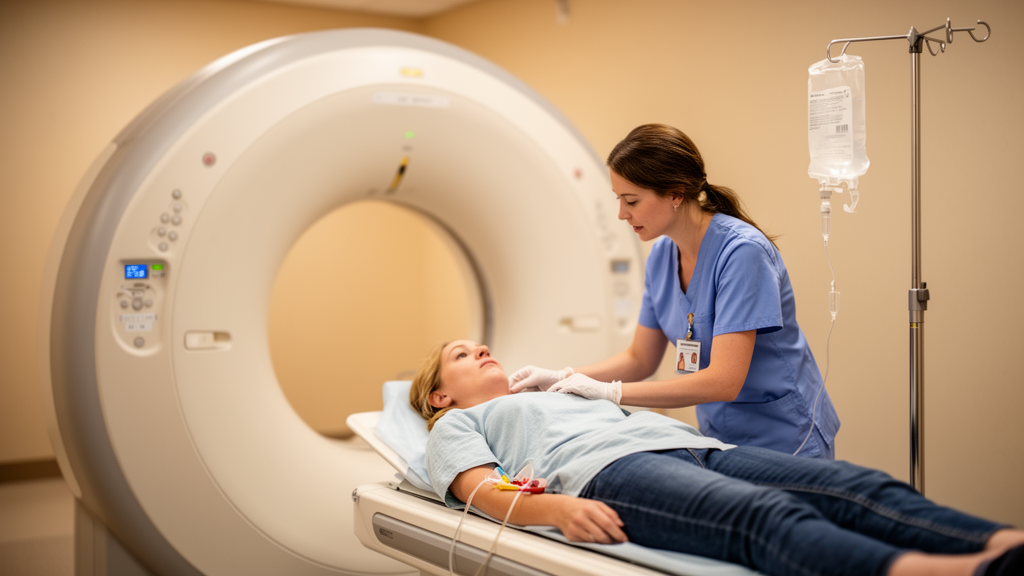
Patients with a history of hypersensitivity reactions to iodinated contrast media can often tolerate being given these agents again, according to a retrospective real-world study conducted at Peking Union Medical College Hospital in China. The research, published in Allergy, Asthma & Clinical Immunology, reviewed the outcomes of patients who had experienced a previous hypersensitivity reaction to iodinated contrast and then underwent re-administration of the agent, most of them after preventive measures such as premedication or switching to a different contrast agent.
The study team reviewed medical records of inpatients who received allergy consultations at the hospital between January 1, 2019 and July 31, 2024. From 997 patients referred for allergy consultation, 65 met the inclusion criteria: they had a documented prior hypersensitivity reaction related to iodinated contrast media and subsequently underwent re-administration of the agent. The cohort included 47 males, accounting for 72.3 percent of the group, with a mean age of 59.6 years and a standard deviation of 16.1 years.
Among the 65 patients, 28, or 43.1 percent, had experienced a previous non-immediate hypersensitivity reaction, while the remainder had prior immediate reactions. The researchers observed that patients with prior non-immediate reactions were more likely to receive iodixanol than those whose previous reaction had been immediate. In total, 55 patients, or 84.6 percent, received premedication before re-exposure, and 33 patients, or 50.8 percent, underwent switching to a different iodinated contrast agent.
The central finding concerned what happened after re-exposure. Recurrent hypersensitivity reactions occurred in 6 patients, representing 9.2 percent of the cohort, while 59 patients, or 90.8 percent, had no recurrence. Of the six recurrent reactions, two were immediate and four were non-immediate. The authors conclude that most patients with a history of iodinated contrast-related hypersensitivity safely tolerate re-administration when managed with contrast switching, premedication, or a combination of both.
The analysis also identified patterns in who was most likely to react again. The proportion of patients with prior non-immediate hypersensitivity reactions was significantly higher among those who experienced a recurrent reaction than among those who did not, at 100 percent versus 52.5 percent, a difference the researchers report as statistically significant with a P value of 0.025. This suggests that the timing of a patient’s original reaction may be relevant when assessing the risk of re-exposure, although the study’s retrospective design and small number of recurrence events limit the strength of this observation.
The management strategy appeared to matter as well. The recurrence rate was lowest among patients who underwent both switching to a different contrast agent and premedication, compared with patients who received premedication without switching and those who switched agents without premedication. The reported recurrence rates for these three groups were 0.0 percent, 33.3 percent, and 14.3 percent respectively, with a P value of 0.021. The authors caution that these figures come from a single-center retrospective review, and the numbers of patients in each management subgroup were small, so the comparisons should be interpreted with care.
The study authors note that their findings provide a clinical reference for managing re-exposure, particularly in medical centers where allergy testing for iodinated contrast is not routinely available. Because the data come from a single hospital’s allergy consultation service, the results may not generalize to all clinical settings or patient populations.
As a retrospective chart review, the study describes observed outcomes rather than the results of a randomized trial, and it cannot establish with certainty which preventive strategy is causally superior. The authors describe the work as a real-world study intended to offer practical reference information for clinicians managing patients with a history of iodinated contrast hypersensitivity who need contrast-enhanced imaging again. The full open-access article, published on August 26, 2026, reports the complete cohort characteristics and outcome data.
Subject of Research: Real-world outcomes of iodinated contrast media re-exposure in patients with prior hypersensitivity reactions
Article Title: Real world outcomes of iodinated contrast media re-exposure in Chinese patients with prior hypersensitivity
Article References: Bian, S., Li, L., Cui, L., Du, Z., Lyu, L., Ru, Y., Wang, Z., & Guan, K. (2026). Real world outcomes of iodinated contrast media re-exposure in Chinese patients with prior hypersensitivity. Allergy, Asthma & Clinical Immunology. https://doi.org/10.1186/s13223-026-01058-6
Image Credits: AI Generated
DOI: 10.1186/s13223-026-01058-6
Keywords: iodinated contrast media, hypersensitivity reactions, re-exposure, premedication, contrast switching, retrospective study, allergy consultation, Peking Union Medical College Hospital, immediate reactions, non-immediate reactions, drug allergy, patient safety
News Source: Ophelia Keating. (October 29, 2026). Most patients with prior contrast hypersensitivity tolerate re-exposure, study finds. Scienmag.



