


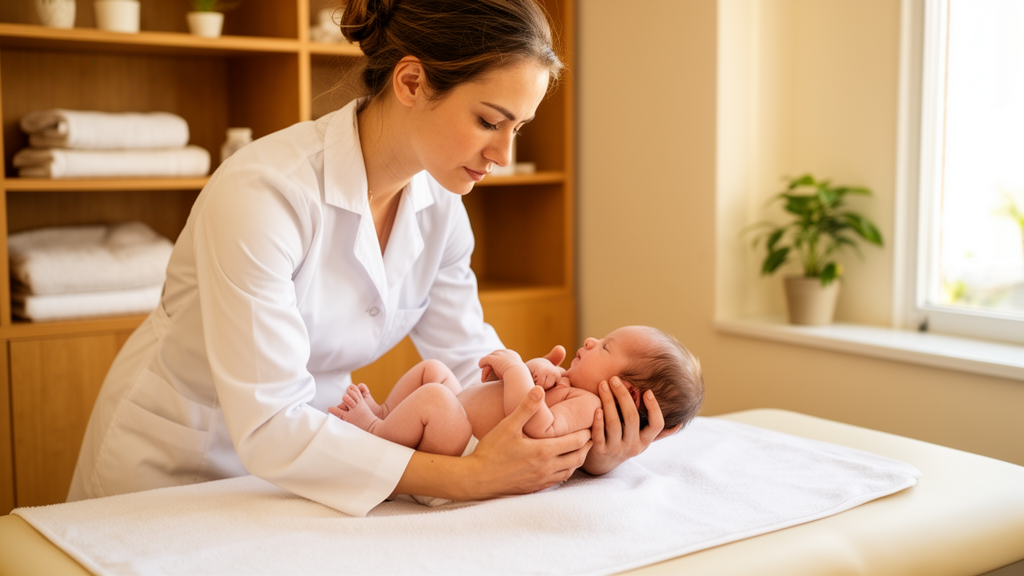
Most osteopaths worldwide never use high-velocity, low-amplitude (HVLA) thrust techniques on newborns and infants, according to two multinational cross-sectional surveys covering practitioners and training institutes across 28 countries. Among 2,607 responding osteopathic practitioners, only 6.5 percent reported using HVLA techniques on newborns or infants, with cervical HVLA used by just 3.9 percent. Use rose steeply with patient age: 43.5 percent of respondents applied the techniques to children aged 2 to 12 years, and 78.3 percent to adolescents aged 13 to 17.
HVLA techniques, defined in the study as a method in which the restrictive barrier is engaged and then a rapid, therapeutic force of brief duration traveling a short distance is applied within the anatomic range of motion, rank among the most frequently used manual approaches in osteopathy worldwide, with reported usage of roughly 34 to 85 percent across general practice. Among the small minority of practitioners who do apply HVLA to newborns and infants, 54 percent reported doing so only rarely, and just six respondents out of 2,607, or 0.23 percent, said they used the techniques on newborn infants very often. Among the 102 practitioners who reported using cervical HVLA on newborns and infants, 53.9 percent described such use as rare.
Up to one in four osteopathic consultations involves infants and children, with children under 2 years accounting for roughly 10 to 19.5 percent of patients receiving osteopathic care annually depending on the country. Common paediatric presentations include infantile postural asymmetry, plagiocephaly, excessive crying, infantile colic, and feeding and sleep disorders. Yet while evidence suggests osteopathic care in paediatric populations is generally safe, HVLA has been associated with potential adverse effects, and systematic reviews have either found no evidence supporting its use for any paediatric condition or been unable to draw conclusions because of the low methodological quality of available studies. Reviews of spinal manipulation in children document predominantly mild adverse events, such as crying, with moderate, serious, and indirect events reported much less frequently, though some serious events may relate to pre-existing underlying pathology rather than the intervention itself.
The controversy has a concrete political history. Public and media concern erupted in Australia after a video circulated showing a chiropractor performing cervical manipulation on an infant, prompting a governmental investigation. Citing insufficient evidence of clinical effectiveness and persistent uncertainty about potential harm, the Australian government subsequently recommended that manual therapists refrain from spinal manipulation in children younger than 12 years, and Australian chiropractic, physiotherapy, and osteopathic associations issued position statements echoing that advice. Internationally, a physiotherapy-led research task force recommended against spinal manipulation in infants, against cervical and lumbar manipulation in children, and against spinal manipulation for non-musculoskeletal conditions across paediatric age groups. A Dutch clinical guideline and a non-peer-reviewed statement from an Australian osteopathic association similarly advised against spinal manipulation in infants and in children under 2 and 12 years respectively.
To fill that gap, the research team ran two online cross-sectional surveys implemented in REDCap and available in 11 languages, recruiting between October 2025 and January 2026. The practitioner survey, consisting of seven mandatory close-ended questions, was distributed through 27 osteopathic professional associations affiliated with Osteopathy Europe plus the Swiss Osteopathic Association, Osteopathy Australia, and Osteopaths New Zealand, reaching 24,261 practitioners in 28 countries. The second survey, with three close-ended questions, targeted osteopathic education institutes and continuing professional development providers in 24 European countries, Australia, Brazil, Israel, and New Zealand, with 212 institutes invited. The practitioner survey achieved a response rate of 10.7 percent, varying dramatically from 0.0 percent in Iceland and Slovenia to 53.7 percent in Ireland. Questionnaires underwent two pilot studies for content validity and linguistic clarity, and translation followed World Health Organization forward-backward recommendations.
The educational findings mirror the clinical gradient. Of the 62 responding education institutes, 91.4 percent offered paediatric osteopathic education, with 80.6 percent covering newborns and infants, 82.3 percent children, and 87.1 percent adolescents. But when it came to teaching HVLA specifically, only 4.8 percent, three institutions, taught it for newborns and infants, 11.3 percent for children, and 56.4 percent for adolescents. The three institutions teaching cervical HVLA for newborns and infants were the same ones teaching HVLA in general for that age group, and some institutes taught HVLA for other spinal regions while excluding the cervical spine, one for children and ten for adolescents. The authors note it remains unclear whether adolescent HVLA training is adapted to developmental characteristics or largely derived from adult-oriented teaching models.
Beyond simple prevalence, the study used latent class analysis to identify distinct practitioner profiles among the 777 respondents who believed some conditions could justify HVLA in newborns and infants. Three permissive stances emerged: a precaution-informed stance held by 11.2 percent of all respondents, an implicit-authority stance at 10.9 percent, and a procedural-ethical stance at 7.7 percent. The precaution-informed profile reflected active HVLA use within an explicit benefit-risk framework, supported by training and supervision and embedded in substantial paediatric clinical exposure, and it was the stance most strongly associated with paediatric practice and with the highest reported HVLA use in this age group. The implicit-authority stance was characterised as weakly constrained, lacking clear exclusion criteria or a strong justificatory framework, while the procedural-ethical stance emphasised authorisation through process, such as training and consent, rather than precautionary outcome evaluation.
Statistical modelling sharpened the picture of what drives use. Years of experience, formal HVLA training for newborns and infants, practical supervision, and holding any permissive stance were all positively and independently associated with increased odds of HVLA use, including cervical techniques, after adjustment for covariates. The proportion of newborns and infants in a practitioner’s caseload, by contrast, was not independently associated with use after adjustment. HVLA use was most strongly associated with adopting a precaution-informed stance, with an adjusted odds ratio of 11.5, and with prior training, at adjusted odds ratios of 7.3 for undergraduate training, 6.5 for postgraduate training, and 2.6 for practical supervision. Among practitioners holding the HVLA-opposed stance, 98.4 percent consistently reported not using the techniques on newborns and infants, and 83.1 percent reported no HVLA training at all, suggesting that training exposure and clinical stance travel together.
Among the 777 respondents open to conditional HVLA use, 34.6 percent did not consider parental or guardian consent necessary, and 39 respondents reported using HVLA techniques without considering consent necessary at all. These practitioners were more likely to be older, with an odds ratio of 1.56 per 10 years of age, to practise in Germany, to have received practical supervision when learning paediatric HVLA, and to have received paediatric training in postgraduate settings. The authors suggest this may reflect misunderstandings of informed consent, possibly interpreted as non-verbal or tissue-based assent rather than formal legal consent, and they call for education programmes to explicitly include consent procedures in their teaching objectives and evaluations.
Respondents working in Germany, Spain, and Switzerland reported the highest use of cervical HVLA in newborns and infants, at 14.1, 11.4, and 9.5 percent respectively, while Finland, the Netherlands, and the United Kingdom reported less than 1 percent. They also caution that the findings are limited by potential coverage and self-selection bias, possible duplicate responses that could not be identified in anonymised data, and the low and variable response rate to the practitioner survey, with most highly responding countries being European and the United States, a large share of the global osteopathic workforce, not included.
Subject of Research: Cross-sectional surveys of osteopathic practitioners and education institutes on the use and teaching of high-velocity, low-amplitude techniques in paediatric care
Article Title: The use of high-velocity, low-amplitude techniques in paediatric osteopathic care: two multinational cross-sectional surveys on clinical practice and educational curricula
Article References: van Dun, P. L. S., Bohlen, L., Ellwood, J., Ferreira, A. P. A., Steel, A., Draper-Rodi, J., & Vaucher, P. (2026). The use of high-velocity, low-amplitude techniques in paediatric osteopathic care: two multinational cross-sectional surveys on clinical practice and educational curricula. Chiropractic & Manual Therapies, 34(1), Article 32. https://doi.org/10.1186/s12998-026-00670-y
Image Credits: AI Generated
DOI: 10.1186/s12998-026-00670-y
Keywords: osteopathy, HVLA, paediatric care, spinal manipulation, cross-sectional survey, manual therapy, adverse events, clinical guidelines, osteopathic education, infant health, professional regulation, latent class analysis
News Source: Harold Sullivan. (October 30, 2026). Most osteopaths shun spinal thrusts in babies, global survey finds. Scienmag.



