• HOME
  • NEWS
  • EXPLORE
    • CAREER
      • Companies
      • Jobs
    • EVENTS
    • iGEM
      • News
      • Team
    • PHOTOS
    • VIDEO
    • WIKI
  • BLOG
  • COMMUNITY
    • FACEBOOK
    • INSTAGRAM
    • TWITTER
Monday, September 7, 2026
BIOENGINEER.ORG
No Result
View All Result
  • Login
  • HOME
  • NEWS
  • EXPLORE
    • CAREER
      • Companies
      • Jobs
        • Lecturer
        • PhD Studentship
        • Postdoc
        • Research Assistant
    • EVENTS
    • iGEM
      • News
      • Team
    • PHOTOS
    • VIDEO
    • WIKI
  • BLOG
  • COMMUNITY
    • FACEBOOK
    • INSTAGRAM
    • TWITTER
  • HOME
  • NEWS
  • EXPLORE
    • CAREER
      • Companies
      • Jobs
        • Lecturer
        • PhD Studentship
        • Postdoc
        • Research Assistant
    • EVENTS
    • iGEM
      • News
      • Team
    • PHOTOS
    • VIDEO
    • WIKI
  • BLOG
  • COMMUNITY
    • FACEBOOK
    • INSTAGRAM
    • TWITTER
No Result
View All Result
Bioengineer.org
No Result
View All Result
Home NEWS Science News Biology

Mosquito populations give a new insight into the role of Caucasus in evolution

Bioengineer by Bioengineer
August 6, 2018
in Biology
Reading Time: 2 mins read
0
Share on FacebookShare on TwitterShare on LinkedinShare on RedditShare on Telegram
IMAGE

Credit: Dr Mukhamed Karmokov

We know that the Caucasus is a relatively large mountainous region, situated between Black and the Caspian seas. In its turn, it is divided into three subregions: Ciscaucasia, Greater Caucasus and Transcaucasia, also known as South Caucasus.

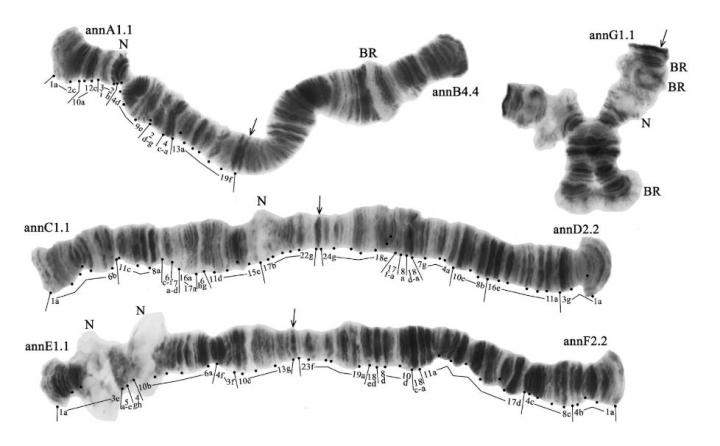
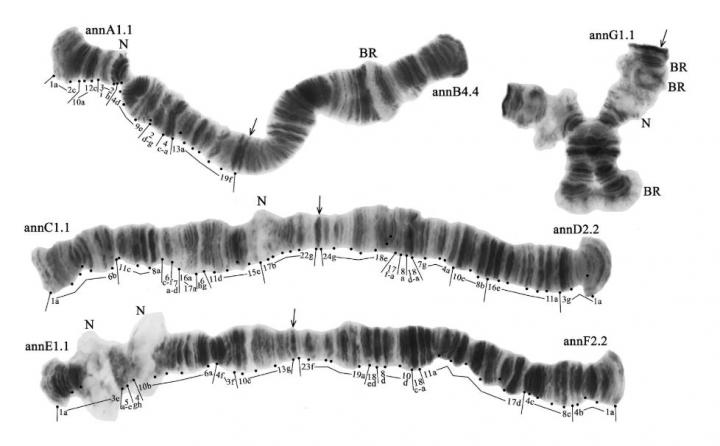
A closer look into the chromosome structure of mosquito larvae of a curious group of species (Chironomus "annularius" sensu Strenzke (1959)), collected from the three localities, has allowed Dr Mukhamed Karmokov of the Tembotov Institute of Ecology of Mountain territories at the Russian Academy of Science to figure out how the specificity of the Caucasian region has simultaneously unified its fauna geographically, yet has divided it evolutionarily. His paper is published in the open access journal Comparative Cytogenetics.

Having collected a sufficient amount of mosquito larvae, the researcher managed to study the chromosome structure, rearrangements and possible peculiarities of the separate Caucasian populations, in order to compare them.

Additionally, he analysed their relations to earlier known populations from Europe, Siberia, Kazakhstan and North America.

Amongst the curious peculiarities Karmokov identified in the chromosome structure of the studied larvae were some rearrangements which appear unique to Caucasus. Furthermore, he found that despite the close geographic proximity, the genetic distance between the Caucasian populations is quite significant, even While not enough to determine them as separate species, it could prove them as separate subspecies.

In conclusion, the scientist notes that the obtained data confirm that the Caucasian populations of the studied species have complex genetic structure and provide evidence for microevolution processes in the region.

###

Original source:

Karmokov MKh (2018) Karyotype characteristics and chromosomal polymorphism of Chironomus "annularius" sensu Strenzke (1959) (Diptera, Chironomidae) from the Caucasus region. Comparative Cytogenetics 12(3): 267-284. https://doi.org/10.3897/CompCytogen.v12i3.25832

Media Contact

Dr Mukhamed Karmokov
[email protected]
@Pensoft

http://www.pensoft.net

Related Journal Article

http://dx.doi.org/10.3897/CompCytogen.v12i3.25832

Share16Tweet8Share2ShareShareShare2

Related Posts

Metabolomic analysis reveals biological pathways altered by clinical intervention

Metabolomic analysis reveals biological pathways altered by clinical intervention

September 7, 2026
Replicator framework reveals how vaginal microbiome defends against pathogens

Replicator framework reveals how vaginal microbiome defends against pathogens

September 7, 2026

Scrub typhus bacteria found in chiggers and ground birds

September 7, 2026

Insect-specific viruses discovered in Papua New Guinea Culex mosquitoes

September 7, 2026
Please login to join discussion

POPULAR NEWS

  • Bidirectional decoupled learning improves cross-subject emotion recognition from physiological signals

    29 shares
    Share 12 Tweet 7
  • New multi-axis study probes how AI verifiers disagree on clinical reasoning

    29 shares
    Share 12 Tweet 7
  • Optimizing multi-drug chemotherapy schedules using double deep Q-learning

    29 shares
    Share 12 Tweet 7
  • Evaluating frailty in aging mice: current methods and challenges

    29 shares
    Share 12 Tweet 7

About

We bring you the latest biotechnology news from best research centers and universities around the world. Check our website.

Follow us

Recent News

Bidirectional decoupled learning improves cross-subject emotion recognition from physiological signals

New multi-axis study probes how AI verifiers disagree on clinical reasoning

Optimizing multi-drug chemotherapy schedules using double deep Q-learning

Subscribe to Blog via Email

Enter your email address to subscribe to this blog and receive notifications of new posts by email.

Join 85 other subscribers
  • Contact Us

Bioengineer.org © Copyright 2023 All Rights Reserved.

Welcome Back!

Login to your account below

Forgotten Password?

Retrieve your password

Please enter your username or email address to reset your password.

Log In
No Result
View All Result
  • Homepages
    • Home Page 1
    • Home Page 2
  • News
  • National
  • Business
  • Health
  • Lifestyle
  • Science

Bioengineer.org © Copyright 2023 All Rights Reserved.