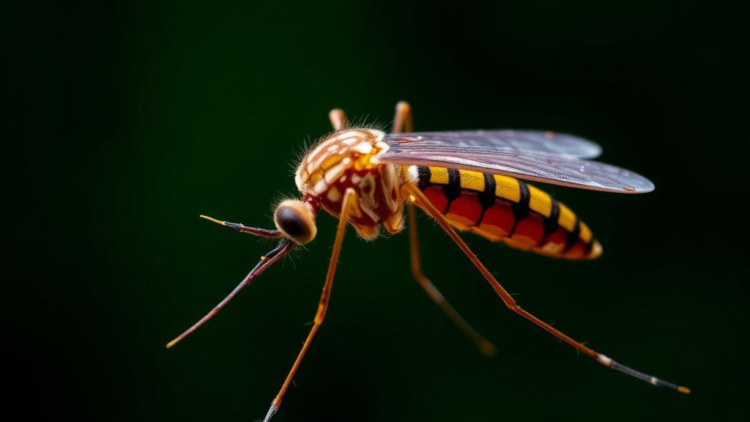
Mosquitoes are among the most intensively studied insects on Earth, yet the vast majority of genomic attention has focused on a handful of disease vectors such as Aedes aegypti and Anopheles gambiae. A new study published in the journal Parasites & Vectors turns the spotlight on three ecologically interesting but largely neglected Neotropical species: the predatory elephant mosquitoes Toxorhynchites theobaldi and Toxorhynchites violaceus, and the culicine mosquito Lutzia bigoti. By combining classical chromosome staining, molecular cytogenetics, chromosome micromanipulation, and flow cytometry, a research team at the Universidade Federal de Viçosa in Brazil has uncovered a striking paradox. All three species carry exactly the same number of chromosomes, and their overall chromosome dimensions are statistically indistinguishable, yet their nuclear DNA contents differ dramatically. The finding demonstrates that the visible architecture of mosquito genomes can remain essentially frozen while the underlying genetic material expands and contracts through the accumulation of repetitive DNA.
The conserved chromosome complement of culicid mosquitoes has long been recognized. Across the family Culicidae, most species share a diploid number of six chromosomes, typically organized as two pairs of autosomes and one pair of sex chromosomes. This remarkable stability contrasts sharply with many other insect groups, where chromosome fusions, fissions, and rearrangements frequently reshape karyotypes over evolutionary time. The Brazilian team set out to ask what this chromosomal conservatism actually conceals. If the number and gross morphology of chromosomes are so similar, does that mean the genomes themselves are similar? The answer, according to the new data, is an emphatic no. The study reveals that genome size, heterochromatin distribution, ribosomal DNA organization, and microsatellite landscapes can all diverge substantially even when the karyotype appears identical under the microscope.
To build this picture, the researchers applied an unusually broad toolkit to mitotic chromosomes prepared from the three species. Giemsa staining provided the baseline description of chromosome number and shape. C-banding then highlighted the distribution of constitutive heterochromatin, the densely packed, repeat-rich chromatin that tends to cluster around centromeres. Sequential staining with the fluorochromes chromomycin A3 and DAPI distinguished GC-rich from AT-rich regions, revealing compositional differences that ordinary stains cannot resolve. Fluorescence in situ hybridization, or FISH, allowed the team to physically map ribosomal DNA clusters and repetitive microsatellite motifs onto specific chromosomes. Finally, flow cytometry delivered precise measurements of nuclear DNA content, using the stingless bee Scaptotrigona xanthotricha as an internal reference standard. This integrative design meant that every claim about genome organization could be cross-checked against an independent measurement technique.
The flow cytometry results delivered the study’s headline surprise. The haploid genome size of Toxorhynchites violaceus was estimated at 1.199 picograms, while its congener Toxorhynchites theobaldi measured 1.003 picograms, and Lutzia bigoti came in at just 0.684 picograms. In relative terms, the genome of T. violaceus is roughly 75 percent larger than that of L. bigoti, a difference that would be expected to leave some visible trace in chromosome dimensions. Yet when the team subjected total chromosome length to statistical analysis, no significant differences emerged among the three species. This decoupling of genome size from chromosome size and number is the central conceptual contribution of the paper. It indicates that the extra DNA in the larger genomes is not organized into new chromosomes or visibly elongated arms, but is instead packed into regions of the genome that standard cytological preparation does not resolve as length differences.
What kind of DNA accounts for this hidden variation? The cytogenetic evidence points squarely at repetitive sequences, the so-called repeatome. C-banding showed that heterochromatin is consistently concentrated in pericentromeric regions in all three species, a pattern typical of many animal genomes. However, the amount and fine distribution of this heterochromatin varied between species, and the fluorochrome staining revealed species-specific patterns of GC-rich sequence accumulation. In both Toxorhynchites species, the team also documented heteromorphisms, cases where one homologous chromosome carried a larger CMA3-positive region or a ribosomal DNA site that its partner lacked. Such within-individual variation is a classic signature of recent transposition and unequal crossing over among tandem repeats, processes that can rapidly inflate or deflate specific genomic compartments without altering chromosome structure in any obvious way.
The ribosomal DNA findings added another layer of intrigue. In both Toxorhynchites species, FISH with an 18S rDNA probe labeled distinct chromosomal sites, and the overall organization of these ribosomal clusters appeared conserved between the two relatives. In Lutzia bigoti, however, no detectable rDNA signal was observed under the hybridization conditions used. The authors suggest this absence may reflect divergence in the structure of the ribosomal DNA repeats themselves, such that the probe no longer binds strongly enough to produce a visible signal. Rather than indicating that L. bigoti lacks ribosomal genes entirely, which would be biologically implausible, the result most likely points to sequence divergence or chromosomal relocation of the ribosomal arrays in this lineage. It is a reminder that even the most essential and conserved gene families in eukaryotic genomes can evolve lineage-specific quirks in their physical organization.
One of the most technically impressive aspects of the study involved chromosome microdissection. Using micromanipulation, the researchers isolated an individual chromosome and amplified its DNA to generate a chromosome-specific probe. When this probe was hybridized back onto chromosome spreads from both Toxorhynchites species, it painted the pericentromeric regions in each, confirming that repetitive DNA concentrated around the centromeres is at least partially shared between the two species. Intriguingly, however, the labeled chromosome pair differed between T. theobaldi and T. violaceus, meaning that the same repeat family occupies different chromosomal addresses in the two genomes. Combined with the species-specific microsatellite distribution patterns documented by FISH, this result paints a picture of a repeatome in constant flux, with sequences being amplified, eroded, and redeployed across the karyotype even between closely related species.
The broader significance of the work lies in what it says about genome evolution in the Culicidae as a whole. Mosquito genome sizes reported across the family span a considerable range, and previous studies have linked this variation primarily to the content of transposable elements and other repeats rather than to whole-genome duplications. The new data from T. theobaldi, T. violaceus, and L. bigoti reinforce that interpretation with an unusually clean example: three species with indistinguishable karyotypes but genome sizes differing by up to three-quarters. The authors conclude that genome evolution in mosquitoes is driven primarily by changes in the content and organization of repetitive DNA rather than by alterations in chromosome number or large-scale morphology. In other words, the karyotype is a poor proxy for genomic diversity, and studies that rely on chromosome counts alone will systematically underestimate the evolutionary dynamism of these insects.
There are also practical implications for research on mosquito biology and control. Toxorhynchites larvae are predatory on other mosquito larvae, and several species in the genus have been explored as biological control agents against disease vectors. Lutzia bigoti, likewise, is a natural predator of container-breeding mosquitoes in the Neotropics. Understanding the genome organization of these non-hematophagous relatives not only fills a gap in comparative cytogenetics but may also inform future genomic and transgenic approaches to vector control, where knowledge of repeat landscapes matters for genome assembly, transgene insertion, and the design of gene drive systems. The finding that rDNA organization can diverge to the point of probe non-detection between genera underscores how much basic cytogenetic ground remains to be covered even within a single well-known insect family.
The study, led by Mara Garcia Tavares and Wellington Ronildo Clarindo with colleagues in the Department of General Biology at the Universidade Federal de Viçosa, was published open access in Parasites & Vectors, with the accepted manuscript released ahead of the final version of record. The team notes that its integrative approach, pairing flow cytometric genome sizing with multi-probe FISH and microdissection-derived probes, offers a template for future work on understudied taxa. As sequencing costs continue to fall, cytogenetic ground-truthing of the kind presented here will remain essential for interpreting assembled genomes correctly, particularly in repeat-rich regions where short-read assembly struggles. For now, the message from these three Neotropical mosquitoes is clear: beneath a calm and unchanging chromosomal surface, their genomes are churning with repetitive DNA, and that hidden churn is the real engine of mosquito genome evolution.
Subject of Research: Comparative cytogenetics and genome size evolution in Neotropical mosquitoes
Article Title: Integrative cytogenetic and genome size analyses reveal conserved karyotypes and repetitive DNA-driven genome variation in the mosquitoes Toxorhynchites theobaldi, Toxorhynchites violaceus, and Lutzia bigoti
Article References: Tavares, M. G., Lopes, A. L. G., Soares, A. L. M., Soares, F. A. F., Martins, G. F., & Clarindo, W. R. (2026). Integrative cytogenetic and genome size analyses reveal conserved karyotypes and repetitive DNA-driven genome variation in the mosquitoes Toxorhynchites theobaldi, Toxorhynchites violaceus, and Lutzia bigoti. Parasites & Vectors. https://doi.org/10.1186/s13071-026-07641-5
Image Credits: AI Generated
DOI: 10.1186/s13071-026-07641-5
Keywords: Culicidae, karyotype, repetitive DNA, genome size, flow cytometry, fluorescence in situ hybridization, rDNA, microsatellites, heterochromatin, chromosome microdissection, Toxorhynchites, Lutzia bigoti
Cite Scienmag News
APA MLA Chicago
Juliet Wilcox. (October 1, 2026). Mosquito Genomes Hide Dramatic Diversity Behind Identical Chromosome Counts. Scienmag. https://scienmag.com/mosquito-genomes-hide-dramatic-diversity-behind-identical-chromosome-counts/
Juliet Wilcox. “Mosquito Genomes Hide Dramatic Diversity Behind Identical Chromosome Counts.” Scienmag, 1 October 2026, https://scienmag.com/mosquito-genomes-hide-dramatic-diversity-behind-identical-chromosome-counts/. Accessed 1 October 2026.
Juliet Wilcox. “Mosquito Genomes Hide Dramatic Diversity Behind Identical Chromosome Counts.” Scienmag. October 1, 2026. https://scienmag.com/mosquito-genomes-hide-dramatic-diversity-behind-identical-chromosome-counts/
Copy citation Download RIS
Tags: chromosome microdissectionchromosome stability in mosquitoesCulicidaecytogenetic techniques in entomologyflow cytometryflow cytometry in genome analysisfluorescence in situ hybridizationgenome expansion and contraction in mosquitoesgenome sizeheterochromatininsect chromosome number conservationkaryotypeLutzia bigotiLutzia bigoti genome variationmicrosatellitesmolecular cytogenetics of mosquitoesmosquito genome diversitymosquito species genetic diversityNeotropical mosquito species genomicsrDNArepetitive DNArepetitive DNA in insect genomesToxorhynchitesToxorhynchites mosquito species