• HOME
  • NEWS
  • EXPLORE
    • CAREER
      • Companies
      • Jobs
    • EVENTS
    • iGEM
      • News
      • Team
    • PHOTOS
    • VIDEO
    • WIKI
  • BLOG
  • COMMUNITY
    • FACEBOOK
    • INSTAGRAM
    • TWITTER
Wednesday, October 21, 2026
BIOENGINEER.ORG
No Result
View All Result
  • Login
  • HOME
  • NEWS
  • EXPLORE
    • CAREER
      • Companies
      • Jobs
        • Lecturer
        • PhD Studentship
        • Postdoc
        • Research Assistant
    • EVENTS
    • iGEM
      • News
      • Team
    • PHOTOS
    • VIDEO
    • WIKI
  • BLOG
  • COMMUNITY
    • FACEBOOK
    • INSTAGRAM
    • TWITTER
No Result
View All Result
Bioengineer.org
No Result
View All Result
Home NEWS Science News Biology

Morphological study describes Lissomus arawak, a new female click beetle from the Dominican Republic

by
October 21, 2026
in Biology
Reading Time: 3 mins read
0
Morphological study describes Lissomus arawak, a new female click beetle from the Dominican Republic

New click beetle species with glossy black shell discovered in Dominican Republic

Share on FacebookShare on TwitterShare on LinkedinShare on RedditShare on Telegram

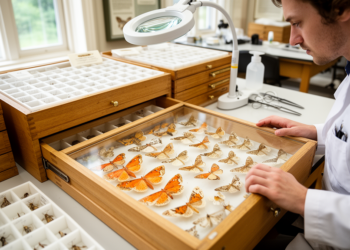
A morphological taxonomic study has described Lissomus arawak as a new species of click beetle from the Dominican Republic. The description was based on one female holotype and four female paratypes collected in the provinces of Monseñor Nouel, Pedernales and Puerto Plata.

The researchers examined the five specimens using an ocular micrometer at magnifications ranging from 7 to 90 times. Body length was measured from the anterior margin of the frons to the elytral apices, while width was measured across the elytral humeri. Where needed, specimens were dissected to expose and examine genitalic and terminal abdominal structures.

L. arawak measured 7.9–9.0 mm long and 4.4–4.8 mm wide. It has a strongly convex dorsum, a shining dark red-black to black integument, short pale hair-like pubescence, and pale yellow intermediate antennomeres. Diagnostic features include smooth and visually indistinguishable elytral striae and intervals, constricted anterior pronotal angles, polished humeral bosses, and a deep ninth elytral sulcus separated from the humeral sulcus by a carinate bridge.

The female ovipositor was 4.3 mm long, with a dorsoventrally compressed baculus approximately four times longer than the coxite. Males were not known. Because the sexes generally cannot be distinguished in Lissomus without examining genitalia, the available material does not establish the species’ male morphology.

The authors found L. arawak most similar to members of the Lissomus gagatinus group, which includes L. impressifrons and ranges from Costa Rica and Colombia eastward to Guyane and north to Guadeloupe. The new species differs in body form and sculpture, including more strongly domed elytra, stronger humeral bosses, subparallel lateral margins in dorsal view, and yellow intermediate antennomeres.

It is also morphologically distinct from L. quisqueya and L. woodruffi, two previously described Dominican Republic species. Based on those morphological comparisons, the authors characterized L. arawak as probably representing a second intrageneric lineage of Lissomus in the Greater Antilles. The evidence presented was morphological rather than molecular.

Known collection localities are associated with mesic tropical montane broadleaf forest, pine transitions and cloud forest. The holotype was collected at 700 m elevation along the Alcoa Road in the Sierra de Bahoruco, where mixed, dense forest transitions from dry broadleaf forest at lower elevations into forest dominated by endemic Pinus occidentalis at higher elevations.

Collection dates from early May to late June may suggest a primary adult activity period during the early rainy season, but the authors described this as a tentative inference. The description was based on only five known female specimens from five distinct collecting events, and no males were known. The specific epithet arawak refers to the Arawak culture of Indigenous peoples who lived on Hispaniola and other Antillean islands before 16th-century colonization.

Subject of Research: Morphological description of a new endemic click beetle species in the Dominican Republic

Article Title: Lissomus arawak sp. nov. ( Coleoptera , Elateridae ), a new species from the Dominican Republic

Article References: Johnson, P. J., & Hodecek, J. (2026). Lissomus arawak sp. nov. (Coleoptera, Elateridae), a new species from the Dominican Republic. Alpine Entomology, 10, 155-161. https://doi.org/10.3897/alpento.10.193434

Image Credits: AI Generated

DOI: 10.3897/alpento.10.193434

Keywords: Lissomus arawak, click beetle, Elateridae, taxonomy, Dominican Republic, morphology, Hispaniola, new species, entomology, Lissomus, arawak, Coleoptera

News Source: Drew Townsend. (October 21, 2026). Morphological study describes Lissomus arawak, a new female click beetle from the Dominican Republic. Scienmag.

Tags: arawakclick beetleColeopteraDominican RepublicElateridaeEntomologyHispaniolaLissomusLissomus arawakmorphologyNew speciestaxonomy
Share12Tweet7Share2ShareShareShare1

Related Posts

Taxonomic study identifies 15 new tineid moth species and 10 new Ethiopian records

Taxonomic study identifies 15 new tineid moth species and 10 new Ethiopian records

October 21, 2026
Morphological and phylogenetic study identifies seven new Hygrocybe taxa in the Dominican Republic

Morphological and phylogenetic study identifies seven new Hygrocybe taxa in the Dominican Republic

October 21, 2026

Redescription of two cave-dwelling Oncopodura species from the Balkan Peninsula

October 21, 2026

Review assesses network pharmacology for herbal medicines in rheumatoid arthritis

October 21, 2026

POPULAR NEWS

  • Taxonomic study identifies 15 new tineid moth species and 10 new Ethiopian records

    Taxonomic study identifies 15 new tineid moth species and 10 new Ethiopian records

    29 shares
    Share 12 Tweet 7
  • Morphological and phylogenetic study identifies seven new Hygrocybe taxa in the Dominican Republic

    29 shares
    Share 12 Tweet 7
  • Redescription of two cave-dwelling Oncopodura species from the Balkan Peninsula

    29 shares
    Share 12 Tweet 7
  • Morphological study describes Lissomus arawak, a new female click beetle from the Dominican Republic

    29 shares
    Share 12 Tweet 7

About

We bring you the latest biotechnology news from best research centers and universities around the world. Check our website.

Follow us

Recent News

Taxonomic study identifies 15 new tineid moth species and 10 new Ethiopian records

Morphological and phylogenetic study identifies seven new Hygrocybe taxa in the Dominican Republic

Redescription of two cave-dwelling Oncopodura species from the Balkan Peninsula

Subscribe to Blog via Email

Enter your email address to subscribe to this blog and receive notifications of new posts by email.

Join 85 other subscribers
  • Contact Us

Bioengineer.org © Copyright 2023 All Rights Reserved.

Welcome Back!

Login to your account below

Forgotten Password?

Retrieve your password

Please enter your username or email address to reset your password.

Log In
No Result
View All Result
  • Homepages
    • Home Page 1
    • Home Page 2
  • News
  • National
  • Business
  • Health
  • Lifestyle
  • Science

Bioengineer.org © Copyright 2023 All Rights Reserved.