• HOME
  • NEWS
  • EXPLORE
    • CAREER
      • Companies
      • Jobs
    • EVENTS
    • iGEM
      • News
      • Team
    • PHOTOS
    • VIDEO
    • WIKI
  • BLOG
  • COMMUNITY
    • FACEBOOK
    • INSTAGRAM
    • TWITTER
Wednesday, May 20, 2026
BIOENGINEER.ORG
No Result
View All Result
  • Login
  • HOME
  • NEWS
  • EXPLORE
    • CAREER
      • Companies
      • Jobs
        • Lecturer
        • PhD Studentship
        • Postdoc
        • Research Assistant
    • EVENTS
    • iGEM
      • News
      • Team
    • PHOTOS
    • VIDEO
    • WIKI
  • BLOG
  • COMMUNITY
    • FACEBOOK
    • INSTAGRAM
    • TWITTER
  • HOME
  • NEWS
  • EXPLORE
    • CAREER
      • Companies
      • Jobs
        • Lecturer
        • PhD Studentship
        • Postdoc
        • Research Assistant
    • EVENTS
    • iGEM
      • News
      • Team
    • PHOTOS
    • VIDEO
    • WIKI
  • BLOG
  • COMMUNITY
    • FACEBOOK
    • INSTAGRAM
    • TWITTER
No Result
View All Result
Bioengineer.org
No Result
View All Result
Home NEWS Science News Biology

More support needed for pollination services in agriculture

Bioengineer by Bioengineer
September 23, 2021
in Biology
Reading Time: 3 mins read
0
Landscape comparisons
Share on FacebookShare on TwitterShare on LinkedinShare on RedditShare on Telegram

The global decline of pollinators threatens the reproductive success of 90 per cent of all wild plants globally and the yield of 85 per cent of the world’s most important crops. Pollinators – mainly bees and other insects – contribute to 35 per cent of the world’s food production. The service provided by pollinators is particularly important for securing food produced by the more than two billion small farmers worldwide. An agroecologist at the University of Göttingen points out that yields could be increased if pollinators were encouraged. The article was published in One Earth.
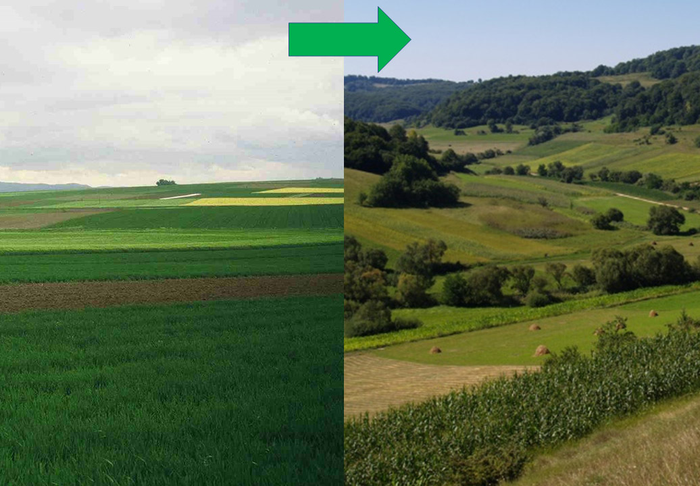
Landscape comparisons

Credit: Dr Tibor Härtel (right), Professor Teja Tscharntke (left)

The global decline of pollinators threatens the reproductive success of 90 per cent of all wild plants globally and the yield of 85 per cent of the world’s most important crops. Pollinators – mainly bees and other insects – contribute to 35 per cent of the world’s food production. The service provided by pollinators is particularly important for securing food produced by the more than two billion small farmers worldwide. An agroecologist at the University of Göttingen points out that yields could be increased if pollinators were encouraged. The article was published in One Earth.

Current estimates put the value of pollination services at around 200 to 400 billion US dollars per year. Smallholder farmers, whose fields are less than two hectares, represent about 83 per cent of all farmers. They benefit from pollination services much more than farmers with large fields. If the fields are smaller than two hectares, any shortfall in yields can be reduced much more efficiently through pollination than in large fields. Many smallholder farmers live in the Global South and suffer from hunger or malnutrition. Crops that are dependent on pollinators, such as fruits and nuts, contain nutrients that are particularly important for health. “Pollination services in agriculture should be given more attention, in addition to pest regulation and good nutrient supply,” claims author Professor Teja Tscharntke, Head of the Agroecology Group at Göttingen University. The benefits are not limited to an increase in how much fruit can be produced: its quality can also be improved, for instance, in terms of nutrient content or how long it can be stored. Smallholder agroforestry systems in the tropics are particularly well suited for this and stand out due to their comparatively species-rich pollinator communities.

“More needs to be done to halt the decline of pollinators, which are mostly bees and other insects. The stress to pollinators caused by agrochemicals, large monocultures and the loss of semi-natural habitats should be minimised,” says Tscharntke. “However, considerable research efforts are still needed to make agricultural landscapes productive and, at the same time, species-rich – in particular to improve the situation in the tropics.”

###

Original publication: Teja Tscharntke: Disrupting plant-pollinator systems endangers food security. One Earth (2021), https://doi.org/10.1016/j.oneear.2021.08.022  

Contact:

Professor Teja Tscharntke

University of Göttingen

Agroecology Group

Grisebachstraße 6, 37077 Göttingen, Germany

Tel: +49 (0)551 39 9209

Email: [email protected]

www://uni-goettingen.de/en/74726.html


Journal

One Earth

DOI

10.1016/j.oneear.2021.08.022

Method of Research

News article

Subject of Research

Not applicable

Article Title

Disrupting plant-pollinator systems endangers food security.

Article Publication Date

17-Sep-2021
Share12Tweet8Share2ShareShareShare2

Related Posts

Brookfield Zoo Chicago Achieves Major Milestone in Puerto Rican Crested Toad Conservation with Over 12,000 Tadpoles — Biology

Brookfield Zoo Chicago Achieves Major Milestone in Puerto Rican Crested Toad Conservation with Over 12,000 Tadpoles

May 19, 2026
Decoding p53 Vulnerability: Unraveling Why the Genome Guardian Often Fails — Biology

Decoding p53 Vulnerability: Unraveling Why the Genome Guardian Often Fails

May 19, 2026

New Imaging Technique Simultaneously Maps Brain Activity in Nine Cell Types — Over Four Times the Previous Limit

May 19, 2026

Decoding the Tumor Microenvironment Chemokine Network: From Immune Evasion to Innovative Multi-Target Therapies

May 19, 2026

POPULAR NEWS

  • blank

    New Study Reveals Plants Can Detect the Sound of Rain

    732 shares
    Share 292 Tweet 183
  • Research Indicates Potential Connection Between Prenatal Medication Exposure and Elevated Autism Risk

    846 shares
    Share 338 Tweet 212
  • Breastmilk Balances E. coli and Beneficial Bacteria in Infant Gut Microbiomes

    58 shares
    Share 23 Tweet 15
  • ESMO 2025: mRNA COVID Vaccines Enhance Efficacy of Cancer Immunotherapy

    246 shares
    Share 98 Tweet 62

About

BIOENGINEER.ORG

We bring you the latest biotechnology news from best research centers and universities around the world. Check our website.

Follow us

Recent News

Cerebral NIRS: Key in Managing Post-Hemorrhagic Dilation?

Evaluating APR-246 Response in Ovarian Cancer Mutants

Shattering Barriers: Integrated Solar-Powered Approach for Upcycling Biomass and Plastic Waste

Subscribe to Blog via Email

Enter your email address to subscribe to this blog and receive notifications of new posts by email.

Join 82 other subscribers
  • Contact Us

Bioengineer.org © Copyright 2023 All Rights Reserved.

Welcome Back!

Login to your account below

Forgotten Password?

Retrieve your password

Please enter your username or email address to reset your password.

Log In
No Result
View All Result
  • Homepages
    • Home Page 1
    • Home Page 2
  • News
  • National
  • Business
  • Health
  • Lifestyle
  • Science

Bioengineer.org © Copyright 2023 All Rights Reserved.