• HOME
  • NEWS
  • EXPLORE
    • CAREER
      • Companies
      • Jobs
    • EVENTS
    • iGEM
      • News
      • Team
    • PHOTOS
    • VIDEO
    • WIKI
  • BLOG
  • COMMUNITY
    • FACEBOOK
    • INSTAGRAM
    • TWITTER
Sunday, August 30, 2026
BIOENGINEER.ORG
No Result
View All Result
  • Login
  • HOME
  • NEWS
  • EXPLORE
    • CAREER
      • Companies
      • Jobs
        • Lecturer
        • PhD Studentship
        • Postdoc
        • Research Assistant
    • EVENTS
    • iGEM
      • News
      • Team
    • PHOTOS
    • VIDEO
    • WIKI
  • BLOG
  • COMMUNITY
    • FACEBOOK
    • INSTAGRAM
    • TWITTER
  • HOME
  • NEWS
  • EXPLORE
    • CAREER
      • Companies
      • Jobs
        • Lecturer
        • PhD Studentship
        • Postdoc
        • Research Assistant
    • EVENTS
    • iGEM
      • News
      • Team
    • PHOTOS
    • VIDEO
    • WIKI
  • BLOG
  • COMMUNITY
    • FACEBOOK
    • INSTAGRAM
    • TWITTER
No Result
View All Result
Bioengineer.org
No Result
View All Result
Home NEWS Science News Biology

More efficient use of raw materials with the aid of ‘molecular conveyor belts’

Bioengineer by Bioengineer
September 18, 2017
in Biology
Reading Time: 2 mins read
0
Share on FacebookShare on TwitterShare on LinkedinShare on RedditShare on Telegram
IMAGE

Credit: GU

FRANKFURT. Making valuable products, such as fuels, synthetic materials or pharmaceuticals, from renewable raw materials is to date not efficient enough because the microorganisms used only process the raw materials very slowly and generate many by-products in addition to the substances actually wanted. Biotechnologists at Goethe University Frankfurt have now succeeded in optimizing sugar utilization in baker's yeast.

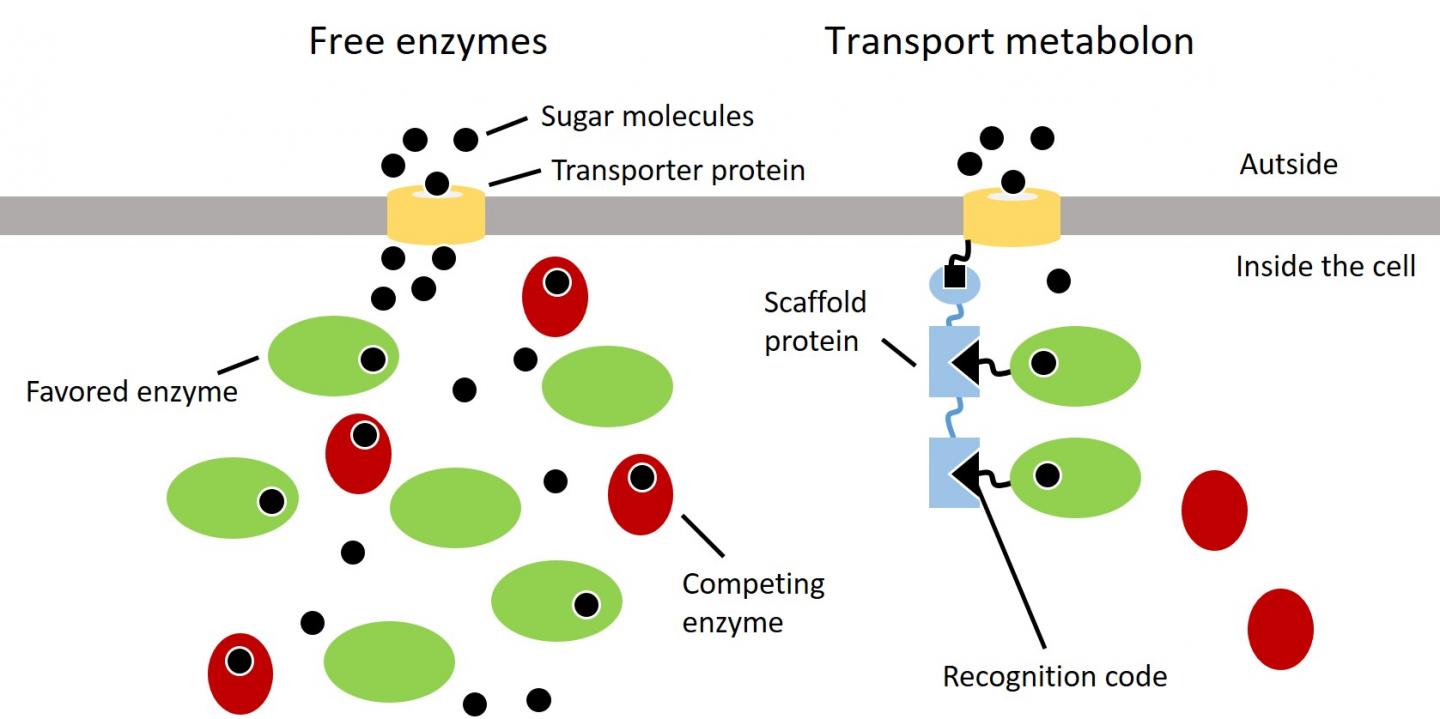
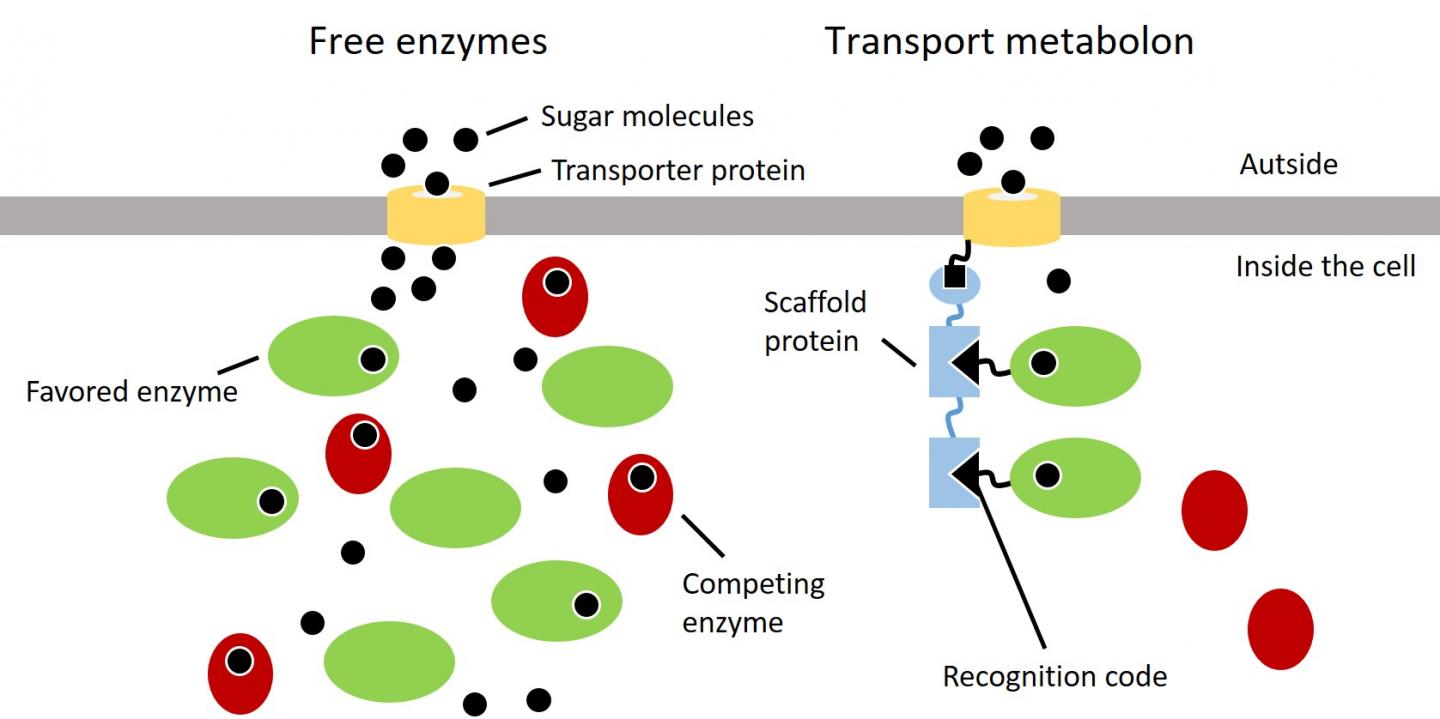
Microorganisms such as baker's yeast can be compared to a miniature factory: the raw materials (generally sugar) are carried in through gates (transport proteins) and converted in a multi-stage process with the help of enzymes. By contrast to a man-made factory, in microbes not only technologically interesting products are turned out but also many by-products. This is due to the fact that various enzymes compete for the sugar so that different building blocks important for the cell's survival are formed.

Thomas Thomik and Dr. Mislav Oreb from the Institute of Molecular Biosciences at Goethe University Frankfurt have now succeeded in channeling the metabolism of baker's yeast in such a way that sugar, as the raw material, can be used more productively. In the latest issue of the renowned scientific journal "Nature Chemical Biology", the researchers present a new mechanism with which the raw materials are delivered directly to the desired enzymes by transport proteins.

Mislav Oreb explains the principle: "We have built a 'scaffold protein' that binds to the transport protein and then serves as a docking station for the desired enzymes. Recognition codes in the enzymes enable them to dock. The result is an accumulation of the desired enzymes near the transporter. In this way, the cell can process the raw material like on a conveyor belt, without the competing enzymes having a chance to convert it."

In their study, the biotechnologists show that the sugar xylose is converted into ethanol by such "molecular conveyor belts" (transport metabolons) more efficiently by minimizing the production of the unwanted by-product xylitol.

"The underlying principle could be used to make any manner of product from various sugars, such as biofuels, synthetic materials or pharmaceuticals. The concept has the potential to make biotechnological processes generally more ecologically and economically sustainable, since efficient sugar utilization is a fundamental requirement for this," says Mislav Oreb, explaining the significance of the new process.

###

Media Contact

Dr. Mislav Oreb
[email protected]
49-069-798-29331
@goetheuni

http://www.uni-frankfurt.de

Share13Tweet8Share2ShareShareShare2

Related Posts

Ancient giant tortoise DNA reveals secrets lost to time

Ancient giant tortoise DNA reveals secrets lost to time

August 29, 2026
Large DNA viruses carry their own membrane remodelling machinery

Large DNA viruses carry their own membrane remodelling machinery

August 29, 2026

Brassinosteroids boost sugar synthesis by blocking BIN2 phosphorylation of PEP carboxykinase

August 29, 2026

Pistacia atlantica Extract Shows Potent Activity Against Giardia lamblia Cysts

August 29, 2026
Please login to join discussion

POPULAR NEWS

  • Buy or outsource? What drives German farmers toward field robots

    29 shares
    Share 12 Tweet 7
  • Emerging contaminants found in Vietnam’s water sources and urban systems, review shows

    29 shares
    Share 12 Tweet 7
  • Electroacupuncture protects mouse brains from stroke via lactylation-driven ZIP14 expression

    29 shares
    Share 12 Tweet 7
  • Orthogonal silver nanorods enable terahertz polarization conversion, simulations show

    29 shares
    Share 12 Tweet 7

About

We bring you the latest biotechnology news from best research centers and universities around the world. Check our website.

Follow us

Recent News

Buy or outsource? What drives German farmers toward field robots

Emerging contaminants found in Vietnam’s water sources and urban systems, review shows

Electroacupuncture protects mouse brains from stroke via lactylation-driven ZIP14 expression

Subscribe to Blog via Email

Enter your email address to subscribe to this blog and receive notifications of new posts by email.

Join 85 other subscribers
  • Contact Us

Bioengineer.org © Copyright 2023 All Rights Reserved.

Welcome Back!

Login to your account below

Forgotten Password?

Retrieve your password

Please enter your username or email address to reset your password.

Log In
No Result
View All Result
  • Homepages
    • Home Page 1
    • Home Page 2
  • News
  • National
  • Business
  • Health
  • Lifestyle
  • Science

Bioengineer.org © Copyright 2023 All Rights Reserved.