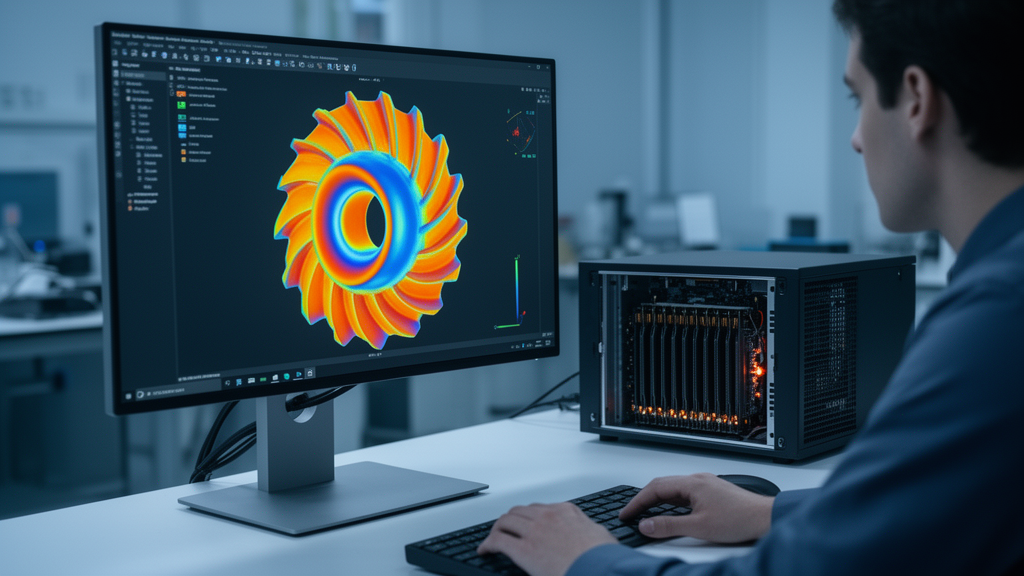
The framework, which allows researchers to build tightly coupled simulations of interacting physical processes, has been continuously and collaboratively developed, and this update reports on features implemented since the previous update in mid-2025. The headline change is a dramatic widening of GPU support: dedicated Kokkos systems now accelerate the native libMesh finite-element backend, while the MFEM backend has been expanded, with both new capabilities remaining compatible with existing CPU workflows.
The Kokkos-MOOSE framework achieves residual object polymorphism statically through a C++ template pattern rather than the traditional virtual-keyword-based dynamic polymorphism. Although the polymorphic dispatch is statically rather than dynamically encoded, the residual object method structures are very similar, so users still define their own physics models by overriding base-class methods such as computeQpResidual and computeQpJacobian just as they always have, making adoption straightforward in downstream applications. Beyond the residual objects that form the backbone of MOOSE, the developers have accelerated materials and traditional postprocessing systems, including postprocessors, vector postprocessors and auxiliary kernels, following the same static polymorphism strategy. Functions, which provide arbitrary on-the-fly spatial and temporal evaluations, are also available in Kokkos-MOOSE, though their dynamic dispatch is currently disabled in GPU execution paths because of limitations that MOOSE’s upstream packages impose on relocatable device code compilation.
Initial Kokkos support has also been merged for MOOSE’s linear finite-volume system, including elemental kernels, flux kernels and boundary conditions. Paired with the Kokkos-MOOSE parsed function object, this ensures that users are equipped to assemble and solve advection-diffusion equations via the finite-volume method on GPUs. In parallel, NEML2, the GPU-accelerated material-modeling backend introduced with MOOSE 4.0, has undergone a major architectural overhaul. NEML2 v3 is now Python-native and uses PyTorch AOTInductor to compile material models ahead of time into portable, Python-free artifacts callable directly from C++. According to the developers, this new compilation pathway improves GPU performance by up to 4.5 times compared with the previous TorchScript/JIT implementation. The update also adds a new implicit-solver infrastructure with adaptive substepping and scalable solution strategies, expands the available physics-model catalog, and substantially redesigns the MOOSE integration to support efficient batched constitutive updates and multi-device CPU/GPU execution.
To support batched, device-resident constitutive updates without the overhead of per-element finite-element reinitialization, MOOSE introduced a reinit-free NEML2 assembly infrastructure. Two caching ElementUserObjects named NEML2Assembly and NEML2FEInterpolation gather quadrature weights, coordinate data and shape function values once per timestep and hold them as batched tensors, while NEML2PreKernel and NEML2PostKernel objects, such as NEML2SmallStrain and NEML2StressDivergence, perform the constitutive update and residual assembly as batch operations evaluated directly on-device. The NEML2ModelExecutor can additionally keep material state and force tensors resident on-device across a timestep, advancing state to old state directly on the GPU once the solve converges, thus avoiding a round trip through MOOSE’s material system, which is usually required to guarantee timestep-rollback safety.
Discretization techniques have advanced as well. Where the previous version of MOOSE offered local hybridized discontinuous Galerkin (L-HDG) discretizations, the framework now additionally supports interior penalty HDG (IP-HDG) discretizations. The IP-HDG capability, together with the built-in static condensation capability in libMesh, was leveraged to build a field-split preconditioner capable of efficiently solving high-Reynolds-number Navier-Stokes flow problems. IP-HDG Navier-Stokes introduces multiple facet fields, one for velocity and one for pressure, but no nonlinear variable for the velocity gradient or viscous flux, whereas L-HDG uses only a single facet field and employs nonlinear velocity gradient fields. The two approaches suit different problems: IP-HDG generates an exactly divergence-free velocity field, making it excellent for building flow-transport-compatible discretizations that decouple pressure and transport bases, while when viscous effects are dominant, L-HDG allows postprocessing of a velocity field that is O(hp+2) accurate in the L2 norm, gaining an additional polynomial order of accuracy.
Another notable addition is a new Shifted Boundary Method module for solving partial differential equations on complex geometries without requiring boundary-fitted meshes. Instead of conforming the mesh to curved boundaries, the geometry is embedded inside a background mesh and the boundary conditions are shifted from the true interface to surrogate locations on nearby mesh faces. This approach preserves accuracy and avoids potentially difficult meshing, yet still enables robust treatment of Dirichlet, Neumann and Robin boundary conditions. The linearized finite-volume discretization capabilities introduced in the previous version, which form system matrices and right-hand sides rather than the residual and Jacobian, have been further extended via the migration of face interpolation and gradient methods to custom extendable systems, allowing downstream application developers to override these to provide custom schemes.
The MFEM backend has grown considerably. MOOSE-MFEM now wraps the MFEM geometric multigrid capability for bilinear forms; geometric multigrid, generally called p-multigrid when the grids are constructed with varying finite-element polynomial orders, is much more amenable to achieving high throughput on accelerators such as GPUs because it eliminates the construction of memory-bandwidth-intensive data structures such as compressed sparse row matrices. New interpolative transfers enable variable transfers between libMesh and MFEM problems when the finite-element spaces of the variables are consistent, easing the use of MFEM sub-applications in MOOSE multi-app simulations. MOOSE-MFEM support now also includes the setup and solution of mixed and multivariate linear MFEM finite-element problems, nonlinear problems with on-diagonal and coupling-wise nonlinear contributions solvable with MFEM’s own Newton solver or PETSc solvers, and face integrators enabling discontinuous Galerkin problems. Real eigenproblems can be solved using locally optimal block preconditioned conjugate gradient and auxiliary-space Maxwell eigensolvers from Hypre, and support for complex variables has been added for time-harmonic problems, with examples in frequency-domain electromagnetics. The ability to segregate equation solves between nonlinear and linear systems, referred to as multi-system, was significantly expanded, with the Convergence system extended to multi-system solves and per-system preconditioners settable through prefixes in PETSc options.
Meshing and geometry capabilities also advanced. Building on previously added general geometry meshing libraries for triangulation and tetrahedralization, the developers expanded libMesh to include polygonal and polyhedral element support, added mesh generators in MOOSE that can generate and perform operations such as extrusion with these element types, and enabled input and output on polyhedral meshes in libMesh. Rudimentary surface meshing capabilities that leverage surface projections and 2D triangulation were created to begin meshing directly from STL files generated via computer-aided design. To facilitate nuclear engineering analysis workflows using Monte Carlo particle transport, a constructive solid geometry framework was introduced, building the real analytical constructive solid geometry during mesh generation; this geometry will enable MOOSE to connect directly to Monte Carlo codes like Shift, using its Titan frontend, or OpenMC, facilitating the construction of consistent geometries and automating workflows.
Artificial intelligence features made their debut in this release. Taking advantage of agentic artificial intelligence technology, Idaho National Laboratory has developed MOOSEnger, an agentic tool that helps users create simulation inputs, address issues and process outputs. It leverages a harness based on deterministic input checks, retrieval-augmented generation of application data, integration of the MOOSE language server and version-controlled artifact management, and a memory capability to record user decisions. Designed as an extendable agentic framework, it can be quickly adapted by MOOSE-based applications to develop new domain-specific agents, such as a BISON agent. MOOSEnger has not yet been released as an open-source tool but is available upon request. Separately, recent developments in meshing capabilities, 3D mortar contact methods and the Kokkos linear finite-volume discretization have heavily leveraged AI-assisted development, which was also deployed to aid in creating patches for user support as part of routine maintenance, although no formal policy has yet been introduced for contributing using AI assistance.
The release also strengthens the surrounding ecosystem. Nearly 13,000 tests are run on more than 50 configurations for MOOSE and its modules, with new support for GPU testing using CUDA on NVIDIA GPUs, testing with x86-64-v3 optimization flags and the Intel compiler suite, and automatic collection of timing and memory statistics that fails tests using more memory than expected. Restep testing, in which a timestep is intentionally failed and repeated to verify identical results, has been deployed across nearly the entire ecosystem of applications, and a new capability registry consolidates test requirements into a single boolean-expression test-spec parameter. On the user interface side, MOOSE now supports creation of Functional Mock-up Units on Linux, and the WASP parser and MOOSE language server provide richer language services with a new plotting extension. The community continues to grow, with an ecosystem webpage tracking 80 applications identified to date, a UK MOOSE conference held at the Center for Modeling and Simulation in Bristol in May 2026, and conferences and trainings planned for 2027 at the University of Utah, MIT, Columbus, Ohio and Idaho Falls. In the past year, one notable research achievement was the Nuclear Regulatory Commission’s approval of Kairos Power’s topical report on their safety analysis methodology, which relied on KP-SAM and KP-BISON, both proprietary MOOSE-based applications, while TMAP8 and Griffin, two other MOOSE-based applications, earned R&D-100 awards. Planned future work includes deployment of physics solvers for fluid dynamics and thermo-mechanics on GPU architectures, additional flexibility in distributing simulations, and further integration of AI into analysis workflows.
Subject of Research: Release of MOOSE 5.0, an open-source multiphysics simulation framework with expanded GPU acceleration, new discretization and solver capabilities, and AI-assisted development tools.
Article Title: 5.0 MOOSE: Enabling massively parallel multiphysics simulation
Article References: Choi, N., Giudicelli, G., Lindsay, A., Harbour, L., German, P., Hansel, J., Prince, Z., Stogner, R., Li, M., Icenhour, C., Wang, Y., Schwen, D., Behne, P., Spencer, B. W., Win, M. T., Kyriakopoulos, V., Frederiksen, A., Vazic, B., Munday, L., … Permann, C. (2026). 5.0 MOOSE: Enabling massively parallel multiphysics simulation. SoftwareX, 36, Article 103122. https://doi.org/10.1016/j.softx.2026.103122
Image Credits: AI Generated
DOI: 10.1016/j.softx.2026.103122
Keywords: MOOSE, multiphysics simulation, GPU acceleration, Kokkos, MFEM, finite element method, discontinuous Galerkin, NEML2, constructive solid geometry, artificial intelligence, Idaho National Laboratory, open-source software
News Source: Denise Maddox. (October 28, 2026). MOOSE 5.0 Brings GPU Acceleration, New Discretizations and AI Tools to Multiphysics Simulation. Scienmag.