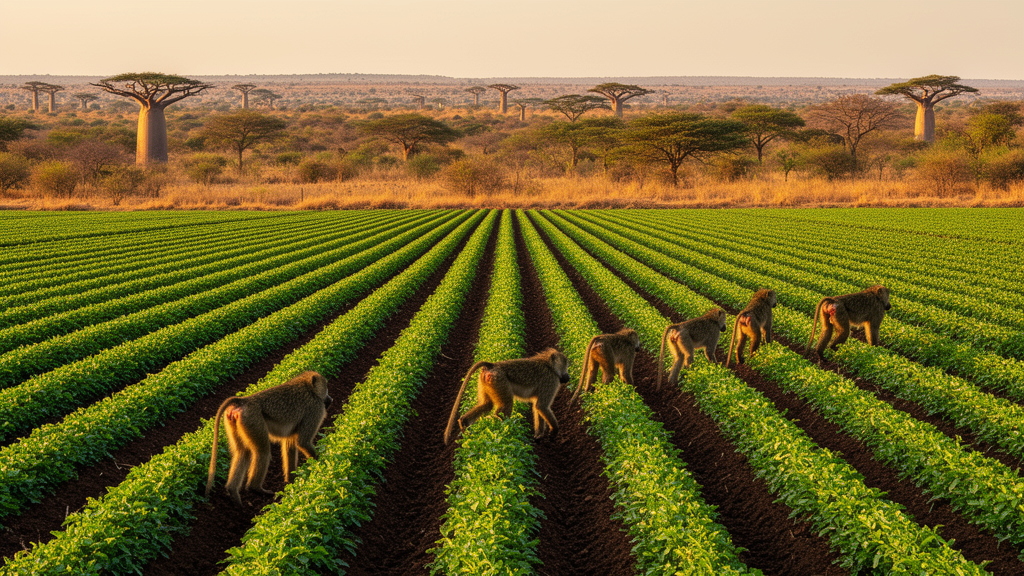
Across the savannahs and dry forests of West Africa, one of the continent’s most adaptable primates is quietly losing the genetic connections that keep its populations alive. A new study published in Heredity has mapped, at unprecedented scale, how farmland expansion is reshaping the DNA of the Guinea baboon (Papio papio), a Near Threatened species that ranges from the arid mountain massifs of Mauritania to the humid forests of the Republic of Guinea. By genotyping hundreds of faecal samples collected non-invasively across the species’ entire distribution, an international team of researchers has revealed that intensive agriculture acts as a powerful barrier to gene flow, while rivers and patchy natural habitats serve as the invisible corridors that keep populations connected. The findings carry warnings that extend well beyond baboons, touching on how the future of West African biodiversity will be decided on farmland as much as in reserves.
The research team assembled a dataset of 243 unique baboon genotypes drawn from samples collected between 2010 and 2022, using eleven microsatellite loci amplified from faecal DNA. Non-invasive sampling of this kind is technically demanding: DNA in faeces is degraded and often dominated by microbial and dietary contamination, so the researchers used a modified multi-tube approach, running at least four amplifications per locus per sample and applying a strict quality index to discard unreliable consensus genotypes. They confirmed species identity through mitochondrial DNA sequencing, molecularly determined the sex of many individuals, and carefully removed duplicate genotypes and close relatives to avoid biasing downstream analyses. The result is one of the most geographically comprehensive landscape genetic datasets ever assembled for a West African primate, spanning Mauritania, Mali, Senegal, Gambia, Guinea-Bissau and the Republic of Guinea.
The genetic structure that emerged tells a story of both connection and isolation. Bayesian clustering analyses identified six genetic clusters across the range, with considerable admixture among most geographic demes but one striking exception: the population sampled in Mali’s Kongassambougou Reserve formed a clearly distinct, well-separated group. The researchers suggest two possible explanations for this Malian isolation. The population may have experienced long-term reproductive isolation and genetic drift, or it may carry introgressed genes from the olive baboon (Papio anubis), since the region lies in a hypothesised contact zone between the two species where hybridization has been suspected but never documented. Distinguishing between these scenarios, the authors note, would require whole-genome sequencing and morphological assessment in a region where political instability has long limited field research.
At the opposite, western edge of the distribution, Gambian populations showed the lowest genetic diversity and among the highest inbreeding levels of any deme sampled, along with the highest mean pairwise relatedness. The researchers interpret this as consistent with a history of sequential founder events during range expansion, a process known as allele surfing, in which rare alleles are pushed to high frequency at the leading edge of a population wave. But they also warn that this historically low diversity may now be compounded by contemporary pressures: Gambia has one of the highest human footprint scores and the lowest proportion of natural habitat within the study area. As habitat suitability breaks apart along the coast and interior, gene flow between Gambian baboons and their Senegalese neighbours appears to be weakening, potentially locking the westernmost populations into a spiral of inbreeding and isolation.
The heart of the study lies in its landscape genetics analysis, which tested 59 different resistance surfaces representing competing hypotheses about which landscape features facilitate or impede movement. Genetic differentiation between demes was related to landscape resistance using circuit theory, implemented in Circuitscape, and evaluated with maximum likelihood population effect models corrected for small sample sizes. The best-supported model, explaining roughly 72 percent of the variation in genetic differentiation, combined two key elements: rivers acting as dispersal corridors with large waterbodies as barriers, and croplands acting as strong barriers to movement while natural habitats such as forest-savannah mosaics, grasslands, shrublands and bare areas actively facilitate connectivity. Notably, mosaics of forest and cropland proved far more permeable than strict monocultures, suggesting that the structural complexity of traditional farming landscapes matters as much as the presence of agriculture itself.
This distinction between heterogeneous and intensive agriculture may prove to be the study’s most consequential insight. Traditional West African farming systems, developed over millennia of co-adaptation between people and ecosystems, produce mosaics of cultivated plots and remnant natural vegetation that structurally resemble the savannah-forest mosaics they replaced. Since the beginning of the twenty-first century, however, intensive monoculture plantations of commodity crops have been increasingly favoured across Sub-Saharan Africa, driven by international market demand. These simplified landscapes homogenise the environment, reduce species richness, and, according to the new genetic evidence, sever the functional connections that allow animals to disperse, mate and recolonise. The contrast between the low-diversity, highly related Gambian demes and the more genetically diverse populations in heterogeneous habitats elsewhere offers a sobering natural experiment in what landscape simplification does to the raw material of evolution.
The environmental drivers of genetic diversity within populations followed a similar pattern. Allelic richness and the number of private alleles were both positively associated with mosaics of forest and savannah-like environments, while observed heterozygosity correlated positively with shrubland cover, though the authors treat the latter result cautiously because heterozygosity estimates are more sensitive to null alleles and inbreeding effects. These associations, based on ten geographic demes, are explicitly exploratory and limited in statistical power, but they align with the species’ ecology: Guinea baboons are dietary generalists that use all available habitat types, spend significant time in gallery forests, and travel more when food and water become scarce toward the end of the dry season. Heterogeneous landscapes provide the food, water and sleeping sites that support large, well-connected populations, and their loss erodes the demographic foundation on which genetic diversity ultimately depends.
The study also grapples honestly with its own limitations. Because the genetic data reflect one to two baboon generations, the observed structure may retain signatures of older demographic processes, including historical metapopulation dynamics of colonisation and extinction, particularly in the arid Sahelian north where natural climate fluctuations have long driven population change independently of human influence. The resistance surfaces were parameterised uniformly across the range, so inferred resistance values represent range-wide averages that may miss regionally varying responses. And because the analysis relied on neutral microsatellite markers, it cannot test for local adaptation. The authors call for future work integrating GPS tracking, telemetry, remote sensing and landscape genomics, including Y-linked markers that could finally resolve the sex-specific dispersal patterns that remain elusive when fewer than half of sampled individuals could be sexed.
For conservation, the message is urgent and specific. The researchers recommend prioritising the preservation of riverine corridors, particularly between southern Mauritania and Senegal, within Gambia, and between Gambia and Niokolo-Koba National Park, alongside the protection of temporary rivers and mountain rock pools that sustain the species’ most marginal populations. More provocatively, they argue that replacing monoculture farming with agroecological practices such as agroforestry is crucial to maintaining landscape connectivity. Agroforestry, the integration of native trees and shrubs into cultivated land, reduces soil erosion, boosts carbon sequestration and improves water retention while providing farmers with diversified income, and it recreates the mosaic structure that the genetic data show baboons and presumably many other species can move through. With West Africa’s human population having grown five-fold in the last seventy years and agricultural expansion projected to accelerate, the choice between wall-to-wall monocultures and connected, tree-rich farmland may determine whether the region’s wildlife retains the genetic diversity needed to adapt to a changing climate.
Ultimately, the study’s implications reach far beyond a single primate. The Guinea baboon is among the most ecologically flexible mammals in West Africa, and if agriculture is fracturing even its connectivity, species with narrower habitat requirements are likely faring considerably worse. The authors argue that conservation strategies should focus not on individual species but on maintaining habitat heterogeneity across entire landscapes, promoting sustainable land-use practices that benefit whole ecosystems. In the genetic signatures of 243 baboons lies a broader verdict on how West Africa is choosing to share its land, and a reminder that the corridors animals need to survive are increasingly written in farmland as much as in forest.
Subject of Research: Landscape genetics of how agricultural land use affects genetic diversity and functional connectivity in the Guinea baboon across West Africa
Article Title: Agriculture affects genetic diversity and functional connectivity in an ecologically flexible West African primate
Article References: Pizzigalli, C., Brito, J. C., Diop, A. T., Sow, A. S., Barlow, C., Montauban, C., Vittori, F., Dieng, H., Teixeira, H., Borges, F., Aleixo-Pais, I., Djaló, M., Sanneh, M., Fernandes, N., Rocha, R., Minhós, T., Jenkins, T. L., Silva, V., Zinner, D., … Razgour, O. (2026). Agriculture affects genetic diversity and functional connectivity in an ecologically flexible West African primate. Heredity. https://doi.org/10.1038/s41437-026-00880-3
Image Credits: AI Generated
DOI: 10.1038/s41437-026-00880-3
Keywords: Guinea baboon, landscape genetics, functional connectivity, habitat fragmentation, agriculture, monoculture, agroforestry, West Africa, gene flow, conservation, microsatellites, Papio papio
News Source: Juliet Wilcox. (October 8, 2026). Monoculture Farms Are Silently Cutting Off West Africa’s Guinea Baboons. Scienmag.