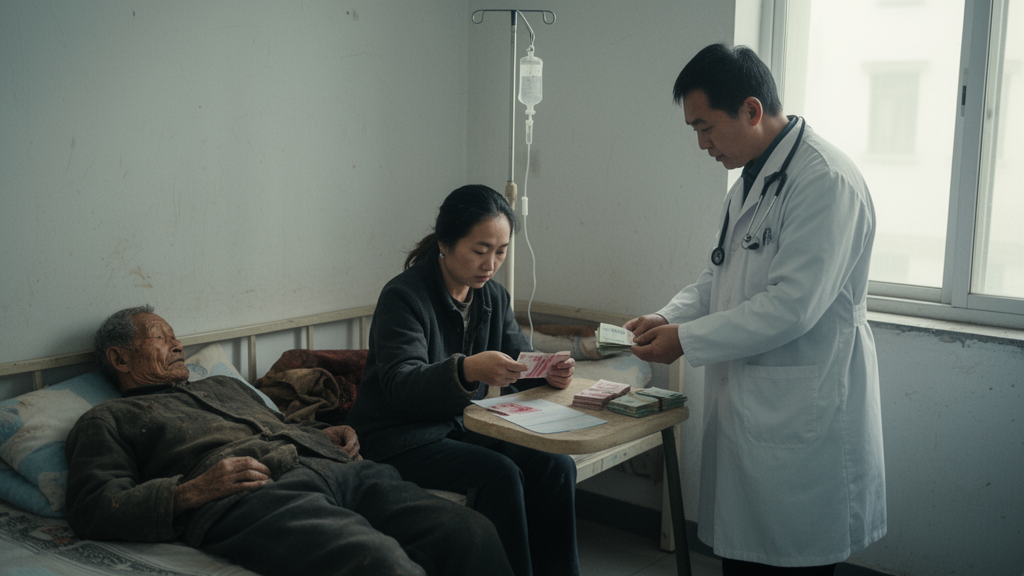
In an ideal health system, the sick get treated and the healthy stay home. A new study from Jiangsu Province, China, suggests that in rural areas, something else may be deciding who ends up in a hospital bed: the contents of a household’s wallet. Researchers analyzing data from the seventh Jiangsu National Health Service Survey, conducted in 2023, found that after accounting for differences in actual healthcare need, hospitalization among rural residents was significantly skewed toward the rich — while their urban neighbors showed almost no income-related imbalance at all.
The study, published in BMC Health Services Research by a team from Nanjing Medical University and collaborators, examined 9,330 respondents, split between 4,245 urban residents and 5,085 rural residents across the province. Jiangsu is one of China’s most economically developed provinces, which makes the findings all the more striking: even in a wealthy coastal region with extensive insurance coverage, the road to a hospital admission appears to run more smoothly for those with greater spending power in the countryside.
The headline numbers reveal a curious asymmetry between city and countryside. Urban respondents reported a slightly higher rate of two-week outpatient utilization — 10.79 percent versus 9.64 percent for rural residents. But rural respondents were hospitalized at a notably higher rate in the preceding year: 12.70 percent compared with just 7.73 percent among urban residents. At first glance, that might suggest rural residents enjoy generous access to inpatient care. The inequality analysis tells a more complicated story about who those hospital beds are actually serving.
To measure inequality rigorously, the researchers used the concentration index, or CI, a standard tool in health economics. The CI ranges from negative to positive values: a negative value indicates that healthcare use is concentrated among the poor, a positive value indicates concentration among the rich, and zero indicates perfect equality. Crucially, the index can be standardized for need — adjusting for the fact that poorer populations often carry a heavier burden of illness and would, on grounds of need alone, be expected to use more care. Only after this adjustment does the index reveal whether the system is distributing care according to need or according to means.
For urban residents, the results were reassuringly flat. The concentration index for outpatient visit frequency was −0.0221, and for hospitalization days it was −0.0057 — both close to zero and neither statistically significant. In plain terms, among Jiangsu’s city dwellers, neither outpatient visits nor hospital stays showed a meaningful tilt toward rich or poor. Whatever is driving healthcare use in urban areas, income does not appear to be the dominant force once the data are examined closely.
Rural inpatient care was a different matter. Before need standardization, the concentration index for hospitalization days among rural residents was 0.0454, a pro-rich pattern that fell just short of statistical significance with a P value of 0.063. But when the researchers adjusted for healthcare need — asking what utilization should look like if illness, rather than income, determined who was admitted — the standardized index rose to 0.0559, with a P value of 0.016. That crossed the threshold of statistical significance. In other words, once you strip away the legitimate influence of health status, a genuine pro-rich bias in rural hospitalizations comes into focus. Poorer rural residents, who tend to be sicker, are not converting their greater need into proportionally greater hospital use.
Why does this happen? The study’s decomposition analysis offers a quantitative answer. Decomposition breaks the concentration index into contributions from different categories of factors, revealing which forces push inequality up and which pull it down. The result was unambiguous: enabling factors — the economic and access-related resources that allow people to actually use services — accounted for 109.43 percent of rural inpatient inequality overall, more than the entire observed inequality itself. Within this category, household consumption expenditure alone contributed 125.84 percent, making family finances the single dominant driver. Insurance-related factors also contributed meaningfully to the pattern.
Just as revealing is what pushed in the opposite direction. Need factors — the distribution of illness and health conditions themselves — contributed −15.59 percent, an overall equalizing effect. Because poorer rural residents have greater healthcare needs, if the system responded purely to need, it would favor them. The fact that the observed pattern instead favors the rich means economic barriers are not merely present; they are strong enough to overwhelm and reverse the equalizing pressure of illness. This is the analytical heart of the study, and it justifies the title’s phrase: the inequality lies beyond healthcare needs.
The decomposition also flagged a set of variables with potentially equity-favorable associations: primary care and prevention-related measures, including family doctor contracting and health check-ups. China has invested heavily in family doctor contract services as a pillar of primary care reform, and the new findings suggest these mechanisms may help distribute care in ways that counteract income-based disparities. The authors point to strengthening primary care and implementing targeted financial protection measures as promising policy directions for narrowing the rural inpatient gap.
The context makes these findings urgent. China faces rapid population aging and a rising burden of chronic disease, trends that fall hardest on rural populations and that will only increase the demand for hospital care. The study distinguishes between the two main insurance schemes — Urban Employee Basic Medical Insurance and the Urban and Rural Resident Basic Medical Insurance — and identifies insurance-related factors among the contributors to inequality, underscoring that coverage on paper does not guarantee equal access in practice. Deductibles, co-payment rates, and the depth of reimbursement all shape whether a rural family can afford an admission when a doctor recommends one.
Methodologically, the study draws its strength from a large, province-wide survey and from the discipline of the concentration index framework, which forces researchers to separate what people need from what they can afford. The authors, led by Jiamin Zhang and Qian Zhang of Nanjing Medical University’s School of Public Health, with Haiya Shao and Mingsheng Chen of the School of Health Policy and Management among the corresponding contributors, analyzed the data separately for urban and rural populations — a decision that proved essential, since pooling the two groups would have masked the sharp contrast between near-zero urban inequality and significant rural pro-rich disparity.
There are, of course, limits to what a single provincial survey can show. The study captures one province at one point in time, and the pro-rich pattern in rural inpatient care was only marginally significant before standardization. Survey-based measures of utilization also rely on self-reporting, which can be influenced by recall and by differing expectations about what counts as a healthcare encounter. The authors themselves frame the primary care findings as distributional associations rather than proof of causal effect, a appropriately cautious reading of observational data.
Yet the policy implications travel well beyond Jiangsu. The study offers a template for diagnosing health inequity: measure utilization, standardize for need, and then decompose the residual inequality to find its economic roots. Applied elsewhere, the same approach could reveal whether the pattern holds across other Chinese provinces and in other middle-income countries that have expanded insurance coverage without fully closing the affordability gap. The core lesson is sobering and actionable at once — universal insurance coverage is a necessary foundation, but without attention to household costs and to the primary care layer that catches illness early, hospital beds will continue to fill unevenly, with income quietly deciding who gets admitted.
For the poorer rural households of Jiangsu, the numbers translate into a familiar dilemma: a recommended admission that competes with household consumption, a chronic condition managed without a check-up, a family doctor contract that may or may not translate into real access. The study’s message to policymakers is that the levers of change are identifiable — financial protection targeted at the households that need it most, and primary care systems robust enough to treat illness before it demands a hospital bed. In a province as prosperous as Jiangsu, the question is no longer whether resources exist, but whether they can be arranged so that need, not income, determines who is hospitalized.
Subject of Research: Income-related inequality in healthcare utilization among urban and rural residents in Jiangsu, China
Article Title: Beyond healthcare needs: income-related inequality in healthcare utilization among urban and rural residents in Jiangsu, China
Article References: Zhang, J., Zhang, Q., Shao, H., Yang, Z., & Chen, M. (2026). Beyond healthcare needs: income-related inequality in healthcare utilization among urban and rural residents in Jiangsu, China. BMC Health Services Research. https://doi.org/10.1186/s12913-026-15683-9
Image Credits: AI Generated
DOI: 10.1186/s12913-026-15683-9
Keywords: healthcare utilization, health inequality, concentration index, rural health, China, hospitalization, primary care, family doctor contracting, health insurance, health economics, Jiangsu, National Health Service Survey
News Source: Phoebe Ingram. (October 15, 2026). Money, Not Medicine: Income Gaps Drive Rural Hospital Stays in China’s Jiangsu Province. Scienmag.