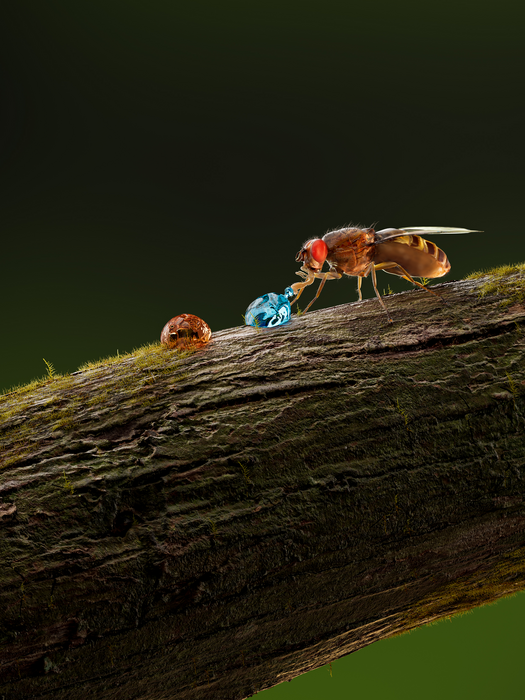
PHILADELPHIA (March 20, 2023) – The sense of taste is among the first to come into contact with food before we ingest it, but whether animals can taste basic or alkaline food and how they do it remained unclear until now. A research group led by Yali Zhang, PhD, Principal Investigator at the Monell Chemical Senses Center, recently addressed this significant question, as they similarly did for sour taste in 2021 on the lower end of the pH scale. Their work, published today in Nature Metabolism and highlighted in Nature, identified a previously unknown chloride ion channel, which they named alkaliphile (Alka), as a taste receptor for alkaline pH.
Credit: Yali Zhang, Monell Chemical Senses Center
PHILADELPHIA (March 20, 2023) – The sense of taste is among the first to come into contact with food before we ingest it, but whether animals can taste basic or alkaline food and how they do it remained unclear until now. A research group led by Yali Zhang, PhD, Principal Investigator at the Monell Chemical Senses Center, recently addressed this significant question, as they similarly did for sour taste in 2021 on the lower end of the pH scale. Their work, published today in Nature Metabolism and highlighted in Nature, identified a previously unknown chloride ion channel, which they named alkaliphile (Alka), as a taste receptor for alkaline pH.
pH, the scale of how acidic or basic a substance is, plays an essential role for living organisms because many biological processes, such as breaking down food and enzymatic reactions, need the level of pH to be just right. While we are familiar with sour taste, which is associated with acids and allows us to sense the acidic end of the pH scale, little is known about how animals perceive bases on the opposite end of the pH spectrum. Detecting both acids and bases, which are commonly present in food sources, is important because they can significantly impact the nutritional properties of what animals consume.
Zhang’s group found that Alka is expressed in the fly’s gustatory receptor neurons (GRNs), the counterpart of taste receptor cells of mammals. When facing neutral food versus alkaline food, wild-type flies normally choose neutral foods because of the toxicity of high pH. In contrast, flies lacking Alka lose the ability to discriminate against alkaline food when presented with it. If the pH of a food is too high, in humans it can be harmful and cause health concerns such as muscle spasms, nausea, and numbness. Likewise, after fruit flies eat food with high pH, their lifespan can be shortened.
The team’s work demonstrates that Alka is critical for flies to stay away from harmful alkaline environments. “Detecting the alkaline pH of food is an advantageous adaptation that helps animals avoid consuming toxic substances,” said Zhang.
To understand how Alka senses high pH, Zhang’s group performed electrophysiological analyses and found that Alka forms a chloride ion (Cl–) channel that is directly activated by hydroxide ions(OH–). Like olfactory sensory neurons in mammals, the concentration of Cl– inside the fly’s GRN is typically higher than outside this nerve cell. Zhang proposes that when exposed to high-pH stimuli, the Alka channel opens, leading to negatively charged Cl– flowing from inside to outside the fly’s GRN. This efflux of Cl– activates the GRN, ultimately signaling to the fly brain that the food is alkaline and should be avoided. “Our work shows that Cl– and Cl– channels, which have been overlooked for a long time, have crucial functions in taste signaling to the brain,” said Zhang.
In addition, Zhang’s group studied how flies detect the taste of alkaline substances using light-based optogenetic tools. They found that when they turned off alkaline GRNs, the flies were no longer bothered by the taste of alkaline food. Conversely, they activated these alkaline GRNs by shining red light on them. Interestingly, when these flies were given sweet food and exposed to red light at the same time, the flies did not want to eat the sweet food anymore. “Alkaline taste can make a big impact on what flies choose to eat,”said Zhang.
Overall, Zhang’s group has established that Alka is a new taste receptor dedicated to sensing the alkaline pH of food. In the future, his team aims to explore whether there are analogous high-pH detectors in mammals. “Our work has settled the argument about whether there is a taste for alkaline things,” said Zhang. “There definitely is.”
Research on new taste qualities of animals, including humans, has important implications for understanding dietary habits and developing strategies for improving nutrition.
This research was funded by the National Institute on Deafness and Other Communication Disorders and the Ambrose Monell Foundation.
###
The Monell Chemical Senses Center is an independent nonprofit basic research institute based in Philadelphia, Pennsylvania. Founded in 1968, Monell‘s mission is to improve health and well-being by advancing the scientific understanding of taste, smell, and related senses, where our discoveries lead to improving nutritional health, diagnosing, and treating disease, addressing smell and taste loss, and digitizing chemosensory data.
Journal
Nature Metabolism