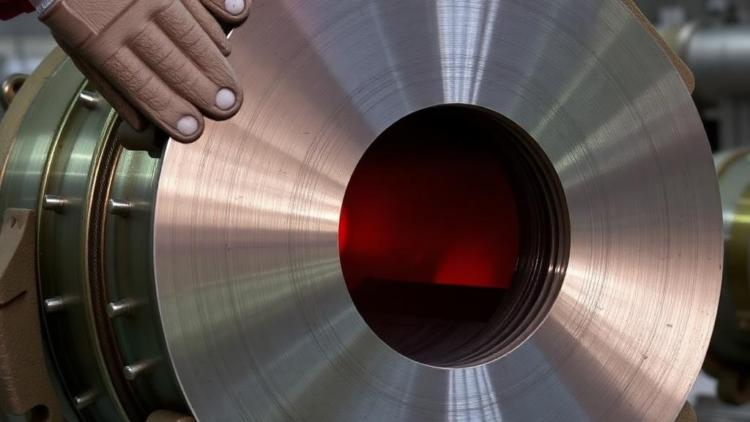
Power plants run on steel that must survive brutal conditions: high temperatures, corrosive environments, and relentless mechanical wear. One of the most widely used materials for such demanding service is P91 steel, a 9 percent chromium martensitic steel prized for its creep strength in boilers, superheaters, and steam turbines. Yet even this robust alloy needs protection in locations where sliding contact and abrasive particles chew through surfaces. A research team from the Indian Institute of Technology Kanpur and the Indian Institute of Technology Guwahati has now reported a new way to armor P91 steel, using a novel gravity-assisted laser cladding technique to build compositionally graded, molybdenum-enriched Stellite 6 coatings on top of a nickel-based buffer layer. The results, published in the Journal of Materials Science, show coatings that are not only crack-free but also measurably harder and more wear-resistant than conventional Stellite 6.
Stellite 6 is a cobalt-based hardfacing alloy that has been a workhorse in industry for decades. Its combination of a tough cobalt matrix and hard chromium-rich carbides makes it a natural choice for valve seats, pump shafts, and other components exposed to friction and erosion. The problem is that Stellite 6 does not always get along with the steels it is asked to protect. When deposited directly onto chromium steels, differences in thermal expansion, thermal conductivity, and microstructure can generate stresses at the interface, and long-term thermal exposure in power plants has been known to trigger delamination failures of Stellite hardfacing. Engineers have therefore explored buffer layers, intermediate compositions that ease the transition between the steel substrate and the cobalt-based coating, to keep the two materials firmly bonded.
The new study tackles this challenge with a two-part strategy. First, the researchers inserted a nickel-based buffer layer between the P91 steel and the Stellite 6 coating, using both pure nickel and the nickel superalloy Inconel 718 in different configurations. Second, they enriched the Stellite 6 with molybdenum, creating a compositional gradient in which the molybdenum content varies through the coating thickness. The deposition itself was carried out with a gravity-assisted laser cladding head, a gas-free, omnidirectional powder delivery system developed under a Department of Science and Technology project in India. Unlike conventional coaxial nozzles that rely on pressurized gas to focus the powder stream, this design uses gravity to feed powder into the laser-generated melt pool, giving the process flexibility in orientation and reducing gas consumption.
The quality of the resulting coatings was the first major finding. Across the gradient layers and the buffer layers, the team observed excellent interfacial integrity with no observable cracks or delamination, a critical result because cracking is the most common failure mode in dissimilar laser-clad systems. The rapid melting and solidification inherent to laser cladding can produce steep thermal gradients and residual stresses, and the mismatch between cobalt-based, nickel-based, and iron-based materials only raises the risk. The nickel buffer layers appear to act as a compliant, chemically compatible bridge that absorbs these stresses, allowing the hard Stellite layer to sit securely on the steel substrate.
Microstructural analysis revealed how the solidification conditions shaped each region of the build. In both the Stellite 6 and the molybdenum-graded layers, the dominant feature was a fine columnar dendritic microstructure, the classic signature of directional solidification under a moving laser heat source. But the story changed at the buffer layers. Above the pure nickel layer, the morphology shifted to coarse columnar structures, while above the Inconel 718 buffer it became cellular. The researchers attribute this transition to differences in the thermophysical properties of the two buffer materials. Thermal conductivity, heat capacity, and the temperature gradient ahead of the solidification front all influence whether dendrites grow long and branched or break up into cellular forms. Because nickel and Inconel 718 conduct and store heat differently, they impose different cooling regimes on the molten layer above them, and the microstructure records that history like a fingerprint.
The molybdenum addition proved to be the key to mechanical performance. X-ray diffraction analysis showed that adding molybdenum promoted the formation of M6C-type complex carbides, in which the metal sites are occupied by cobalt, chromium, and molybdenum together. These carbides are harder and more thermally stable than the carbides in plain Stellite 6, and molybdenum atoms that remain dissolved in the cobalt matrix contribute solid-solution strengthening by distorting the crystal lattice and impeding dislocation motion. The combined effect was a substantial rise in hardness. The best performer was the coating containing 6 weight percent molybdenum, designated S6M, which reached a maximum hardness of 577.1 HV, roughly 20 percent higher than monolithic Stellite 6. That kind of improvement, achieved without exotic reinforcements or post-processing heat treatments, is significant for hardfacing economics.
Hardness alone does not guarantee wear resistance, so the team ran room-temperature reciprocating wear tests to see how the coatings actually behaved under sliding contact. Interestingly, the coefficient of friction did not change significantly with molybdenum addition, meaning the surfaces slid with similar frictional resistance regardless of composition. The wear loss, however, told a different story. The S6M coating exhibited the highest wear resistance of all the compositions tested, with a wear volume reduction of approximately 16.7 percent compared to Stellite 6. The wear behavior was governed by the interplay of two mechanisms: the molybdenum-induced hardening of the coating, which resists material removal, and third-body abrasion by hard silicon dioxide particles trapped between the sliding surfaces. In such three-body abrasion, loose hard particles roll and gouge between the contacting surfaces, and a harder, carbide-rich microstructure is far better at shrugging off that damage.
The broader context makes these results more compelling. Stellite 6 has a long and sometimes troubled history on power plant steels. Delamination failures of Stellite hardfacing in fossil power plants have been documented in microstructural studies, and guidelines for high-reliability plants reflect the need for careful interface engineering. Previous work has shown that buffer layers can improve the survival of Stellite coatings under thermal exposure, and other researchers have explored molybdenum additions to cobalt-based hardfacing alloys as far back as the early 2000s. What the new study adds is the combination: a graded molybdenum enrichment, a nickel-based buffer, and a novel gravity-assisted deposition process, all validated together on P91 steel with a full characterization of microstructure, hardness, and tribology.
The gravity-assisted cladding head itself deserves attention as a piece of engineering. Conventional laser cladding typically uses a coaxial or off-axis nozzle with carrier gas to deliver powder into the melt pool, which works well but constrains the process geometry and consumes shielding gas. A gravity-based, gas-free, omnidirectional head, patented by researchers involved in this work, opens the door to cladding on surfaces at various orientations and to more efficient powder utilization. For large components in power plants, where access and positioning are often awkward, that flexibility could translate into practical repairs and refurbishments that are currently difficult or impossible with standard equipment.
Looking ahead, the study suggests a path toward longer-lasting protective coatings for energy infrastructure. The 6 weight percent molybdenum composition offers a clear sweet spot in this system, balancing carbide formation and solid-solution strengthening against the risk of excessive brittleness at higher alloying levels. The demonstration that a nickel or Inconel 718 buffer can eliminate cracking across a compositional gradient addresses one of the most persistent obstacles in hardfacing dissimilar alloys. While the wear tests reported here were conducted at room temperature, and high-temperature tribological testing would be the natural next step for boiler applications, the fundamental ingredients, a crack-free graded architecture, a hard carbide-strengthened matrix, and a flexible deposition route, are all in place. For an industry where a single unplanned shutdown can cost millions, a coating that resists wear 16.7 percent better than the incumbent material is not a small increment. It is the kind of quiet materials science advance that keeps turbines spinning and boilers firing, one melt pool at a time.
Subject of Research: Compositionally graded Mo-enriched Stellite 6 laser cladding coatings with Ni-based buffer layers on P91 steel for enhanced hardness and wear resistance
Article Title: Microstructure evolution and wear behavior of compositionally graded Mo-enriched stellite 6 coatings with a Ni-based buffer layer via a novel laser cladding technique
Article References: Microstructure evolution and wear behavior of compositionally graded Mo-enriched stellite 6 coatings with a Ni-based buffer layer via a novel laser cladding technique. (n.d.). https://doi.org/10.1007/s10853-026-13786-6
Image Credits: AI Generated
DOI: 10.1007/s10853-026-13786-6
Keywords: laser cladding, Stellite 6, molybdenum, P91 steel, wear resistance, hardfacing, nickel buffer layer, Inconel 718, microstructure, carbides, solid-solution strengthening, additive manufacturing
Cite Scienmag News
APA MLA Chicago
Denise Maddox. (October 2, 2026). Molybdenum-Enriched Stellite Coatings Show Tougher Wear Resistance on Power Plant Steel. Scienmag. https://scienmag.com/molybdenum-enriched-stellite-coatings-show-tougher-wear-resistance-on-power-plant-steel/
Denise Maddox. “Molybdenum-Enriched Stellite Coatings Show Tougher Wear Resistance on Power Plant Steel.” Scienmag, 2 October 2026, https://scienmag.com/molybdenum-enriched-stellite-coatings-show-tougher-wear-resistance-on-power-plant-steel/. Accessed 2 October 2026.
Denise Maddox. “Molybdenum-Enriched Stellite Coatings Show Tougher Wear Resistance on Power Plant Steel.” Scienmag. October 2, 2026. https://scienmag.com/molybdenum-enriched-stellite-coatings-show-tougher-wear-resistance-on-power-plant-steel/
Copy citation Download RIS
Tags: abrasive wear resistance in boiler steelsadditive manufacturingalloying elements enhancing wear resistancecarbidescobalt-based Stellite 6 alloy advantagescompositionally graded coatings for turbine componentscrack-free hardfacing alloysdurability of steam turbine partshardfacinghigh-temperature steel protectionInconel 718industrial applications of Stellite coatingsinnovative coating techniques for P91 steellaser claddinglaser cladding for corrosion resistancemicrostructuremolybdenumMolybdenum-enriched Stellite coatings for wear-resistant power plant steelnickel buffer layernickel-based buffer layers in coating applicationsP91 steelsolid-solution strengtheningStellite 6wear resistance