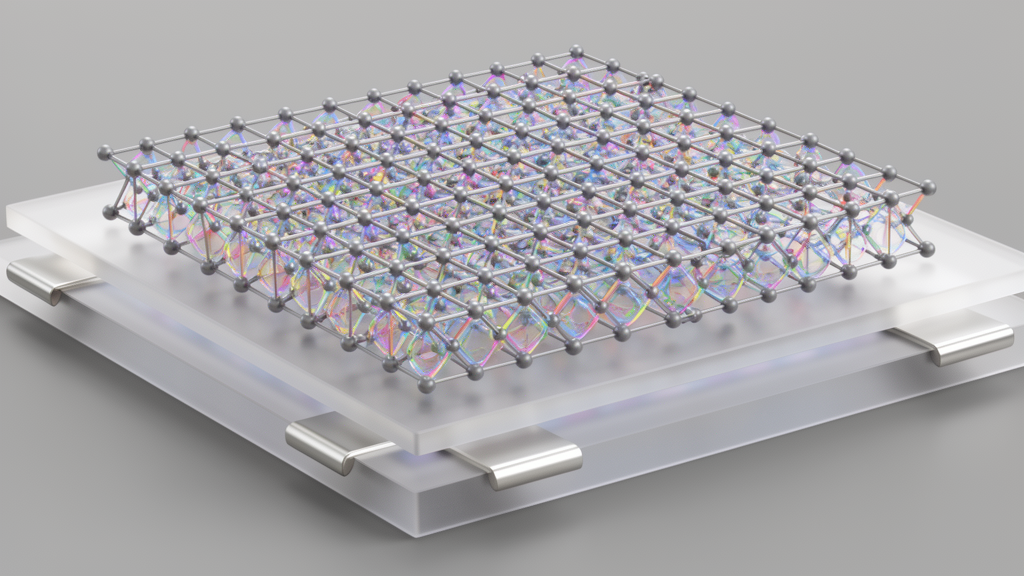
A computational screening strategy guided by molecular polarity has enabled researchers to design chemical additives that suppress field-driven ion migration in tin-based perovskite field-effect transistors, simultaneously improving operational stability and electronic performance. Reporting in Nature Electronics, research teams from Jilin University, the Institute of Coal Chemistry of the Chinese Academy of Sciences, and Liaocheng University demonstrated that molecular polarity can serve as an effective a priori descriptor to predict how additive molecules interact with mobile ionic species within halide perovskite lattices. The resulting p-type formamidinium tin triiodide transistors reached a peak hole field-effect mobility of 41.3 square centimetres per volt-second while maintaining continuous on-state current across more than 9,000 switching cycles.
Metal halide perovskites have attracted extensive research interest in recent decades because of their compositionally tunable electronic structure, strong optical absorption, long carrier lifetimes, long diffusion lengths, and compatibility with low-temperature fabrication methods suited for flexible substrates. These physical and processing attributes have driven rapid performance advancements in perovskite-based photovoltaic cells and light-emitting diodes, renewing scientific focus on perovskite field-effect transistors. Although the earliest field-effect transistor utilizing a two-dimensional tin halide perovskite was reported more than twenty-five years ago, historical development has lagged behind organic semiconductors and metal oxide systems that currently dominate flexible electronics and display backplanes, largely due to poor reproducibility and poor operation at room temperature.
Recent device and material engineering innovations have steadily elevated the field-effect mobilities of select tin halide perovskite transistors to levels competitive with low-temperature polycrystalline silicon. However, as this mobility gap has closed, experimental attention has shifted toward overcoming acute operational instability observed under sustained electrical bias and repetitive gate switching. In perovskite field-effect transistors, gate-field-induced ion migration represents a primary driver of operational degradation. High internal electric fields cause mobile ions to drift along grain boundaries and film surfaces toward the gate dielectric and channel interface. The accumulation of these mobile ionic species screens external gate fields and distorts local carrier densities, creating severe threshold-voltage shifts and pronounced current-voltage hysteresis.
To overcome this limitation without trial-and-error chemical synthesis, the investigators instituted a rational computational workflow beginning with a virtual material screening of 118 million chemical structures indexed in the PubChem database. The initial filtering protocol selected molecules that simultaneously contained fluorine and ammonium chemical groups, were readily available as halide salts, and exhibited a molecular radius small enough to avoid disrupting the host three-dimensional perovskite crystal framework. Dipole moments were subsequently computed using first-principles calculations across a curated library of 1,081 candidate additive molecules, allowing the team to map molecular dipole moments directly against molecular radius and identify compounds combining high molecular polarity with compatible spatial dimensions.
The foundational design principle relies on establishing cross-scale relationships between molecular polarity, additive-to-ion binding strength, perovskite film morphology, and resulting device performance. High molecular polarity reflects substantial intramolecular charge separation, which can be computationally calculated prior to laboratory synthesis and used as a benchmark to rank additive candidates according to their anticipated binding interactions with ionic components in the perovskite matrix. The selected high-polarity additives execute dual hydrogen bonding at opposing ends of the molecule: fluorine atoms establish hydrogen bonds with the formamidinium cation, while ammonium groups anchor iodide anions at the opposite terminus. Larger dipole moments strengthen electrostatic interactions at both molecular ends, tightly constraining ionic species that would otherwise migrate under applied gate fields.
First-principles theoretical calculations confirmed that increased molecular polarity correlated directly with stronger additive-ion binding energies and higher formation energies for ionic vacancies throughout the molecular series. To validate these theoretical predictions experimentally, the researchers characterized doped and undoped thin films using Fourier-transform infrared spectroscopy, X-ray photoelectron spectroscopy, and nuclear magnetic resonance spectroscopy. These spectroscopic analyses substantiated the targeted dual hydrogen-bonding mechanism and demonstrated that stronger ionic anchoring directly influenced crystallization, yielding smoother formamidinium tin triiodide films with larger crystal grains and a preferred crystallographic orientation advantageous for efficient charge transport.
When implemented in physical field-effect transistor architectures, additives exhibiting higher polarity systematically yielded superior device characteristics across the tested series. Incorporating the top-performing candidate, 4-(trifluoromethyl)-phenethylammonium (CF3PEA), enabled p-type formamidinium tin triiodide transistors to deliver reproducible performance across independent fabrication runs with a peak hole field-effect mobility of 41.3 square centimetres per volt-second. Furthermore, electrical measurements on sets of ten independent devices per experimental condition confirmed a positive general association between the additive dipole moment and device field-effect mobility, accompanied by marked reductions in current-voltage hysteresis compared to unmodified control transistors.
Operational endurance assessments under repetitive electrical bias demonstrated the practical efficacy of the molecular-anchor approach in suppressing field-induced ionic redistribution. Unmodified control devices experienced progressive degradation of on-state current during continuous operation, alongside notable threshold-voltage instability caused by mobile ion migration. In contrast, formamidinium tin triiodide transistors fabricated with the high-polarity 4-(trifluoromethyl)-phenethylammonium additive preserved a steady on-state current across more than 9,000 continuous switching cycles with minimal threshold-voltage displacement, verifying that strong electrostatic anchoring of ionic constituents preserves reliable gate modulation.
The successful deployment of molecular polarity as a quantitative design descriptor demonstrates that first-principles calculations can systematically guide additive synthesis to mitigate ion migration in halide perovskite transistors. The authors noted that this computational framework could be extended to engineer novel chemical additives, modify A-site cations, and optimize compositional frameworks across broader perovskite electronics. Integrating predictive molecular calculations with targeted experimental validation provides a rational pathway for discovering functional molecules capable of passivating lattice defects, controlling crystallization dynamics, and forming resilient ion-blocking boundaries in electronic and optoelectronic systems.
The experimental and computational investigation highlights how rational chemical screening bridges the divide between fundamental molecular properties and solid-state device physics in metal halide perovskites. In typical semiconductor systems, improving carrier mobility often comes at the cost of operational durability when mobile lattice components respond to external electrical fields. In tin-based halide perovskites, the migration of ionic species under strong gate fields remains particularly challenging because field-induced ionic accumulation directly screens gate modulation. By establishing molecular polarity as a quantitative descriptor, the research demonstrates that the intramolecular charge separation calculated for prospective additive molecules offers a direct physical proxy for their capacity to anchor vulnerable ionic species inside the crystal framework before chemical synthesis takes place.
A critical stage in the computational filtering procedure involved narrowing the broad PubChem library to identify molecules capable of interacting with the lattice without disrupting its structural integrity. Out of 118 million surveyed chemical structures, the initial selection specifically isolated compounds bearing both fluorine and ammonium functional groups that were accessible as halide salts. Restricting candidate geometries to those that would not distort the three-dimensional perovskite framework yielded a refined set of 1,081 molecules whose dipole moments were calculated against their molecular radii. From this group, fourteen candidate additives situated within a parameter window defined by both high molecular polarity and compatible molecular radius were chosen for focused exploration, establishing a focused subset for detailed evaluation.
Theoretical modeling of the candidate series showed that higher molecular dipole moments consistently produced stronger binding energies between the additive and constituent ions, as well as higher formation energies required to generate ionic vacancies. This dual-ended anchoring mechanism relies on complementary electrostatic interactions at opposing ends of the molecule: fluorine atoms participate in hydrogen bonding with the formamidinium cation, while the ammonium terminus binds iodide anions. Spectroscopic confirmation using Fourier-transform infrared spectroscopy, X-ray photoelectron spectroscopy, and nuclear magnetic resonance verified that these coordinated interactions suppress the detachment and subsequent migration of ions under applied gate bias, directly targeting the structural roots of field-induced ionic displacement.
The suppression of ion movement also provided pronounced microstructural benefits during thin-film formation. Films fabricated with the top candidate, 4-(trifluoromethyl)-phenethylammonium, exhibited smoother topographies, enlarged crystal grains, and a preferred crystallographic orientation aligned for efficient charge transport across the channel. When evaluated in sets of ten independent field-effect transistors per condition, the devices demonstrated a positive correlation between additive dipole moment and hole mobility, demonstrating that polar anchoring not only arrests mobile ions but simultaneously enhances the quality of the semiconducting channel.
These microstructural enhancements directly translated into improved transistor performance, yielding devices that combined a peak hole field-effect mobility of 41.3 square centimetres per volt-second with reproducible operation across distinct fabrication batches. In bias-stress tests, devices containing 4-(trifluoromethyl)-phenethylammonium showed substantially reduced current-voltage hysteresis and minimal threshold-voltage displacement compared to unmodified control transistors. Under repeated switching tests, whereas control devices suffered a progressive decline in on-state current, the modified transistors maintained stable on-state current across more than 9,000 cycles, underscoring the durability achieved through dual-site electrostatic anchoring.
Looking forward, the authors noted that this polarity-guided design paradigm provides a computational framework that can be extended beyond additive screening to the rational engineering of alternative A-site cations and compositional formulations in perovskite electronics and optoelectronics. Integrating first-principles screening with targeted laboratory validation offers a systematic route to discover functional molecules that passivate defects, regulate crystallization processes, and establish robust ion-blocking interfaces in emerging semiconductor technologies.
Subject of Research: Molecular polarity screening of dual hydrogen-bonding additives to suppress ion migration in tin-based perovskite field-effect transistors
Article Title: Designing additives for perovskite transistors using molecular polarity as a guide
Article References: Tian, T., Wang, S., Chu, J., & Li, W. (2026). Designing additives for perovskite transistors using molecular polarity as a guide. Nature Electronics, 9(11), 1184-1185. https://doi.org/10.1038/s41928-026-01733-x
Image Credits: AI Generated
DOI: 10.1038/s41928-026-01733-x
Keywords: perovskite transistors, molecular polarity, ion migration, tin-based perovskites, field-effect mobility, formamidinium tin triiodide, operational stability, first-principles calculations, dual hydrogen bonding, PubChem screening, CF3PEA, gate modulation, halide perovskites, dipole moment, current-voltage hysteresis, additive engineering, flexible electronics
News Source: Denise Maddox. (November 21, 2026). Molecular Polarity Screening Yields Stable High Mobility Perovskite Transistors. Scienmag.