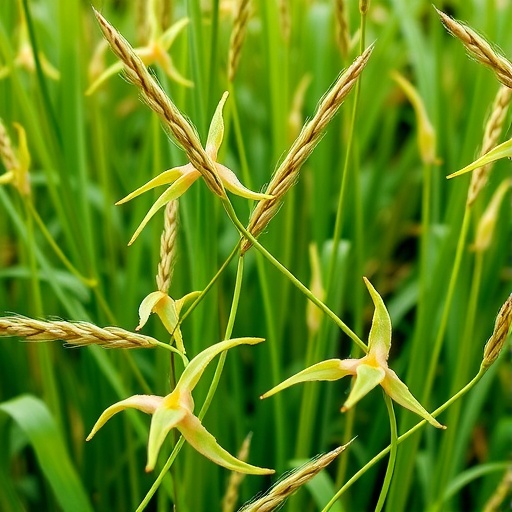
A genetic “shortcut” that helped grasses become some of the most successful plants on Earth may have emerged millions of years before the first wheat fields, according to a new study published in Science. By comparing the genomes of grasses with those of their closest living relatives, researchers have identified metabolic innovations connected to the production of starch and lignin—two compounds that determine how plants store energy, build biomass and compete for space. The findings offer a new explanation for why grasses came to dominate open landscapes and eventually became the foundation of human agriculture.
Grasses include wheat, rice, maize, barley and many other cereal crops that together provide a major share of the calories consumed worldwide. Their evolutionary success is striking because grasses can grow rapidly while producing substantial amounts of lignin, a complex structural polymer that strengthens plant tissues. Lignin is abundant in wood and other slow-growing plants, where it reinforces cell walls but can also make tissues more difficult to digest and process. Grasses appear to have combined strong structural support with unusually efficient growth, and the new research suggests that duplicated or alternative biochemical routes played a central role.
The study was led by researchers at the University of Wisconsin–Madison in collaboration with scientists from institutions including the University of Georgia and research organizations in the United Kingdom and Japan. The team focused on the metabolic pathways plants use to synthesize starch and lignin. Starch is a glucose-based storage molecule that accumulates in seeds and other tissues, providing energy for germination and early development. Lignin, by contrast, is deposited in cell walls, where it provides rigidity and helps plants transport water and remain upright. Both compounds are produced through networks of enzymes encoded by multiple genes, making their evolutionary history possible to reconstruct through comparative genomics.
To identify what changed during the emergence of grasses, the researchers examined the genome of Joinvillea ascendens, a long-leaved plant found in wet forests on South Pacific islands. Joinvillea belongs to a group that is closely related to grasses but diverged from the grass lineage before modern grasses appeared. It grows more slowly than many grasses and lacks the agricultural importance of cereal crops, but its evolutionary position makes it a valuable comparison. The researchers also sequenced the genomes of three related species, creating a broader genetic framework for distinguishing traits that evolved within grasses from those that were already present in their relatives.
Obtaining the plant material was itself a lengthy process. More than 100 seeds collected through the National Tropical Botanical Garden in Hawaii were initially available, but only two germinated. The plants then required approximately two years of growth before they were large enough to harvest for genomic analysis. Once DNA was obtained, the researchers compared thousands of genes and reconstructed the presence and history of biochemical pathways across the plant lineages. This approach allowed them to ask not only which genes exist in grasses, but also when particular genetic changes first appeared.
The starch results revealed a major difference between Joinvillea and grasses. The non-grass relative possesses a single pathway for starch synthesis, whereas all examined grasses contain two. The additional route appears to have originated in the common ancestor of grasses, creating what the researchers describe as a metabolic bypass. In biochemical terms, a bypass can provide an alternative route to the same end product, reducing dependence on a single sequence of reactions and potentially increasing the overall flow of carbon into starch. The researchers propose that this innovation may have substantially increased the capacity of grasses to store energy in seeds and developing tissues.
That advantage could have been especially powerful in open habitats, where sunlight is abundant but competition is intense. A seed with a larger or more rapidly accessible energy reserve can germinate, establish roots and produce leaves before neighboring plants become fully developed. Once photosynthesis begins, the young plant can generate additional sugars while continuing to grow upward toward the light. Over generations, even a modest improvement in early growth could produce a major evolutionary advantage. In agriculture, the same mechanism may have become highly valuable because humans selected grasses that efficiently channel carbon into energy-rich grains.
The researchers found a different evolutionary pattern in lignin production. Both grasses and Joinvillea possess two routes for synthesizing lignin, indicating that this dual-pathway system arose before the grass family itself evolved. The discovery challenges the assumption that every distinctive grass trait originated after grasses became recognizable as a separate group. Instead, some of the biochemical groundwork may have been laid in an ancient ancestor shared by grasses and their close relatives. The team then traced how the second lignin route was created and identified two DNA mutations that were critical and sufficient to establish the new pathway in the system they studied.
These mutations appear to have altered the behavior of enzymes involved in lignin biosynthesis, allowing plant metabolism to reach the same structural products through an alternative sequence of reactions. Such changes can increase flexibility and resilience by distributing biochemical work across more than one route. For plants, that may support rapid construction of stems and leaves without sacrificing the mechanical strength provided by lignin. The researchers say the findings could eventually guide efforts to engineer crops with improved biomass production, stronger stems or altered lignin composition. Introducing a second lignin route into other plants, however, would require careful testing because lignin affects growth, water transport, digestibility and the processing of plant material for biofuels.
The study’s broader message is that evolutionary success can depend on changes that are invisible to the eye but transformative at the molecular level. Grasses did not simply become dominant because they grew quickly; they may have inherited a biochemical architecture that allowed them to produce stored energy and structural material with exceptional efficiency. Understanding that architecture could help scientists improve cereal crops, increase nutritional yields and develop better bioenergy plants while reducing pressure on land and other resources. The researchers are now using this evolutionary knowledge as a foundation for plant biotechnology, exploring whether metabolic bypasses can be adapted to produce more useful nutrients, stronger biomass and valuable chemicals in agricultural species.
Subject of Research: Comparative genomics and the evolution of starch and lignin biosynthesis in grasses and their close relatives.
Article Title: Genomes of Poaceae sisters reveal key metabolic innovations preceding the evolution of grasses
News Publication Date: 20-Aug-2026
Web References: https://doi.org/10.1126/science.adv0443
References: Science, DOI: 10.1126/science.adv0443
Image Credits: Sarah Friedrich / UW–Madison
Keywords: grasses, cereal crops, plant evolution, comparative genomics, Joinvillea, starch biosynthesis, lignin biosynthesis, metabolic pathways, plant biotechnology, agriculture, bioenergy crops, evolutionary biology
Tags: energy storage in grassesevolution of grass speciesgenetic mechanisms of plant growthgenomic comparison of grasses and relativesgrass evolutionimplications for human agriculturelignin and starch biosynthesis in grassesmolecular pathways in cereal cropsplant biomass and competitivenessplant metabolic innovationsplant structural polymer developmentrole of biochemical shortcuts in plant evolution