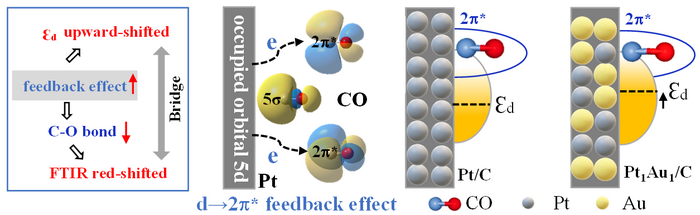
This study is led by Prof. Yanxia Jiang (College of Chemistry and Chemical Engineering, Xiamen University) and Prof. Bin-Wei Zhang (School of Chemistry and Chemical Engineering, Chongqing University). Pt1Au1 alloy supported on the commercial carbon material (Pt1Au1/C) is employed as a typical example to investigate its surface Pt d-band center shift, and as electrocatalyst to study its selectivity towards ethanol oxidation reaction.
Credit: ©Science China Press
This study is led by Prof. Yanxia Jiang (College of Chemistry and Chemical Engineering, Xiamen University) and Prof. Bin-Wei Zhang (School of Chemistry and Chemical Engineering, Chongqing University). Pt1Au1 alloy supported on the commercial carbon material (Pt1Au1/C) is employed as a typical example to investigate its surface Pt d-band center shift, and as electrocatalyst to study its selectivity towards ethanol oxidation reaction.
The d-band center position of metal catalysts is an important parameter that is usually employed to describe their activity. Since the electrocatalytic reactions usually happen on the surface of catalysts, it is important to investigate the d-band center of catalysts surface, which can be utilized to tailor their catalytic activity. Therefore, it is urgently required to develop an experimental method that direct characterize the d-band center of the outer catalyst layer involved in the surface reaction process.
“We used the Pt1Au1 alloy as a model catalyst to investigate how Au element modify the surface electronic structure of Pt. An in situ FTIRS CO-probe strategy is developed to evaluate the surface d-band center shift of Pt-based electrocatalysts. The electrochemical in situ FTIRS CO-probe molecular strategy to evaluate the electronic structure of Pt-based catalyst surfaces is highly reliable, and may be branched out to other Pt-based catalysts.” Jiang says.
It is widely accepted that the ethanol oxidation reaction (EOR) involves the dual pathway mechanisms: the C1 pathway and the C2 pathway. The C1 pathway undergoes C-C bond breaking to generate CO intermediate species, then further oxidized to the final product of CO2 (acid media). This process involves 12 electron transfers, which is also known as the complete oxidation pathway. For the C2 pathway, it is mainly incomplete oxidation of ethanol to acetaldehyde or acetic acid, with involving 2 or 4 electron transfers. The commonly preliminary evaluation for the EOR selectivity by using current ratio of the two ethanol oxidation peaks (I1/I2) is unreliable; the method that calculating the integrated area of the characteristic spectra of CO2 and CH3COOH is limited by heavy reliance on in situ Fourier-transform infrared spectroscopy (FTIRS). Therefore, it is urgently required to develop a general and effective classical electrochemical method to praise the EOR selectivity.
“We have systematically discussed how the modified electronic effect and site effect of Pt1Au1/C determined the adsorption configuration of intermediate species and the OH species coverage for EOR, therefore influencing their CO2 selectivity. More significantly, we also develop a universal and effective cyclic voltammetry (CV) peaks differentiation fitting method via secondary derivative peak-seeking and Gaussian fitting to investigate selectivity for Pt-based electrocatalysts.” Jiang says.
See the article:
General strategy for evaluating the d-band center shift and ethanol oxidation reaction pathway towards Pt-based electrocatalysts
https://doi.org/10.1007/s11426-022-1420-2
Journal
Science China Chemistry
DOI
10.1007/s11426-022-1420-2