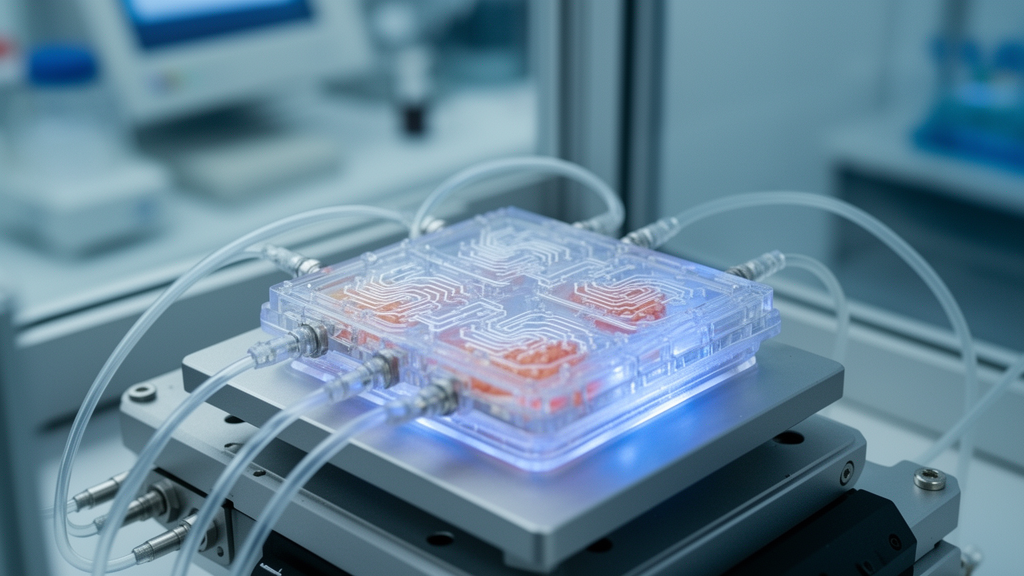
Environmental toxicologists have designed a modular liver-on-a-chip system that enables twelve parallel biological replicates without tubing, offering a more reproducible and physiologically relevant alternative to conventional static cell culture and animal testing. Reported by an engineering research team at Seoul National University of Science and Technology, the platform combines human liver cell cultures with independent unidirectional recirculating flow to evaluate chemical toxicity under controlled hydrodynamic conditions. By integrating clamping-based sealing cartridges and peristaltic pumping, the experimental platform overcomes longstanding technical hurdles that have historically limited the deployment of microfluidic devices in environmental chemical hazard assessment.
Assessing chemical hazards across everyday consumer goods and industrial processes remains an immense challenge because toxicity data exist for only a small fraction of the thousands of compounds encountered in daily life. Furthermore, interspecies physiological differences frequently complicate the translation of animal toxicology data to human biological risks. Organ-on-a-chip architectures that leverage microfluidics have emerged as promising tools to replicate human tissue physiology, but standard systems frequently suffer from cumbersome tubing networks, erratic fluidic control, and a lack of scalable biological replication necessary for rigorous chemical screening.
To overcome these engineering obstacles, the researchers developed a twelve-channel modular platform engineered specifically for toxicological evaluation. Each cartridge-based unit functions as an autonomous liver-on-a-chip featuring a tubing-free architecture sealed by an easy-to-use mechanical clamp. Inside each individual cartridge, cultured human HepG2 liver cells reside in a microenvironment driven by gear-based peristaltic pumping that delivers steady unidirectional recirculating flow.
Within the recirculating microfluidic channel, human hepatocytes experience continuous nutrient renewal and uniform exposure to circulating test media, creating a hydrodynamic environment that more closely mirrors in vivo circulatory exposure. Experimental verification demonstrated that the cartridge modules maintain stable fluid flow control, establish uniform chemical distribution across the cell beds, and generate true independent biological replicates without requiring sample pooling across separate runs.
Baseline functional characterization confirmed that hepatocytes cultured within the dynamic microfluidic environment exhibited substantially enhanced liver-specific biological performance relative to conventional static controls. Quantitative reverse transcription measurements demonstrated markedly elevated messenger RNA expression levels for key cytochrome P450 xenobiotic-metabolizing enzymes, specifically CYP1A2, CYP3A4, and CYP2E1.
To evaluate the platform’s performance in a real-world chemical risk scenario, the investigators investigated the hepatotoxicity of triphenyl phosphate, a common organophosphate flame retardant and plasticizer widely detected in commercial consumer goods and linked to liver toxicity. The modular system permitted direct empirical measurement of chemical concentrations within the circulating medium throughout the exposure timeline, tracking toxicant kinetics as the compound contacted the HepG2 cellular monolayer. This analytical integration ensured that observed biological responses could be tied directly to the exact chemical concentrations to which the cells were actively exposed over time.
Upon exposure to triphenyl phosphate, the liver-on-a-chip demonstrated measurable, dose-dependent alterations in key hepatic phenotypic markers, including urea production, lactate dehydrogenase leakage, and aspartate aminotransferase release. Significantly, the microfluidic platform detected these phenotypic perturbations at lower measured toxicant concentrations than those required to elicit comparable responses in standard static cell cultures, indicating heightened sensitivity to toxic insults under continuous fluid flow.
Beyond classical biochemical markers, the researchers conducted comprehensive RNA sequencing on the exposed HepG2 cells to elucidate the molecular mechanisms driving triphenyl phosphate hepatotoxicity. Transcriptomic profiling revealed significant dysregulation across critical cellular pathways, most notably alterations in spliceosome assembly complexes and inflammatory signaling cascades.
The experimental results underscore that resolving practical usability, flow stability, and multiplexed biological replication can accelerate the adoption of microphysiological systems in regulatory toxicology and next-generation risk assessment. By providing twelve parallel test chambers that eliminate external tubing arrays while continuously tracking exposure kinetics, the platform establishes a standardized framework for testing environmental chemicals. As engineering refinements proceed, the research team aims to extend the modular microfluidic architecture toward evaluating chronic, repeated-dose exposure scenarios and predicting long-term toxicological outcomes in human tissues.
Discussing the operational motivations behind the engineering design, Professor Ki-Tae Kim highlighted the distinct testing hurdles that have historically slowed the practical adoption of microfluidic devices in environmental risk assessment. According to Professor Kim, the use of organ-on-a-chip platforms for environmental chemical assessment has advanced slowly because testing many chemicals at multiple concentrations puts different demands on the system. He explained that their experimental study offers insights into how these issues can be resolved and where these systems could be useful. Addressing these practical challenges required developing a modular platform specifically for environmental toxicological assessment, bypassing the high costs, prolonged timelines, and species differences inherent in high-dose animal studies, which currently provide toxicity information for only a small fraction of the thousands of chemicals used in daily life.
Professor Kim emphasized that a central achievement of the modular liver-on-a-chip platform is its ability to tie observed cellular toxicity directly to measured exposure profiles rather than unmonitored nominal concentrations. As Professor Kim remarked, our platform can support human toxicity assessment based on real cell exposure, enabling next generation risk assessment. Importantly, the researchers measured the chemical concentrations in the system and followed their kinetics during exposure, allowing observed toxicity to be tied directly to the concentration the cells actually experienced. This direct kinetic tracking resolves a primary challenge in applying organ-on-a-chip platforms to toxicological assessment, where usability, flow control, and biological replication have frequently limited practical implementation. By confirming uniform chemical distribution and high reproducibility across the cartridge modules during exposure experiments, the team demonstrated that controlled recirculating flow delivers reliable biological replicates without pooling.
The research was conducted within the Department of Environmental Engineering at Seoul National University of Science and Technology, commonly known as SEOULTECH, a national university located in Nowon-gu, Seoul, South Korea. Founded in April 1910, around the time of the establishment of the Republic of Korea, SEOULTECH has grown into a large and comprehensive university spanning a campus size of 504,922 square meters. The institution comprises ten undergraduate schools, thirty-five departments, and six graduate schools, supporting an enrollment of approximately 14,595 students. By developing an easy-to-use, clamping-based cartridge platform that operates without complex tubing, the SEOULTECH engineering team sought to address longstanding usability constraints and provide an organ-on-a-chip platform designed specifically for practical environmental chemical assessment.
First author Jiyun Kang carried out the experimental investigations as a Ph.D. candidate in the Department of Environmental Engineering and member of Professor Kim’s Environmental Toxicology and Health Laboratory at SEOULTECH. Ms. Kang’s research focuses on mechanistic toxicity assessment using microphysiological systems, with a core emphasis on developing strategies for applying these systems to chemical toxicity testing. Her work on the platform addressed common implementation bottlenecks associated with flow-based organ-on-a-chip designs, where intricate tubing setups frequently hinder routine laboratory operation. By integrating a clamping-based sealing mechanism and gear-based peristaltic pumping for independent unidirectional recirculating flow across twelve chips, Ms. Kang and her colleagues established a tubing-free setup capable of maintaining stable flow control and uniform exposure conditions.
Professor Ki-Tae Kim leads the Environmental Toxicology and Health Laboratory within the Department of Environmental Engineering at SEOULTECH. His broader research program covers environmental toxicology and the management of hazardous chemicals, utilizing zebrafish models, microphysiological systems, and multi-omics for new approach methodology based toxicity assessment. Professor Kim received his Ph.D. from the Gwangju Institute of Science and Technology in 2009 and completed postdoctoral training at Oregon State University before establishing his research group at SEOULTECH. Through the development of the modular liver-on-a-chip platform, Professor Kim’s laboratory aims to expand practical alternatives that can replace resource-intensive animal testing while generating human-relevant toxicological data.
The peer-reviewed experimental study was made available online on August 27, 2026, and officially published on September 15, 2026, in Volume 60, Issue 36 of Environmental Science & Technology under the title Modular Liver-on-a-Chip Platform for Accelerating Toxicological Applications: A Case Study of Triphenyl Phosphate Hepatotoxicity. The journal publication included a competing financial interest statement disclosing that co-author Kyung Hwan Kim is the Chief Executive Officer of BioSpero Inc., a company developing organ-on-a-chip technologies, while all other authors declared no competing financial interests. Looking forward, the researchers noted that this work highlights how practical challenges in applying organ-on-a-chip systems may be addressed, expressing hope that continued improvements will make the modular technology increasingly suitable for assessing or predicting chronic effects and other long-term toxicological outcomes.
Subject of Research: Modular microfluidic liver-on-a-chip platform for environmental chemical toxicity testing
Article Title: SEOULTECH researchers develop liver-on-a-chip platform for practical chemical toxicity testing
Article References: SEOULTECH researchers develop liver-on-a-chip platform for practical chemical toxicity testing. Original publication (Bibliographic details unavailable.)
Image Credits: AI Generated
DOI: Not provided
Keywords: liver-on-a-chip, organ-on-a-chip, microfluidics, chemical toxicity testing, environmental toxicology, triphenyl phosphate, hepatotoxicity, HepG2 cells, peristaltic pumping, xenobiotic metabolism, cytochrome P450, CYP3A4, CYP1A2, CYP2E1, phenotypic markers, aspartate aminotransferase, lactate dehydrogenase, RNA sequencing
News Source: Ophelia Keating. (November 20, 2026). Modular Liver-on-a-Chip Platform Improves Chemical Toxicity Testing Precision and Replication. Scienmag.